Factors like age, education, and income are associated with inequalities in mobile health use
Understanding Inequalities in Mobile Health Utilization Across Phases: Systematic Review and Meta-Analysis
Systematic review and meta-analysisMixed results
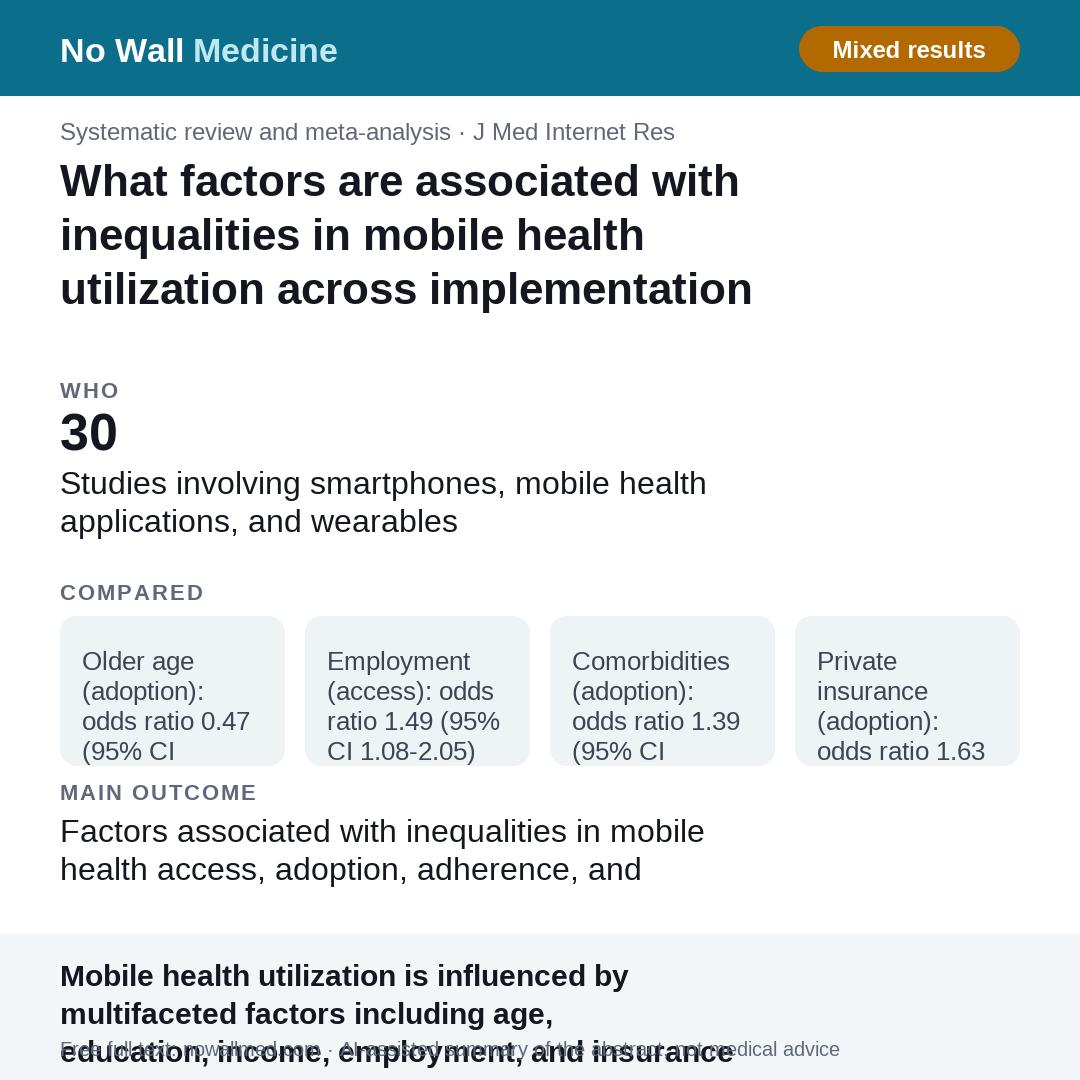
What factors are associated with inequalities in mobile health utilization across implementation phases?
Who
30
Studies involving smartphones, mobile health applications, and wearables
Compared
Older age (adoption): odds ratio 0.47 (95% CI 0.23-0.93)
Employment (access): odds ratio 1.49 (95% CI 1.08-2.05)
Comorbidities (adoption): odds ratio 1.39 (95% CI 1.03-1.86)
Private insurance (adoption): odds ratio 1.63 (95% CI 1.07-2.48)
Main outcome
Factors associated with inequalities in mobile health access, adoption, adherence, and maintenance
Bottom line: Mobile health utilization is influenced by multifaceted factors including age, education, income, employment, and insurance across different implementation phases.
J Med Internet Res · 2025-08-14Download image
Clinical question: What factors are associated with inequalities in mobile health utilization across implementation phases?
Why it matters: Low retention rates and varying barriers to accessing or adopting mobile health may exacerbate health inequalities and contribute to the digital health divide.
Key points
- Researchers analyzed 62 studies and performed meta-analyses on 30 studies regarding mobile health use across access, adoption, adherence, and maintenance phases.
- Older age was associated with lower mobile health adoption (odds ratio 0.47, 95% CI 0.23-0.93), while higher education and income were associated with better access and adoption.
- Women (odds ratio 1.24, 95% CI 1.06-1.45) and physically active individuals (odds ratio 1.64, 95% CI 1.07-2.50) were associated with higher mobile health adoption.
Headline and key points written with AI from the paper’s abstract, with every number checked against it. Read the paper before relying on them.
Was this summary helpful?
Subject terms
Cite this article
Yang S, Cha MJ, van Kessel R, Warrier G, Thrul J, Lee M. Understanding Inequalities in Mobile Health Utilization Across Phases: Systematic Review and Meta-Analysis. J Med Internet Res. 2025. doi:10.2196/71349
Spotted a mistake? Suggest a correction
Top studies every Monday
The week’s key trials and guidelines in your specialties, plus any topics you follow. By email, free.
Get the weekly digest