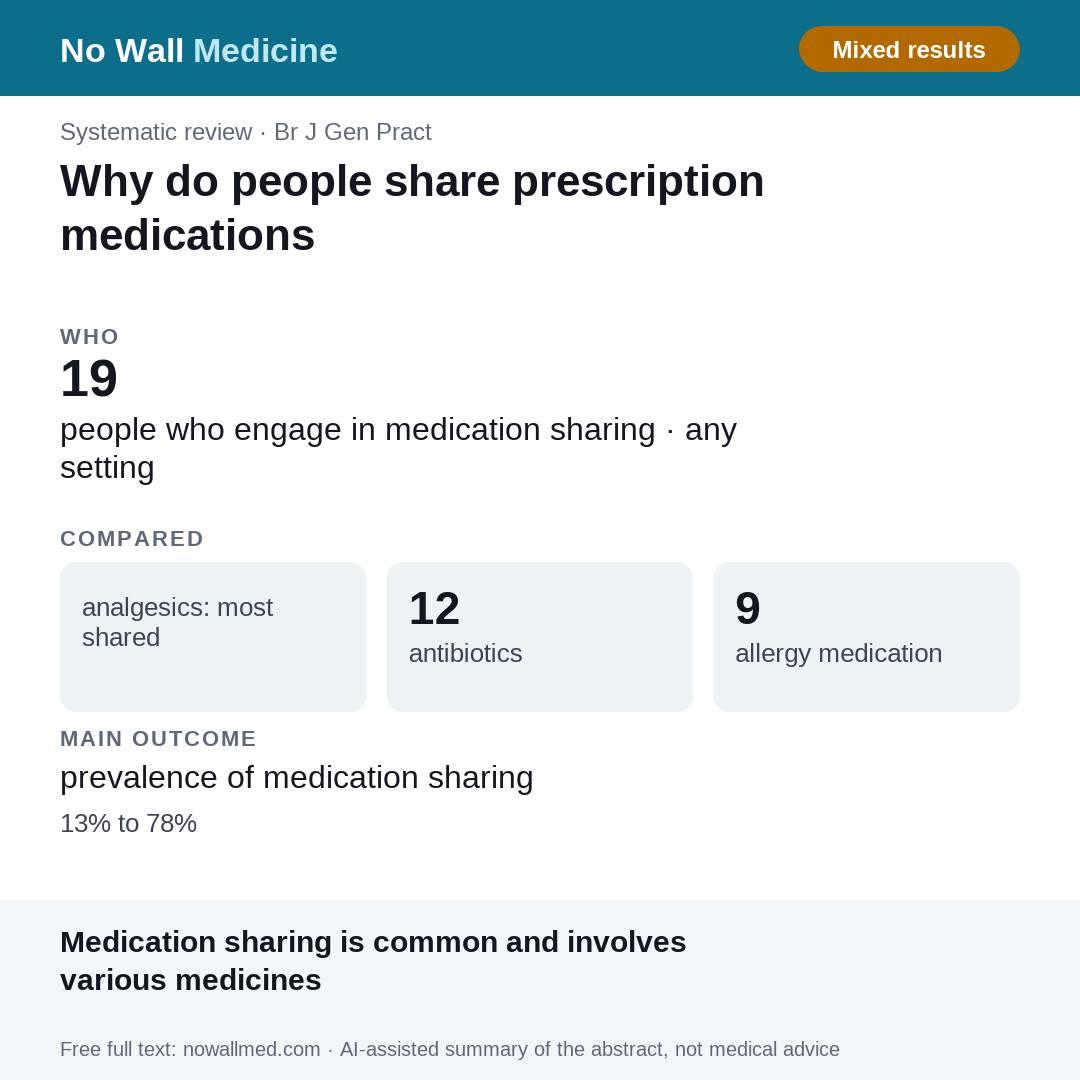
Lifetime prescription medication sharing prevalence ranges from 13% to 78% in systematic review
Understanding non-recreational prescription medication-sharing behaviours: a systematic review
Systematic reviewMixed results
Why do people share prescription medications
Who
19
people who engage in medication sharing · any setting
Compared
analgesics: most shared
12antibiotics
9allergy medication
Main outcome
prevalence of medication sharing
Result: 13% to 78%
Bottom line: Medication sharing is common and involves various medicines
Br J Gen Pract · 2024-02-29Download image
Why it matters: Prevalence estimates for prescription medication sharing vary across populations and the reasons for and perceived risks of these behaviors are poorly understood.
Key points
- Researchers reviewed 19 studies to examine the prevalence, types of drugs, and reasons for non-recreational prescription medication sharing.
- Analgesics (painkillers) were the most shared medications, followed by antibiotics in 12 studies and allergy medication in 9 studies.
- Sharing was associated with being female, having asthma, being a certain age, and having unused medicines stored at home.
Headline and key points written with AI from the paper’s abstract, with every number checked against it. Read the paper before relying on them.
Was this summary helpful?
Subject terms
Cite this article
Dawson S, Johnson H, Huntley AL, Turner KM, McCahon D. Understanding non-recreational prescription medication-sharing behaviours: a systematic review. Br J Gen Pract. 2024. doi:10.3399/BJGP.2023.0189
Spotted a mistake? Suggest a correction
Top studies every Monday
The week’s key trials and guidelines in your specialties, plus any topics you follow. By email, free.
Get the weekly digest