Cobots are associated with increased stress and anxiety despite improving job satisfaction and physical fatigue
Understanding Workers' Well-Being and Cognitive Load in Human-Cobot Collaboration: Systematic Review
Systematic reviewMixed results
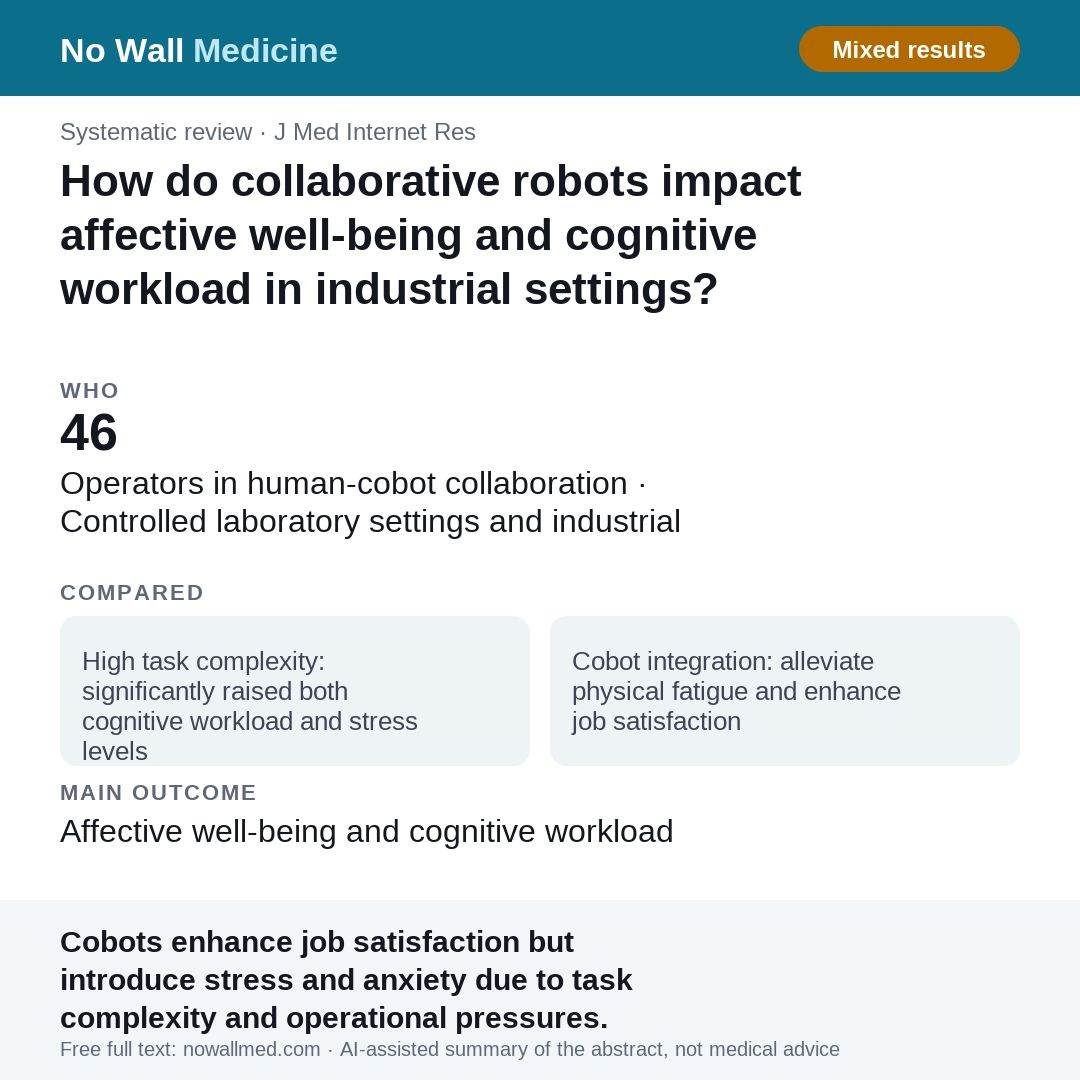
How do collaborative robots impact affective well-being and cognitive workload in industrial settings?
Who
46
Operators in human-cobot collaboration · Controlled laboratory settings and industrial settings
Compared
High task complexity: significantly raised both cognitive workload and stress levels
Cobot integration: alleviate physical fatigue and enhance job satisfaction
Main outcome
Affective well-being and cognitive workload
Bottom line: Cobots enhance job satisfaction but introduce stress and anxiety due to task complexity and operational pressures.
J Med Internet Res · 2025-08-27Download image
Clinical question: How do collaborative robots impact affective well-being and cognitive workload in industrial settings?
Why it matters: Existing research has primarily focused on the physical and cognitive impacts of cobots rather than their effect on affective well-being like anxiety and depression.
Key points
- Researchers reviewed 46 studies to examine how collaborative robots, or cobots, affect worker well-being and mental workload in industrial settings.
- While cobots were linked to higher job satisfaction and less physical fatigue, they were also associated with stress and anxiety symptoms.
- In 38/46 studies, higher task complexity was linked to increased cognitive workload and higher stress levels.
Limitation the authors note: Most studies, representing 28/46 or 61% of the review, were conducted in controlled laboratory settings with university students or researchers rather than in real-world industrial environments.
Headline and key points written with AI from the paper’s abstract, with every number checked against it. Read the paper before relying on them.
Topics
Cite this article
Bassi G, Orso V, Salcuni S, Gamberini L. Understanding Workers' Well-Being and Cognitive Load in Human-Cobot Collaboration: Systematic Review. J Med Internet Res. 2025. doi:10.2196/75658
Spotted a mistake? Suggest a correction