Undiagnosed chronic obstructive pulmonary disease and clinical overdiagnosis were common in primary healthcare settings
Undiagnosed and 'overdiagnosed' COPD using postbronchodilator spirometry in primary healthcare settings: a systematic review and meta-analysis
Systematic review and meta-analysisMixed results
What are the rates of undiagnosed and overdiagnosed chronic obstructive pulmonary disease?
Who
Patients in primary healthcare settings · Primary healthcare settings
Compared
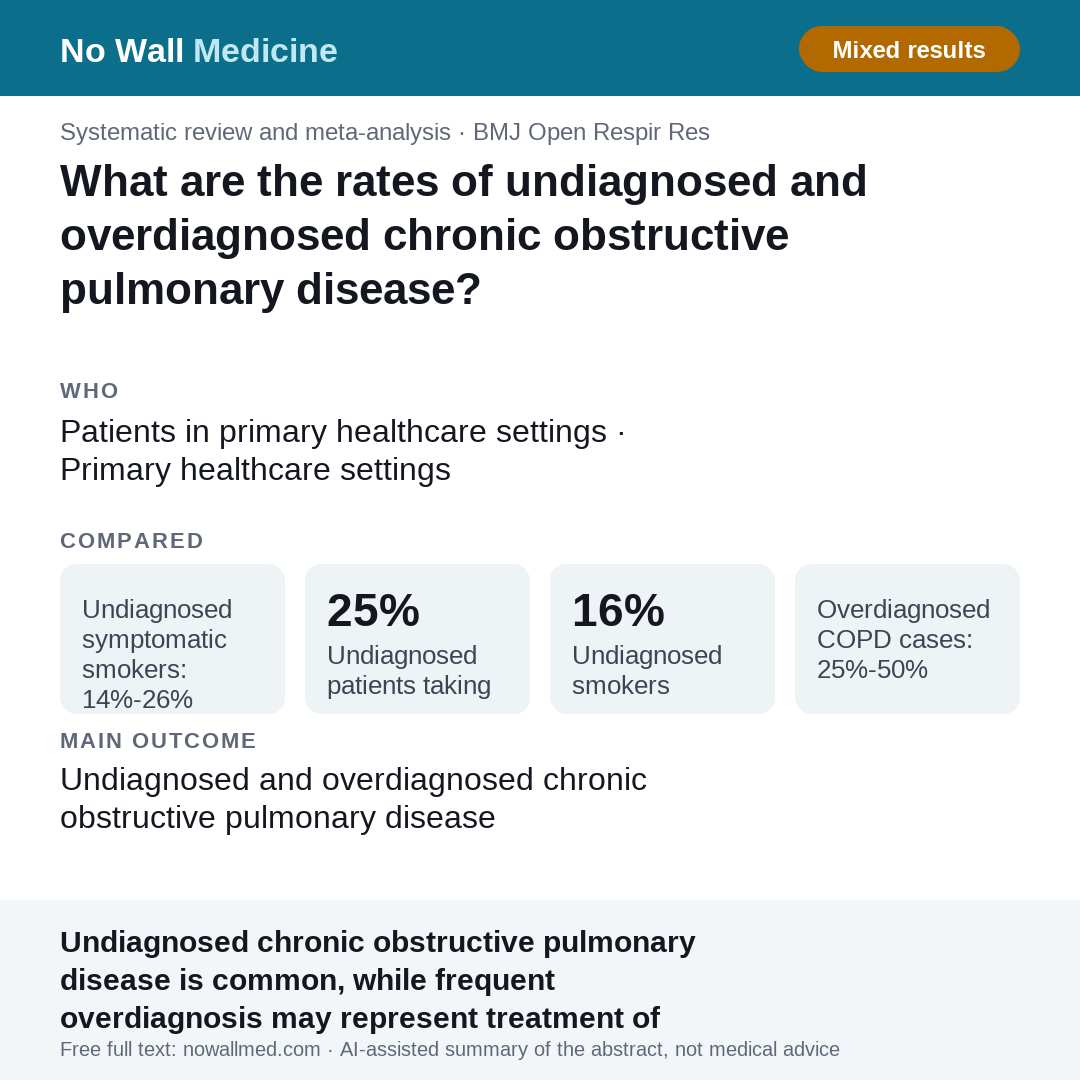
Undiagnosed symptomatic smokers: 14%-26%
25%Undiagnosed patients taking inhaled therapies (95% CI 22% to 28%)
16%Undiagnosed smokers irrespective of symptoms (95% CI 14% to 18%)
Overdiagnosed COPD cases: 25%-50%
Main outcome
Undiagnosed and overdiagnosed chronic obstructive pulmonary disease
Bottom line: Undiagnosed chronic obstructive pulmonary disease is common, while frequent overdiagnosis may represent treatment of asthma or reversible components.
Limitation: Data were heterogeneous and of modest quality.
BMJ Open Respir Res · 2023-05-03Download image
Clinical question: What are the rates of undiagnosed and overdiagnosed chronic obstructive pulmonary disease?
Why it matters: It is unknown how often chronic obstructive pulmonary disease is missed or incorrectly diagnosed in primary healthcare settings using lung function tests.
Key points
- Researchers analyzed 26 articles involving 3,959 cases of spirometry-defined chronic obstructive pulmonary disease and 7,381 patients from case series.
- Undiagnosed cases were found in 14%-26% of symptomatic smokers and 25% (95% CI 22% to 28%) of patients using inhaled therapies.
- Clinical overdiagnosis was observed in 25%-50% of subjects in an adequately powered series of documented chronic obstructive pulmonary disease cases.
Limitation the authors note: The data were heterogeneous and of modest quality.
Headline and key points written with AI from the paper’s abstract, with every number checked against it. Read the paper before relying on them.
Was this summary helpful?
Abstract
Background
Despite chronic obstructive pulmonary disease (COPD) being a major global cause of mortality and hospitalisation, it is often undiagnosed or inaccurately diagnosed in clinical settings. Objective
To systematically synthesise all peer-reviewed papers from primary healthcare settings that have reported data on: (1) undiagnosed COPD, that is, patients with respiratory symptoms and postbronchodilator airflow obstruction consistent with COPD, without a formal clinician's diagnosis of COPD either documented in health records or reported by patients and (2) 'overdiagnosed COPD', that is, clinician's diagnosis without postbronchodilator airflow obstruction. Methods
Studies investigating these diagnostic metrics in patients from primary healthcare clinics (according to predefined inclusion/exclusion criteria) were sourced from Medline and Embase and assessed for bias (Johanna Briggs Institute tools for prevalence studies and case series). Meta-analyses of studies of adequate sample size used random effect modelling stratified by risk factor categories. Results
Of 26 eligible articles, 21 cross-sectional studies investigated 3959 cases of spirometry-defined COPD (with or without symptoms), and 5 peer-reviewed COPD case series investigated 7381 patients. The prevalence of spirometry-confirmed COPD without a diagnosis documented in their health records was 14%-26% in studies of symptomatic smokers (N=3). 1 in 4 patients taking inhaled therapies (25% (95% CI 22% to 28%), N=2) and 1 in 6 smokers irrespective of symptoms (16% (95% CI 14% to 18%), N=6) fulfilled diagnostic spirometry criteria but did not report receiving a COPD-related diagnosis. In an adequately powered series of COPD cases documented in primary healthcare records (N=4), only between 50% and 75% of subjects had any airflow obstruction on postbronchodilator spirometry performed by study researchers, therefore, COPD was clinically 'overdiagnosed' in 25%-50% of subjects. Discussion
Although data were heterogeneous and of modest quality, undiagnosed COPD was common in primary healthcare, especially for symptomatic smokers and patients treated with inhaled therapies. In contrast, frequent COPD 'overdiagnosis' may represent treatment of asthma/reversible component or another medical diagnosis. Prospero registration number
CRD42022295832.
Abstract reproduced under the article’s CC BY NC licence.
Subject terms
Cite this article
Perret J, Yip SWS, Idrose NS, Hancock K, Abramson MJ, Dharmage SC. Undiagnosed and 'overdiagnosed' COPD using postbronchodilator spirometry in primary healthcare settings: a systematic review and meta-analysis. BMJ Open Respir Res. 2023. doi:10.1136/bmjresp-2022-001478
Spotted a mistake? Suggest a correction
Top studies every Monday
The week’s key trials and guidelines in your specialties, plus any topics you follow. By email, free.
Get the weekly digest