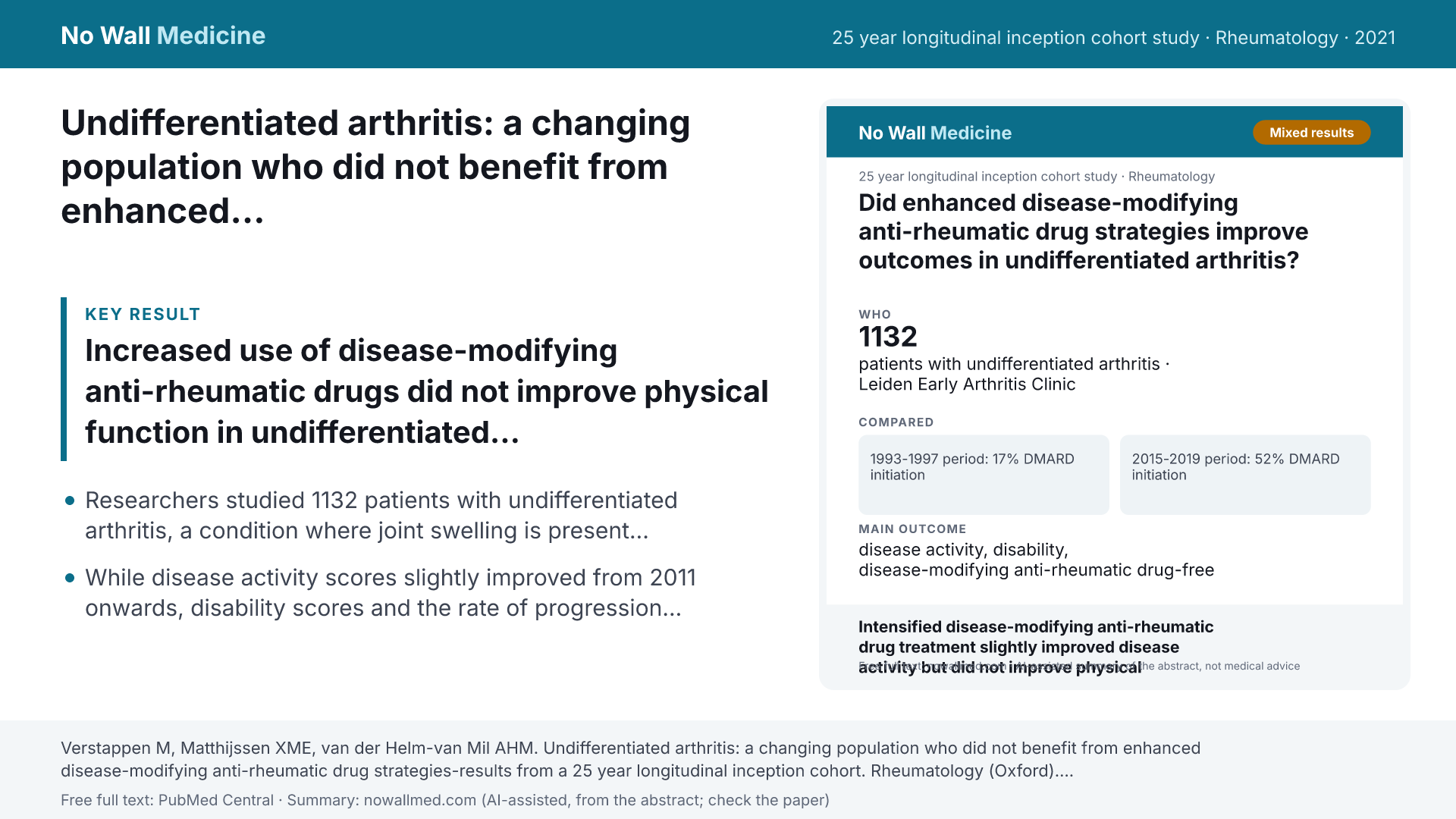
Increased use of disease-modifying anti-rheumatic drugs did not improve physical function in undifferentiated arthritis patients
Undifferentiated arthritis: a changing population who did not benefit from enhanced disease-modifying anti-rheumatic drug strategies-results from a 25 year longitudinal inception cohort
25 year longitudinal inception cohort studyMixed results
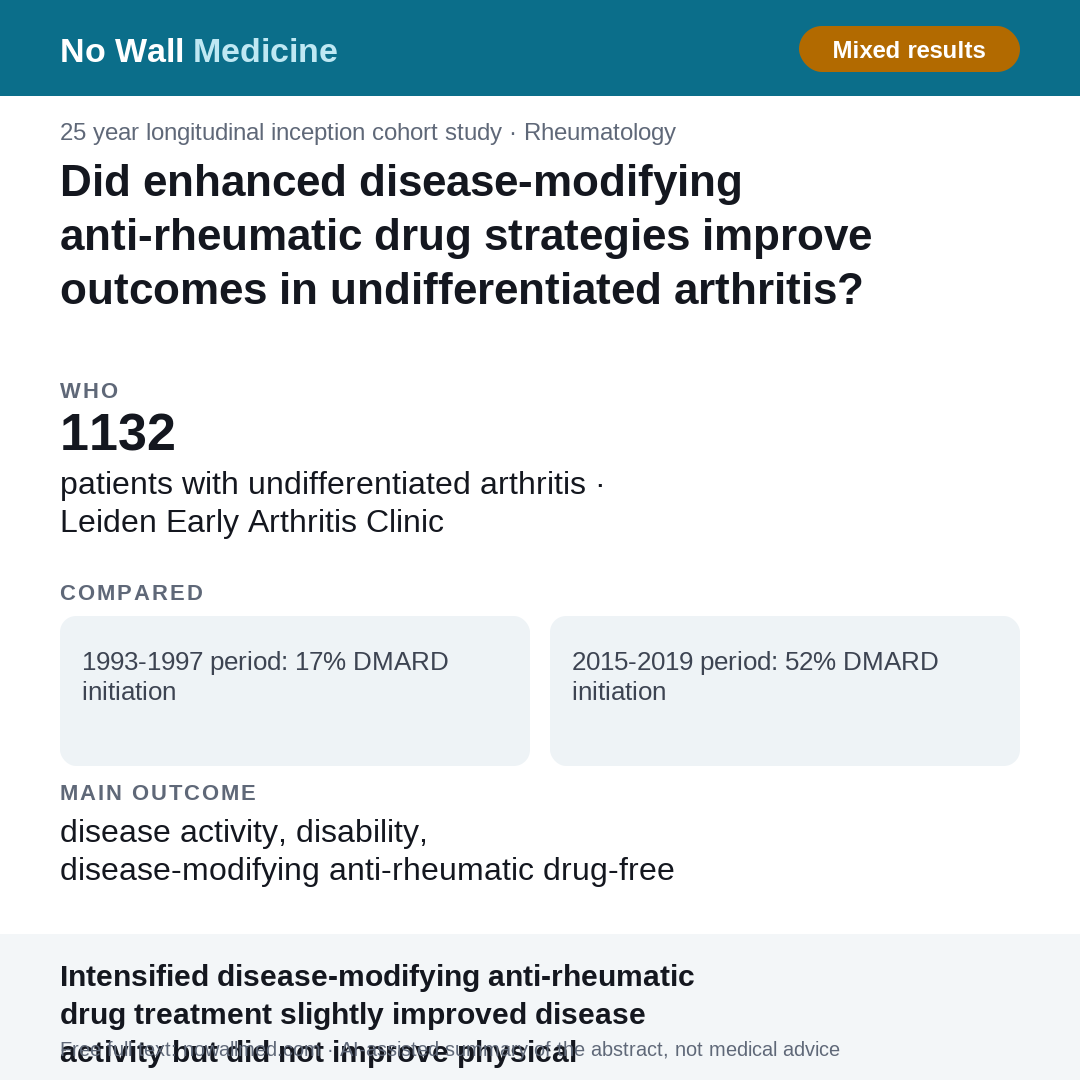
Did enhanced disease-modifying anti-rheumatic drug strategies improve outcomes in undifferentiated arthritis?
Who
1132
patients with undifferentiated arthritis · Leiden Early Arthritis Clinic
Compared
1993-1997 period: 17% DMARD initiation
2015-2019 period: 52% DMARD initiation
Main outcome
disease activity, disability, disease-modifying anti-rheumatic drug-free status, and rheumatoid arthritis progression
Bottom line: Intensified disease-modifying anti-rheumatic drug treatment slightly improved disease activity but did not improve physical functioning or long-term outcomes.
Rheumatology · 2021-12-02Download image
Clinical question: Did enhanced disease-modifying anti-rheumatic drug strategies improve outcomes in undifferentiated arthritis?
Key points
- Researchers studied 1132 patients with undifferentiated arthritis, a condition where joint swelling is present but specific rheumatoid arthritis criteria are not met, over 25 years.
- While disease activity scores slightly improved from 2011 onwards, disability scores and the rate of progression to rheumatoid arthritis did not show significant improvement.
- The frequency of starting disease-modifying anti-rheumatic drugs increased from 17% in 1993-1997 to 52% in 2015-2019.
Headline and key points written with AI from the paper’s abstract, with every number checked against it. Read the paper before relying on them.
Was this summary helpful?
Subject terms
Cite this article
Verstappen M, Matthijssen XME, van der Helm-van Mil AHM. Undifferentiated arthritis: a changing population who did not benefit from enhanced disease-modifying anti-rheumatic drug strategies-results from a 25 year longitudinal inception cohort. Rheumatology. 2021. doi:10.1093/rheumatology/keab880
Spotted a mistake? Suggest a correction