Electronic clinical decision support increased appropriate blood clot prevention in hospitalized medical patients
Universal EHRs Clinical Decision Support for Thromboprophylaxis in Medical Inpatients: A Cluster Randomized Trial
Cluster randomized trialMixed results
Does universal electronic health record clinical decision support increase appropriate thromboprophylaxis in medical inpatients?
Who
10,699
Inpatients over age 60 with key medical illnesses · 4 tertiary academic hospitals
Compared
Intervention (clinical decision support): 80.1% inpatient appropriate thromboprophylaxis
Usual care: 72.5% inpatient appropriate thromboprophylaxis
Main outcome
rate of appropriate thromboprophylaxis
Result: OR: 1.52, 95% CI: 1.39-1.67
Bottom line: Clinical decision support increased appropriate thromboprophylaxis and reduced thromboembolism, but mortality was higher at intervention hospitals.
JACC Adv · 2023-09-13Download image
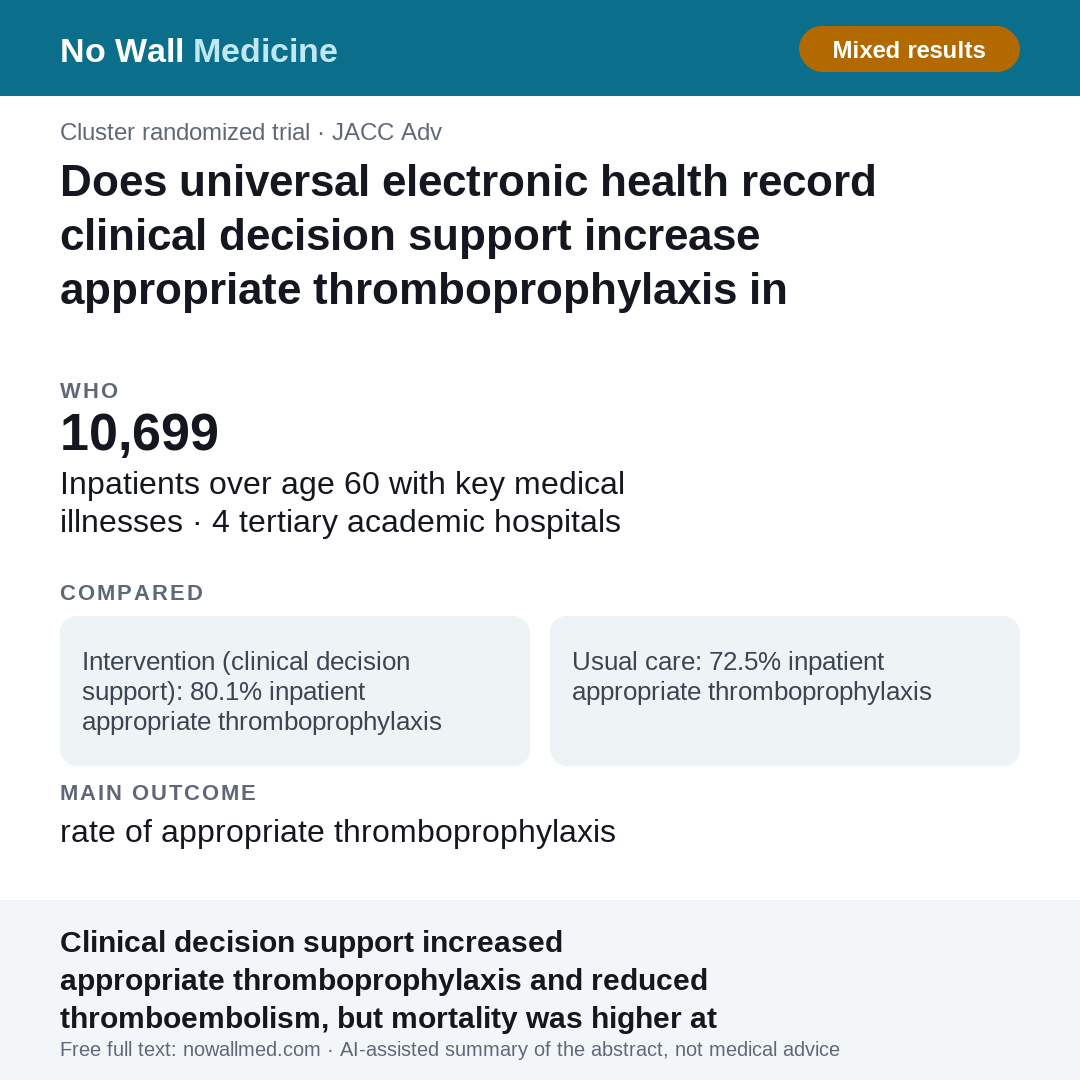
Clinical question: Does universal electronic health record clinical decision support increase appropriate thromboprophylaxis in medical inpatients?
Why it matters: Thromboprophylaxis, or medication to prevent blood clots, remains underutilized for medically ill patients during hospitalization and after discharge.
Key points
- Researchers conducted a cluster randomized trial involving 10,699 inpatients over age 60 across 4 tertiary academic hospitals.
- The use of clinical decision support was associated with higher rates of appropriate blood clot prevention both during hospitalization (80.1% vs 72.5%) and at discharge (13.6% vs 7.5%).
- Intervention hospitals had lower rates of venous (2.7% vs 3.3%), arterial (0.25% vs 0.70%), and total thromboembolism (2.9% vs 4.0%), but higher mortality (9.1% vs 7.0%).
Headline and key points written with AI from the paper’s abstract, with every number checked against it. Read the paper before relying on them.
Was this summary helpful?
Cite this article
Spyropoulos AC, Goldin M, Koulas I, Solomon J, Qiu M, Ngu S. Universal EHRs Clinical Decision Support for Thromboprophylaxis in Medical Inpatients: A Cluster Randomized Trial. JACC Adv. 2023. doi:10.1016/j.jacadv.2023.100597
Spotted a mistake? Suggest a correction
Top studies every Monday
The week’s key trials and guidelines in your specialties, plus any topics you follow. By email, free.
Get the weekly digest