Combining Huachansu with chemoembolization increased survival for patients with unresectable liver cancer
Unresectable hepatocellular carcinoma: transarterial chemoembolisation plus Huachansu - a single-center randomised controlled trial
Single-center randomized controlled trialBenefit found
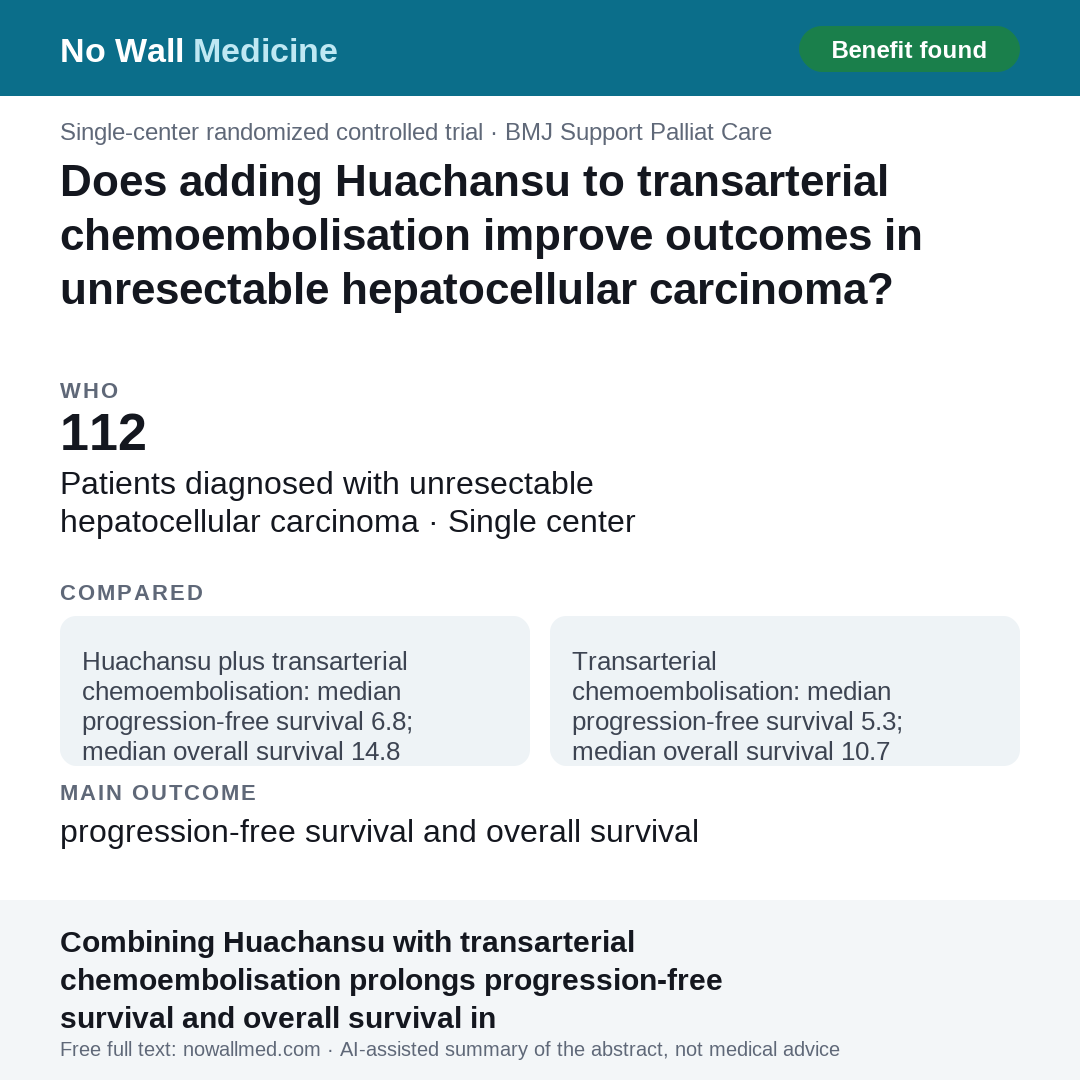
Does adding Huachansu to transarterial chemoembolisation improve outcomes in unresectable hepatocellular carcinoma?
Who
112
Patients diagnosed with unresectable hepatocellular carcinoma · Single center
Compared
Huachansu plus transarterial chemoembolisation: median progression-free survival 6.8; median overall survival 14.8 months
Transarterial chemoembolisation: median progression-free survival 5.3; median overall survival 10.7 months
Main outcome
progression-free survival and overall survival
Bottom line: Combining Huachansu with transarterial chemoembolisation prolongs progression-free survival and overall survival in unresectable hepatocellular carcinoma patients.
BMJ Support Palliat Care · 2023-07-03Download image
Clinical question: Does adding Huachansu to transarterial chemoembolisation improve outcomes in unresectable hepatocellular carcinoma?
Why it matters: It was unknown if adding Huachansu, a Chinese medicine derived from toad venom, to standard chemoembolization improves survival for patients with unresectable liver cancer.
Key points
- Researchers studied 112 patients with unresectable hepatocellular carcinoma, a type of liver cancer, comparing standard chemoembolization to a combination of chemoembolization and Huachansu.
- The combination group had a median progression-free survival of 6.8 months and median overall survival of 14.8 months compared to 5.3 months and 10.7 months in the standard group.
- Changes in serum Na+/K+-ATPase α3 levels after 3 months were associated with overall survival of 8.5 months and 23.8 months.
Headline and key points written with AI from the paper’s abstract, with every number checked against it. Read the paper before relying on them.
Was this summary helpful?
Abstract
Objective
Huachansu, a Chinese medicine derived from the dried skin glands of toad venom, has been used in China since the 1970s to treat liver cancer. Transarterial chemoembolisation (TACE) is the standard of care for patients with unresectable hepatocellular carcinoma (HCC). This study evaluated the efficacy and safety of the combination of TACE and Huachansu in unresectable HCC. Methods
From September 2012 to September 2016, 120 patients diagnosed with unresectable HCC were prospectively enrolled. Patients were randomised at a 1:1 ratio into the combined treatment group (Huachansu-TACE) and the TACE treatment group. The primary endpoint was progression-free survival (PFS) and secondary endpoints were overall survival (OS) and safety. The exploration outcome serum Na+/K+-ATPase (NKA) α3 at baseline and 3-month follow-ups were compared for a prognostic role. All patients were subjected to 36-month follow-up. Results
A total of 112 patients who completed the study were included in the analysis. PFS and OS were significantly better in the Huachansu-TACE group than in the TACE group (p=0.029 and p=0.025, respectively), with a median PFS of 6.8 and 5.3; and a median OS of 14.8 months and 10.7 months, respectively. Although no prognostic significance was found between the baseline NKA-low and NKA-high groups in the patients' OS (p=0.48), its changes after 3-month follow-up showed significant prognostic values, of which, were 8.5 months and 23.8 months, respectively (p<0.001). Treatment-related adverse events were comparable between groups. Conclusions
Huachansu-TACE is effective in prolonging the PFS and OS in patients with unresectable HCC. Trial registration number
NCT01715532.
Abstract reproduced under the article’s CC BY NC licence.
Cite this article
Gao H, He J, Cheng CS, Zhuang L, Chen H, Meng Z. Unresectable hepatocellular carcinoma: transarterial chemoembolisation plus Huachansu - a single-center randomised controlled trial. BMJ Support Palliat Care. 2023. doi:10.1136/spcare-2022-003870
Spotted a mistake? Suggest a correction
Top studies every Monday
The week’s key trials and guidelines in your specialties, plus any topics you follow. By email, free.
Get the weekly digest