Large language models showed feasibility in managing chronic diseases through accurate health recommendations
Unveiling the Potential of Large Language Models in Transforming Chronic Disease Management: Mixed Methods Systematic Review
Mixed methods systematic review and meta-analysisBenefit found
What is the feasibility of large language models in chronic disease management?
Who
20
Studies examining large language models in chronic disease management
Compared
General-purpose large language models
Retrieval-augmented generation-enhanced large language models
Main outcome
Feasibility of large language models in chronic disease management
Result: odds ratio 2.89 (95% CI 1.83-4.58)
Bottom line: Large language models show feasibility in chronic disease management, with retrieval-augmented generation-enhanced models demonstrating higher accuracy rates.
Limitation: Direct application in clinical settings is still in its infancy.
J Med Internet Res · 2025-04-16Download image
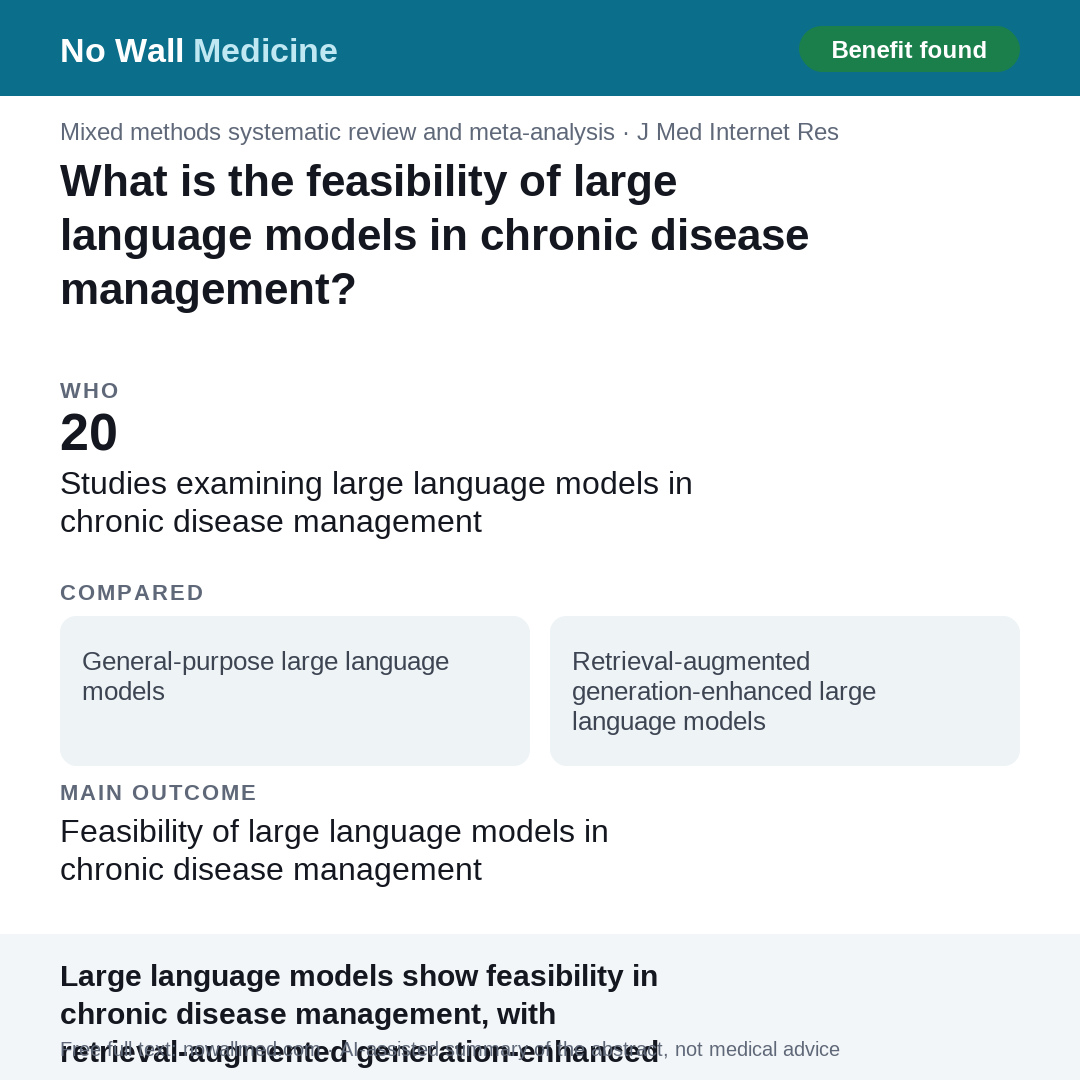
Clinical question: What is the feasibility of large language models in chronic disease management?
Why it matters: Robust evidence is lacking regarding the feasibility, opportunities, and challenges of using large language models across the chronic disease management spectrum.
Key points
- Researchers reviewed 20 studies involving general-purpose and retrieval-augmented generation-enhanced large language models for managing conditions like cancer and cardiovascular diseases.
- The models had a pooled accuracy rate of 71%, with retrieval-augmented generation-enhanced models showing higher accuracy than general-purpose models.
- Challenges were identified regarding privacy, language, cultural issues, and the ability to perform advanced tasks like diagnosis or medication management.
Limitation the authors note: The direct application of these models in clinical settings is still in its infancy.
Headline and key points written with AI from the paper’s abstract, with every number checked against it. Read the paper before relying on them.
Was this summary helpful?
Subject terms
Cite this article
Li C, Zhao Y, Bai Y, Zhao B, Tola YO, Chan CW. Unveiling the Potential of Large Language Models in Transforming Chronic Disease Management: Mixed Methods Systematic Review. J Med Internet Res. 2025. doi:10.2196/70535
Spotted a mistake? Suggest a correction
Top studies every Monday
The week’s key trials and guidelines in your specialties, plus any topics you follow. By email, free.
Get the weekly digest