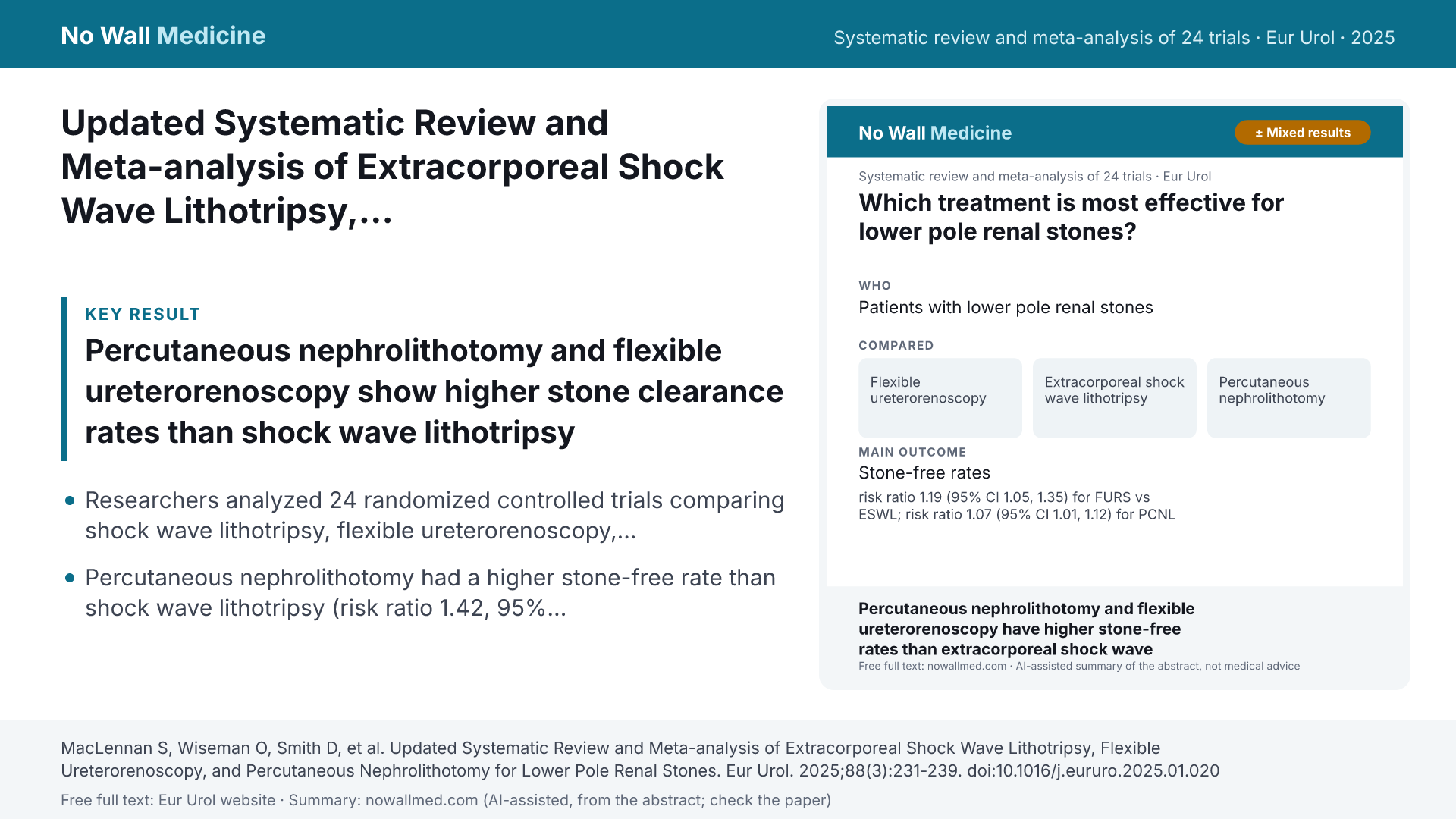
Percutaneous nephrolithotomy and flexible ureterorenoscopy show higher stone clearance rates than shock wave lithotripsy
Updated Systematic Review and Meta-analysis of Extracorporeal Shock Wave Lithotripsy, Flexible Ureterorenoscopy, and Percutaneous Nephrolithotomy for Lower Pole Renal Stones
Systematic review and meta-analysis of 24 trialsMixed results
Which treatment is most effective for lower pole renal stones?
Who
Patients with lower pole renal stones
Compared
Flexible ureterorenoscopy
Extracorporeal shock wave lithotripsy
Percutaneous nephrolithotomy
Main outcome
Stone-free rates
Result: risk ratio 1.19 (95% CI 1.05, 1.35) for FURS vs ESWL; risk ratio 1.07 (95% CI 1.01, 1.12) for PCNL vs FURS; risk ratio 1.42 (95% CI 1.28, 1.58) for PCNL vs ESWL
Bottom line: Percutaneous nephrolithotomy and flexible ureterorenoscopy have higher stone-free rates than extracorporeal shock wave lithotripsy.
Eur Urol · 2025-03-13 · Save PNG
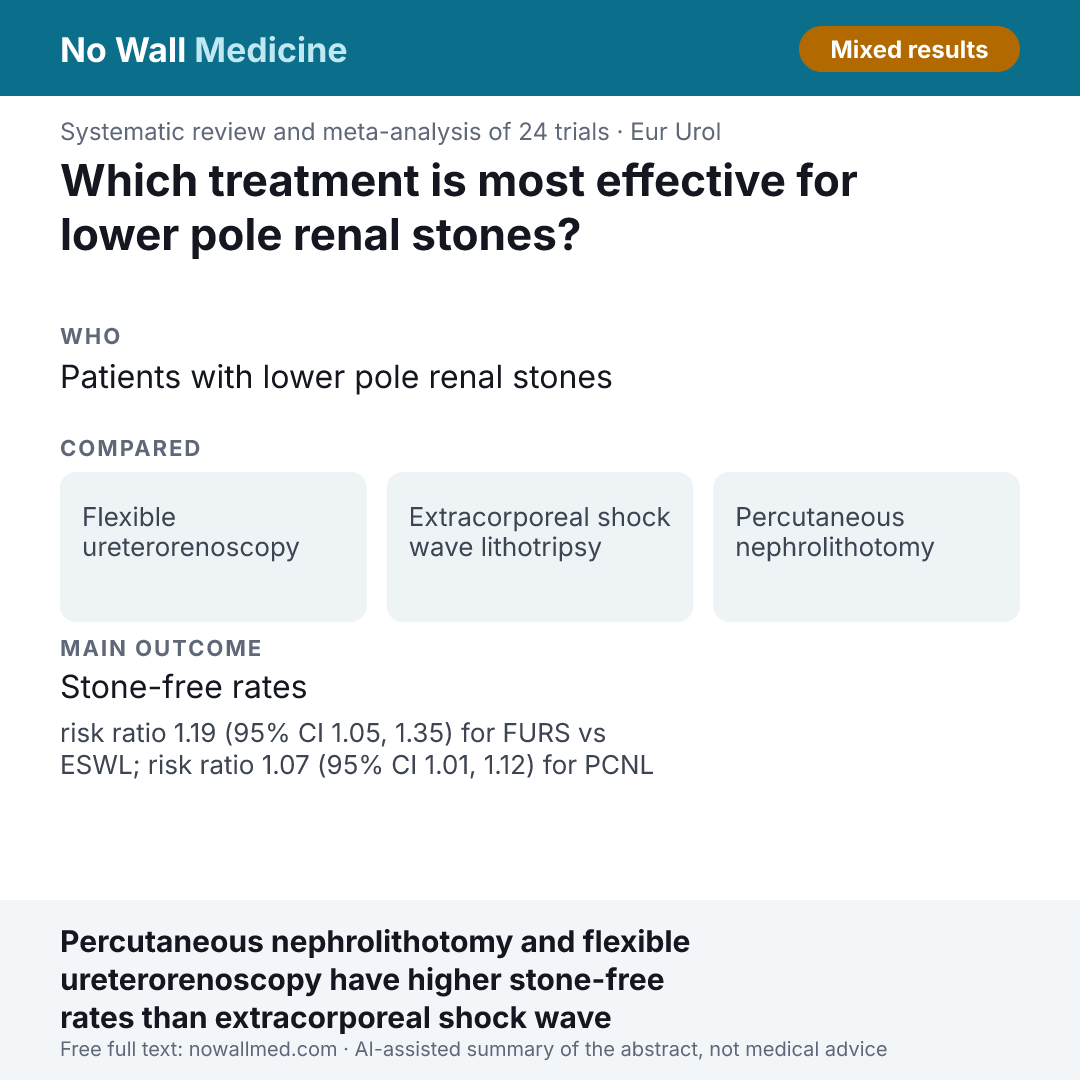
Clinical question: Which treatment is most effective for lower pole renal stones?
Why it matters: The most effective treatment strategy for stones located in the lower pole of the kidney remains uncertain due to varying outcomes in stone clearance and complications.
Key points
- Researchers analyzed 24 randomized controlled trials comparing shock wave lithotripsy, flexible ureterorenoscopy, and percutaneous nephrolithotomy for treating stones in the lower part of the kidney.
- Percutaneous nephrolithotomy had a higher stone-free rate than shock wave lithotripsy (risk ratio 1.42, 95% confidence interval 1.28, 1.58) and a slightly higher rate than flexible ureterorenoscopy (risk ratio 1.07, 95% confidence interval 1.01, 1.12).
- Flexible ureterorenoscopy was more effective at clearing stones than shock wave lithotripsy (risk ratio 1.19, 95% confidence interval 1.05, 1.35), but shock wave lithotripsy was associated with fewer complications.
Headline and key points written with AI from the paper’s abstract, with every number checked against it. Read the paper before relying on them.
Was this summary helpful?
Subject terms
Headline, design, result, key points, caveat and citation as plain text.
Cite this article
MacLennan S, Wiseman O, Smith D, et al. Updated Systematic Review and Meta-analysis of Extracorporeal Shock Wave Lithotripsy, Flexible Ureterorenoscopy, and Percutaneous Nephrolithotomy for Lower Pole Renal Stones. Eur Urol. 2025;88(3):231-239. doi:10.1016/j.eururo.2025.01.020
Spotted a mistake? Suggest a correction