Upper-airway stimulation decreased sleep apnea events by 68% at 12 months
Upper-airway stimulation for obstructive sleep apnea
Why it matters: In a single-group study of adults who could not use CPAP, hypoglossal nerve stimulation reduced apnea severity and daytime sleepiness at 12 months.
Related landmark trials: CHAT (adenotonsillectomy)
Context written by the No Wall Medicine team.
Randomized, controlled trialBenefit found
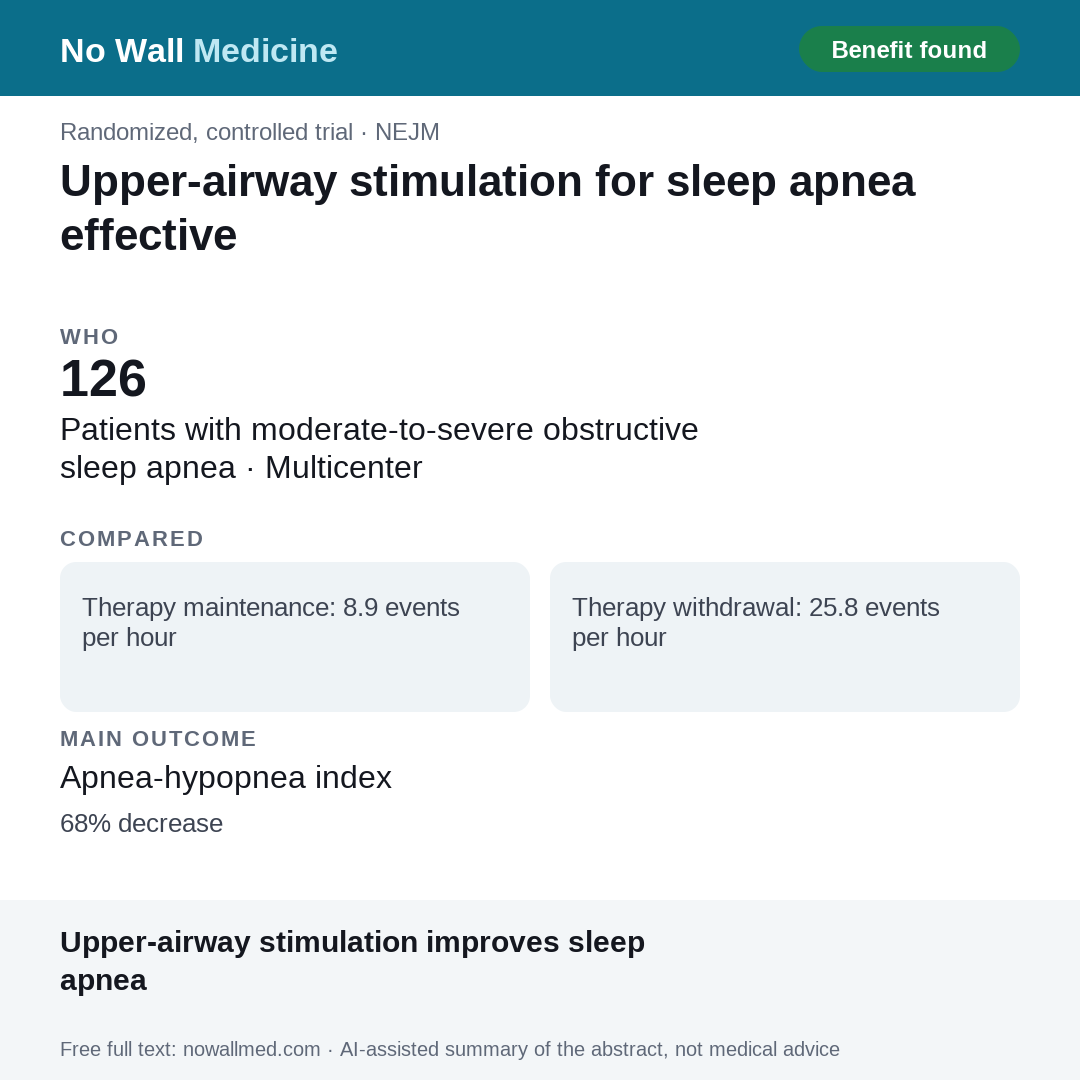
Upper-airway stimulation for sleep apnea effective
Who
126
Patients with moderate-to-severe obstructive sleep apnea · Multicenter
Compared
Therapy maintenance: 8.9 events per hour
Therapy withdrawal: 25.8 events per hour
Main outcome
Apnea-hypopnea index
Result: 68% decrease
Bottom line: Upper-airway stimulation improves sleep apnea
Funded by: Inspire Medical Systems
NEJM · 2014-01-10Download image
Key points
- 126 participants with moderate-to-severe obstructive sleep apnea were studied.
- The apnea-hypopnea index score decreased from 29.3 to 9.0 events per hour.
- Procedure-related serious adverse events occurred in less than 2% of participants.
Headline and key points written with AI from the paper’s abstract, with every number checked against it. Read the paper before relying on them.
Topics
Cite this article
Strollo PJ, Soose RJ, Maurer JT, de Vries N, Cornelius J, Froymovich O. Upper-airway stimulation for obstructive sleep apnea. NEJM. 2014. doi:10.1056/NEJMoa1308659
Spotted a mistake? Suggest a correction