Robotic upper limb rehabilitation shows small improvements in capacity but no difference in daily activities
Upper limb robotic rehabilitation following stroke: a systematic review and meta-analysis investigating efficacy and the influence of device features and program parameters
Systematic review and meta-analysis of randomized controlled trialsMixed results
Is upper limb robotic rehabilitation more effective than conventional rehabilitation following stroke?
Who
2744
Participants following stroke
Compared
Robotic rehabilitation: SMD 0.14 (95% CI [0.02, 0.26]) for upper limb capacity
Conventional rehabilitation
Main outcome
Upper limb capacity and activities of daily living
Result: SMD 0.14 (95% CI [0.02, 0.26])
Bottom line: Robotic rehabilitation shows small positive effects on upper limb capacity post-treatment, but no clinically meaningful improvements in capacity or activities of daily living.
J Neuroeng Rehabil · 2025-07-16Download image
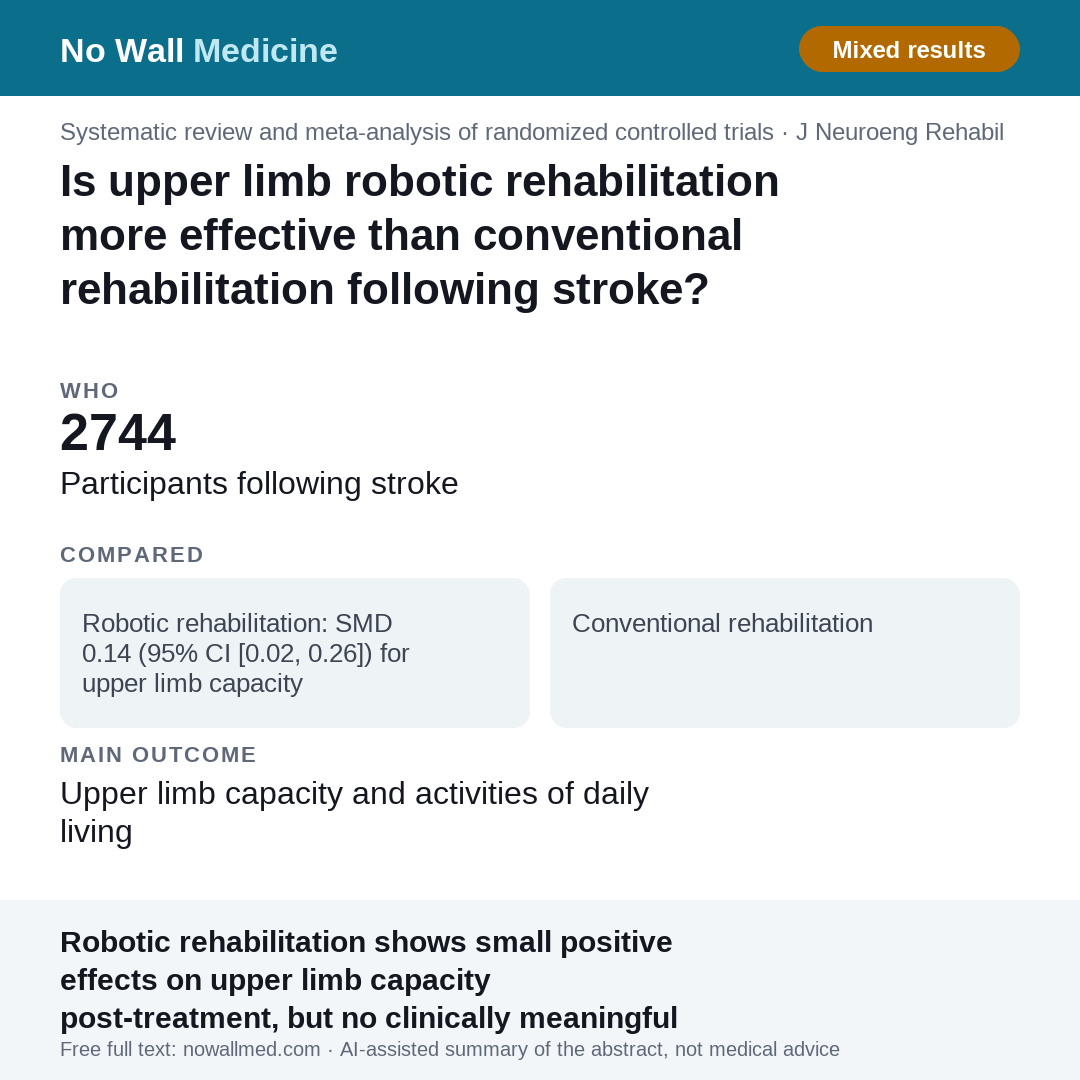
Clinical question: Is upper limb robotic rehabilitation more effective than conventional rehabilitation following stroke?
Why it matters: Knowledge is limited regarding the optimal device features and intervention parameters for using robotic devices to augment upper limb stroke rehabilitation.
Key points
- Researchers analyzed 54 randomized controlled trials involving 2744 participants to compare robotic rehabilitation with conventional therapy after a stroke.
- Robotic rehabilitation had a small, statistically significant effect on upper limb capacity (SMD 0.14, 95% CI [0.02, 0.26]), but these gains were not maintained at follow-up (SMD 0.05, 95% CI [-0.13, 0.24]).
- No significant differences were found between robotic and conventional rehabilitation for activities of daily living outcomes at post-treatment (SMD 0.04, 95% CI [-0.05, 0.13]) or follow-up (SMD 0.05, 95% CI [-0.13, 0.24]).
Headline and key points written with AI from the paper’s abstract, with every number checked against it. Read the paper before relying on them.
Topics
Cite this article
Boardsworth K, Rashid U, Olsen S, Rodriguez-Ramirez E, Browne W, Alder G. Upper limb robotic rehabilitation following stroke: a systematic review and meta-analysis investigating efficacy and the influence of device features and program parameters. J Neuroeng Rehabil. 2025. doi:10.1186/s12984-025-01662-4
Spotted a mistake? Suggest a correction
Top studies every Monday
The week’s key trials and guidelines in your specialties, plus any topics you follow. By email, free.
Get the weekly digest