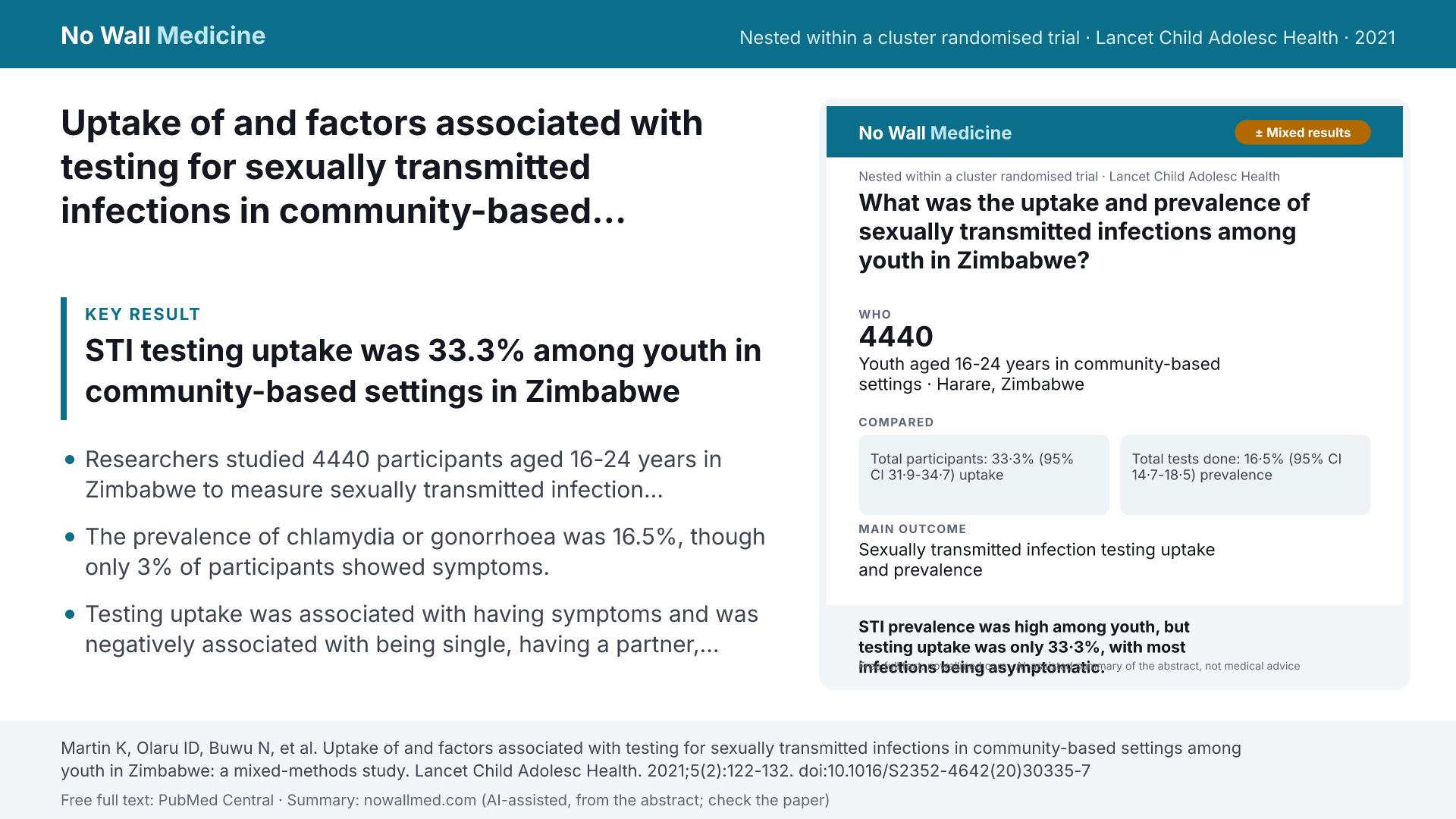
STI testing uptake was 33.3% among youth in community-based settings in Zimbabwe
Uptake of and factors associated with testing for sexually transmitted infections in community-based settings among youth in Zimbabwe: a mixed-methods study
Nested within a cluster randomised trialMixed results
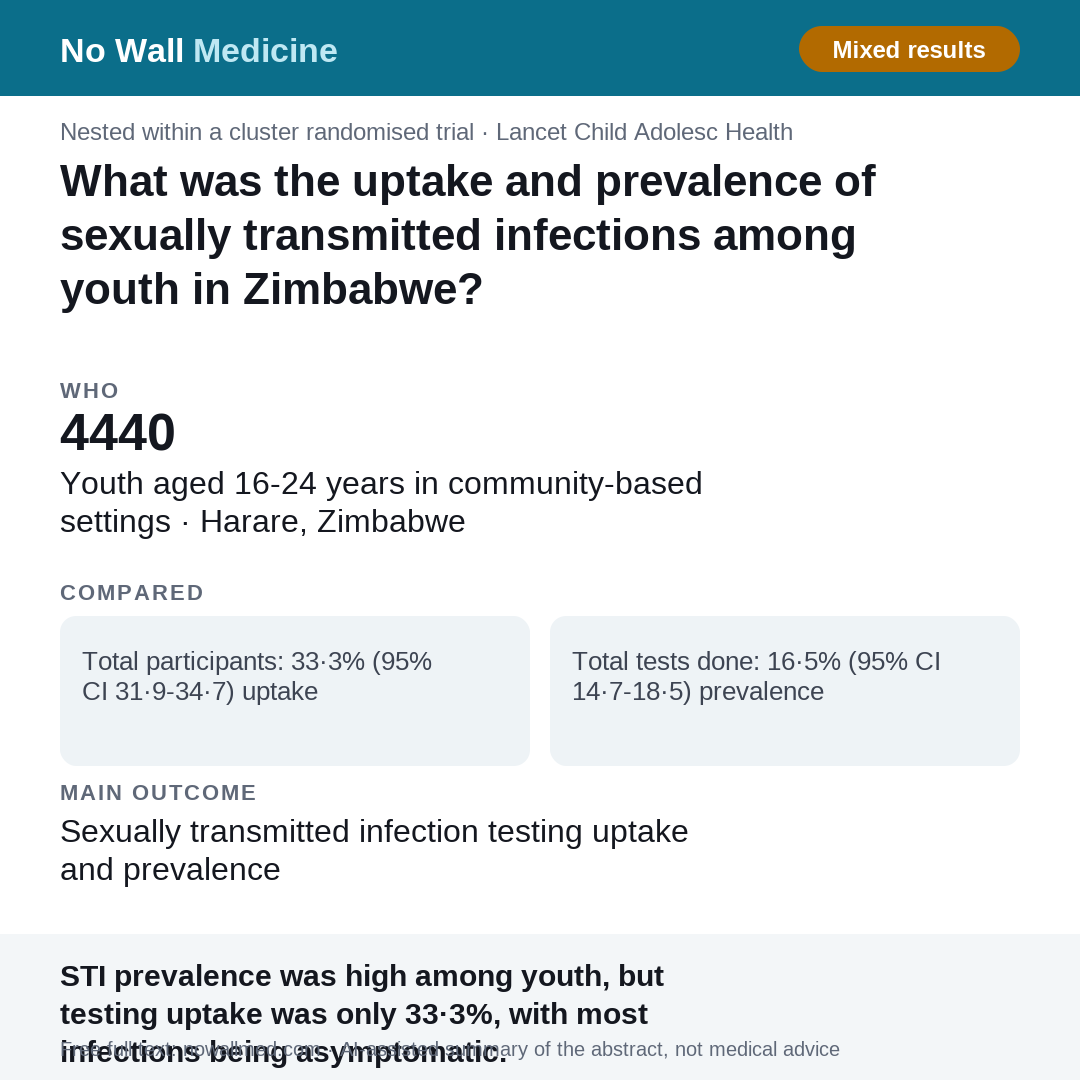
What was the uptake and prevalence of sexually transmitted infections among youth in Zimbabwe?
Who
4440
Youth aged 16-24 years in community-based settings · Harare, Zimbabwe
Compared
Total participants: 33·3% (95% CI 31·9-34·7) uptake
Total tests done: 16·5% (95% CI 14·7-18·5) prevalence
Main outcome
Sexually transmitted infection testing uptake and prevalence
Result: adjusted odds ratio 14·8 (95% CI 1·66-132·07) for symptoms
Bottom line: STI prevalence was high among youth, but testing uptake was only 33·3%, with most infections being asymptomatic.
Funded by: Wellcome Trust
Lancet Child Adolesc Health · 2021-01-06Download image
Clinical question: What was the uptake and prevalence of sexually transmitted infections among youth in Zimbabwe?
Why it matters: The prevalence of sexually transmitted infections is high among youth in sub-Saharan Africa, but it is unknown how many youth utilize community-based testing services.
Key points
- Researchers studied 4440 participants aged 16-24 years in Zimbabwe to measure sexually transmitted infection testing uptake and prevalence.
- The prevalence of chlamydia or gonorrhoea was 16.5%, though only 3% of participants showed symptoms.
- Testing uptake was associated with having symptoms and was negatively associated with being single, having a partner, or being a student.
Headline and key points written with AI from the paper’s abstract, with every number checked against it. Read the paper before relying on them.
Was this summary helpful?
Abstract
Background
The prevalence of sexually transmitted infections (STIs) among youth is high in sub-Saharan Africa. We investigated the uptake of testing for and prevalence of Chlamydia trachomatis (chlamydia) and Neisseria gonorrhoeae (gonorrhoea) infections among youth in community-based settings in Zimbabwe, and explored the facilitators and barriers to testing. Methods
This study was nested within a cluster randomised trial of community-based delivery of integrated HIV and sexual and reproductive health services for youth aged 16-24 years. Chlamydia and gonorrhoea testing via urine samples using the Xpert CT/NG test was offered in the four intervention clusters in Harare, Zimbabwe. Factors associated with testing uptake were investigated in a subset of participants (n=257) using hierarchical multivariate logistic regression. In-depth interviews with a separate purposively selected sample (n=26) explored facilitators and barriers to STI testing and partner notification and were analysed using thematic analysis. Findings
Between June 1, 2019, and Jan 31, 2020, there were 6200 attendances by 4440 participants (78·2% women, 21·8% men) median age 20·3 (IQR 17·9-22·8) years. 1478 participants had 1501 tests done, and 248 tests were positive and 1253 tests were negative for chlamydia or gonorrhoea, or both. STI test uptake was 33·3% (95% CI 31·9-34·7), increasing from 11·7% in June, 2019, to 37·1% in January, 2020. The prevalence of chlamydia or gonorrhoea, or both, was 16·5% (95% CI 14·7-18·5; 248 of 1501), with only seven participants (3%) showing symptoms. The overall yield of testing was 4·0% (95% CI 3·5-4·5; 248 of 6200). Uptake was associated with having symptoms (adjusted odds ratio [OR] 14·8, 95% CI 1·66-132·07) and negatively associated with being single (adjusted OR 0·33, 95% CI 0·13-0·84) or having a boyfriend or girlfriend (adjusted OR 0·19, 95% CI 0·087-0·43) compared with being married, and being a student compared with being employed (adjusted OR 0·26, 95% CI 0·10-0·68). Perceived risk and symptoms of STIs were motivators for testing whereas misinformation, anticipated stigma, and concern about confidentiality were barriers. Interpretation
The prevalence of chlamydia or gonorrhoea, or both, was high among youth but only a minority were symptomatic. Therefore most infections would remain untreated without access to STI testing. Provision of education, counselling, and confidentiality are essential to improve uptake and acceptability of STI testing. Funding
Wellcome Trust.
Abstract reproduced under the article’s CC BY licence.
Subject terms
Cite this article
Martin K, Olaru ID, Buwu N, et al. Uptake of and factors associated with testing for sexually transmitted infections in community-based settings among youth in Zimbabwe: a mixed-methods study. Lancet Child Adolesc Health. 2021. doi:10.1016/S2352-4642(20)30335-7
Spotted a mistake? Suggest a correction