Certain rheumatoid arthritis drugs increase urinary prostanoid levels but do not predict treatment response
Urinary prostanoids are elevated by anti-TNF and anti-IL6 receptor disease-modifying antirheumatic drugs but are not predictive of response to treatment in early rheumatoid arthritis
Randomized trialMixed results
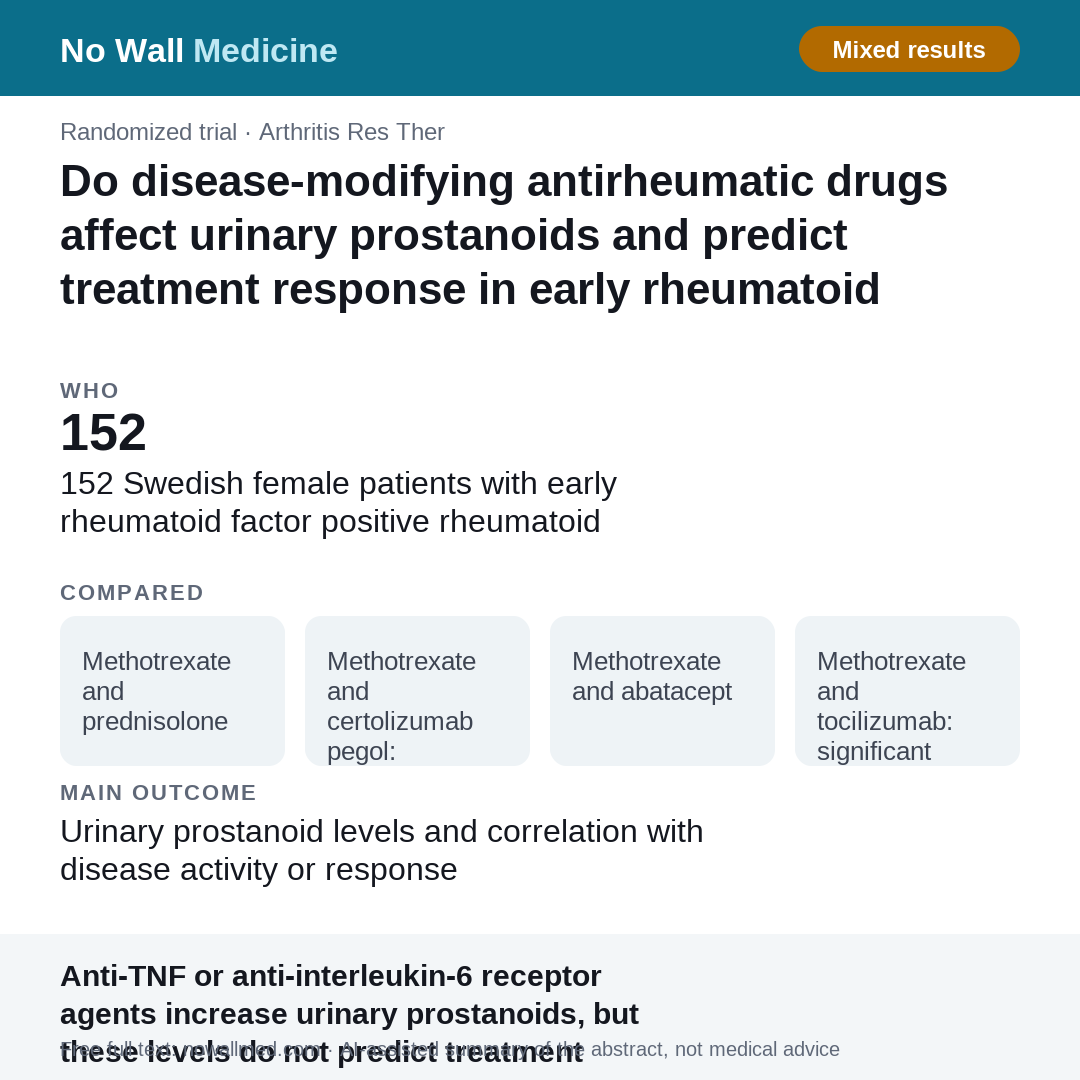
Do disease-modifying antirheumatic drugs affect urinary prostanoids and predict treatment response in early rheumatoid arthritis?
Who
152
152 Swedish female patients with early rheumatoid factor positive rheumatoid arthritis · Sweden
Compared
Methotrexate and prednisolone
Methotrexate and certolizumab pegol: significant elevations in urinary tetranor-prostaglandin E metabolite and 2,3-dinor thromboxane B2
Methotrexate and abatacept
Methotrexate and tocilizumab: significant elevations in urinary tetranor-prostaglandin E metabolite and 2,3-dinor thromboxane B2
Main outcome
Urinary prostanoid levels and correlation with disease activity or response
Bottom line: Anti-TNF or anti-interleukin-6 receptor agents increase urinary prostanoids, but these levels do not predict treatment response.
Arthritis Res Ther · 2024-03-05Download image
Clinical question: Do disease-modifying antirheumatic drugs affect urinary prostanoids and predict treatment response in early rheumatoid arthritis?
Why it matters: It is unknown if prostanoids, which are lipid mediators involved in disease progression, can serve as biomarkers to predict how patients will respond to disease-modifying antirheumatic drugs.
Key points
- The study followed 152 Swedish female patients with early rheumatoid arthritis randomized to four different drug treatment regimens.
- Patients receiving methotrexate combined with certolizumab pegol or tocilizumab showed significant increases in urinary tetranor-prostaglandin E metabolite and 2,3-dinor thromboxane B2 after 24 weeks.
- Urinary prostanoid levels were not linked to clinical disease activity or whether patients achieved remission at 24 weeks.
Headline and key points written with AI from the paper’s abstract, with every number checked against it. Read the paper before relying on them.
Was this summary helpful?
Subject terms
Cite this article
Liu J, Idborg H, Korotkova M, Lend K, van Vollenhoven R, Lampa J. Urinary prostanoids are elevated by anti-TNF and anti-IL6 receptor disease-modifying antirheumatic drugs but are not predictive of response to treatment in early rheumatoid arthritis. Arthritis Res Ther. 2024. doi:10.1186/s13075-024-03295-9
Spotted a mistake? Suggest a correction
Top studies every Monday
The week’s key trials and guidelines in your specialties, plus any topics you follow. By email, free.
Get the weekly digest