Talazoparib with enzalutamide improved radiographic progression-free survival in patients with specific prostate cancer mutations
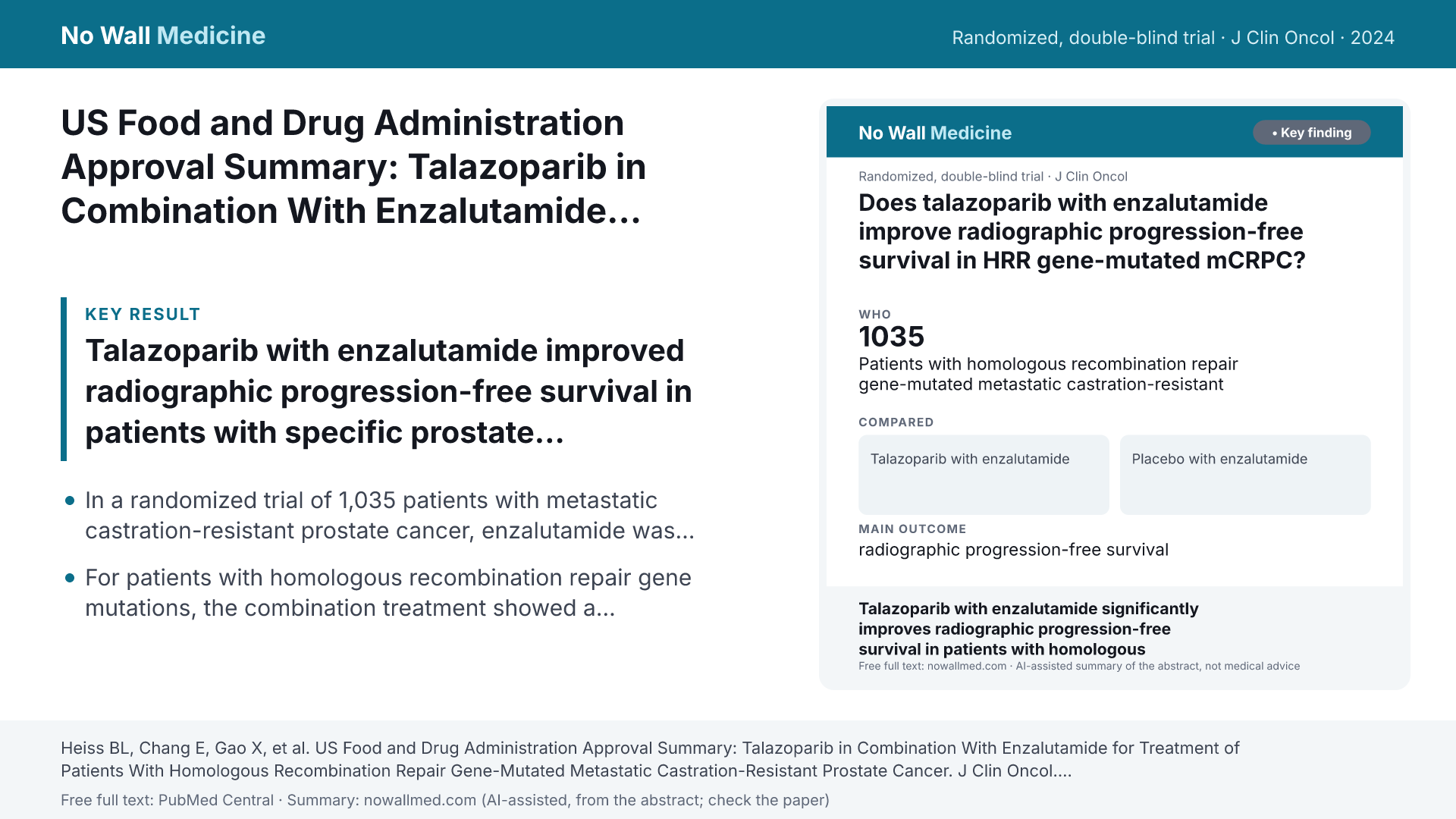
US Food and Drug Administration Approval Summary: Talazoparib in Combination With Enzalutamide for Treatment of Patients With Homologous Recombination Repair Gene-Mutated Metastatic Castration-Resistant Prostate Cancer
Randomized, double-blind trialBenefit found
Does talazoparib with enzalutamide improve radiographic progression-free survival in HRR gene-mutated mCRPC?
Who
1035
Patients with homologous recombination repair gene-mutated metastatic castration-resistant prostate cancer
Compared
Talazoparib with enzalutamide
Placebo with enzalutamide
Main outcome
radiographic progression-free survival
Result: hazard ratio 0.45 (95% CI, 0.33 to 0.61)
Bottom line: Talazoparib with enzalutamide significantly improves radiographic progression-free survival in patients with homologous recombination repair gene-mutated metastatic castration-resistant prostate cancer.
Limitation: Overall survival was immature.
J Clin Oncol · 2024-03-07Download image
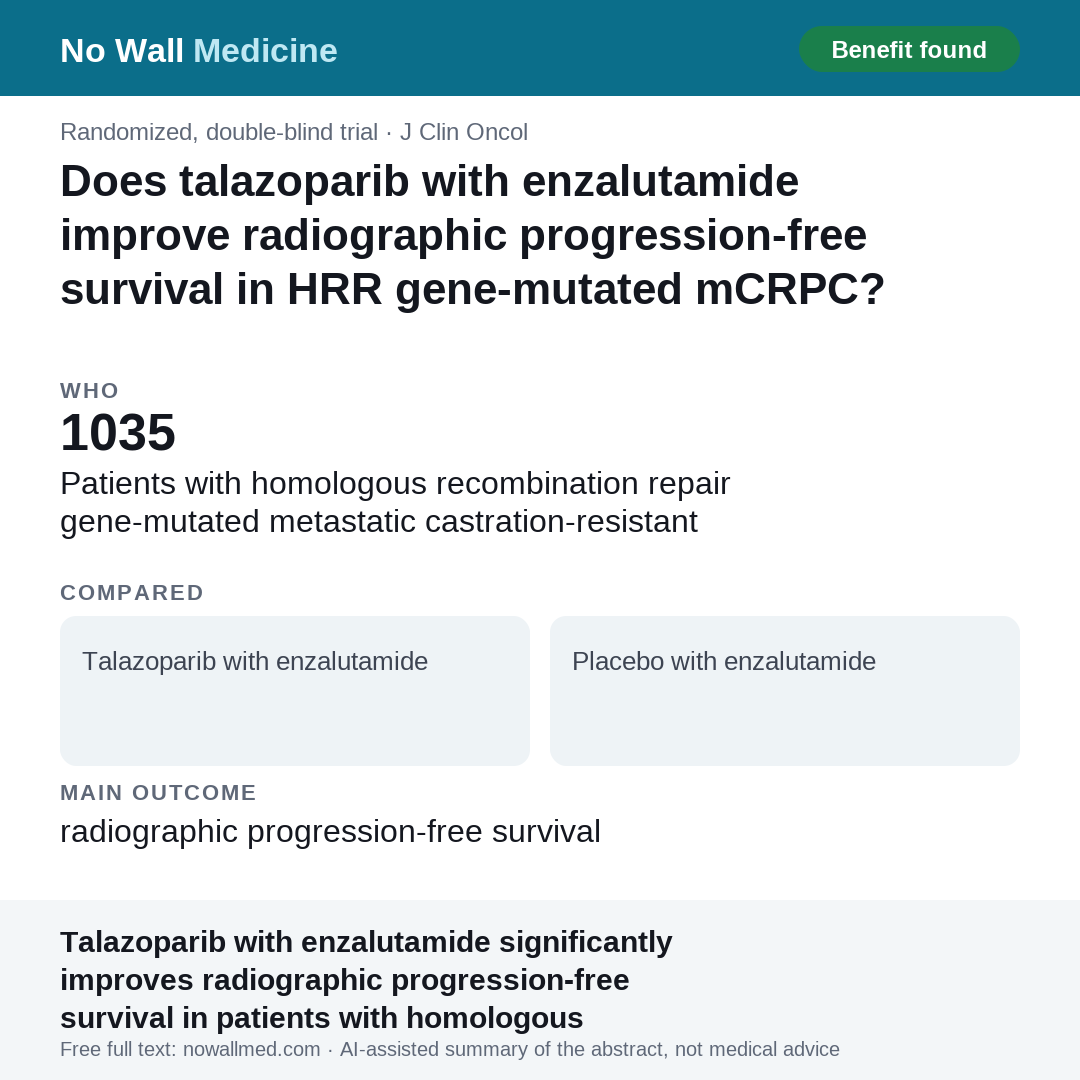
Clinical question: Does talazoparib with enzalutamide improve radiographic progression-free survival in HRR gene-mutated mCRPC?
Why it matters: It was unknown if combining talazoparib with enzalutamide provided a clinically meaningful benefit for all patients with metastatic castration-resistant prostate cancer.
Key points
- In a randomized trial of 1,035 patients with metastatic castration-resistant prostate cancer, enzalutamide was compared with talazoparib or a placebo.
- For patients with homologous recombination repair gene mutations, the combination treatment showed a radiographic progression-free survival hazard ratio of 0.45.
- An exploratory analysis of 155 patients with BRCA mutations showed a radiographic progression-free survival hazard ratio of 0.20.
Limitation the authors note: Overall survival data was immature.
Headline and key points written with AI from the paper’s abstract, with every number checked against it. Read the paper before relying on them.
Was this summary helpful?
Subject terms
Cite this article
Heiss BL, Chang E, Gao X, et al. US Food and Drug Administration Approval Summary: Talazoparib in Combination With Enzalutamide for Treatment of Patients With Homologous Recombination Repair Gene-Mutated Metastatic Castration-Resistant Prostate Cancer. J Clin Oncol. 2024. doi:10.1200/JCO.23.02182
Spotted a mistake? Suggest a correction