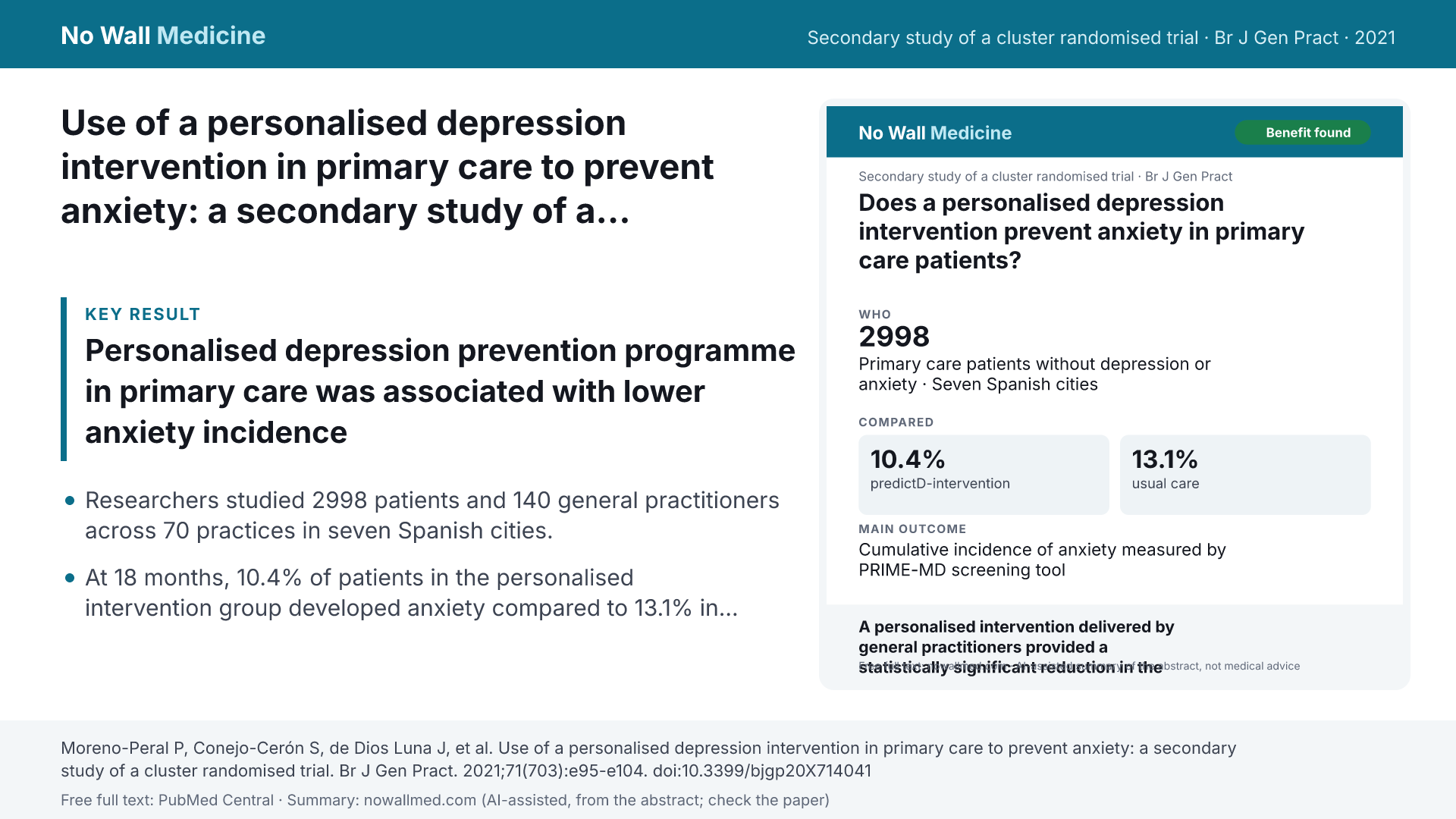
Personalised depression prevention programme in primary care was associated with lower anxiety incidence
Use of a personalised depression intervention in primary care to prevent anxiety: a secondary study of a cluster randomised trial
Secondary study of a cluster randomised trialBenefit found
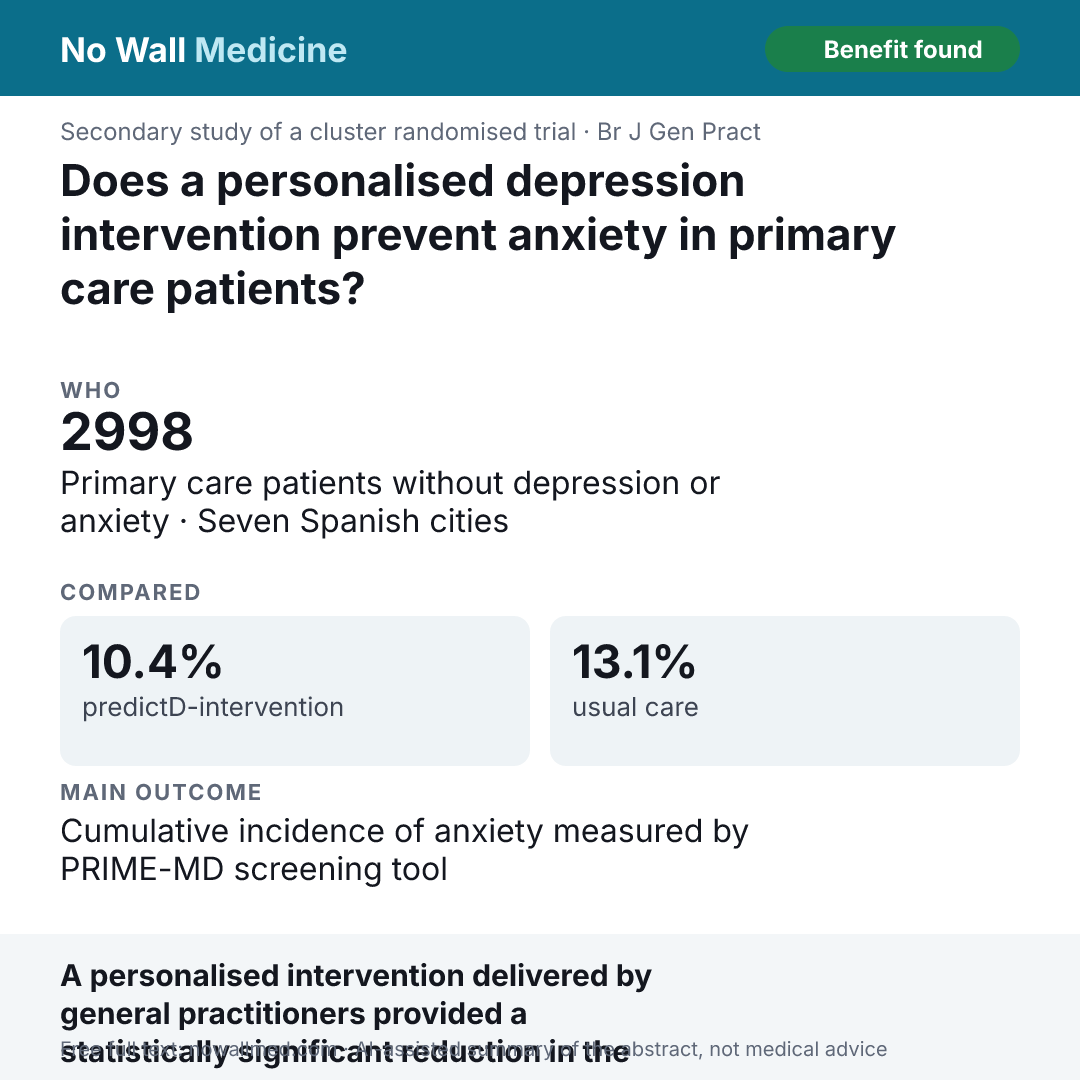
Does a personalised depression intervention prevent anxiety in primary care patients?
Who
2998
Primary care patients without depression or anxiety · Seven Spanish cities
Compared
10.4%predictD-intervention (95% CI = 8.7% to 12.1%)
13.1%usual care (95% CI = 11.4% to 14.8%)
Main outcome
Cumulative incidence of anxiety measured by PRIME-MD screening tool
Result: absolute difference = -2.7% (95% CI = -5.1% to -0.3%)
Bottom line: A personalised intervention delivered by general practitioners provided a statistically significant reduction in the incidence of anxiety.
Br J Gen Pract · 2021-01-28 · Save PNG
Clinical question: Does a personalised depression intervention prevent anxiety in primary care patients?
In absolute numbers
predictD-intervention: 10.4% · usual care: 13.1% → a difference of 2.7 percentage points, so about 38 people would need the treatment for 1 more to benefit (number needed to treat) over the trial’s follow-up.
Worked out by us from the two group results above, not reported by the authors. Check the paper for the exact outcome and timing.
Key points
- Researchers studied 2998 patients and 140 general practitioners across 70 practices in seven Spanish cities.
- At 18 months, 10.4% of patients in the personalised intervention group developed anxiety compared to 13.1% in the usual care group.
- The intervention showed a statistically significant absolute difference of -2.7% in anxiety incidence.
Headline and key points written with AI from the paper’s abstract, with every number checked against it. Read the paper before relying on them.
Was this summary helpful?
Subject terms
Headline, design, result, key points, caveat and citation as plain text.
Cite this article
Moreno-Peral P, Conejo-Cerón S, de Dios Luna J, et al. Use of a personalised depression intervention in primary care to prevent anxiety: a secondary study of a cluster randomised trial. Br J Gen Pract. 2021;71(703):e95-e104. doi:10.3399/bjgp20X714041
Spotted a mistake? Suggest a correction