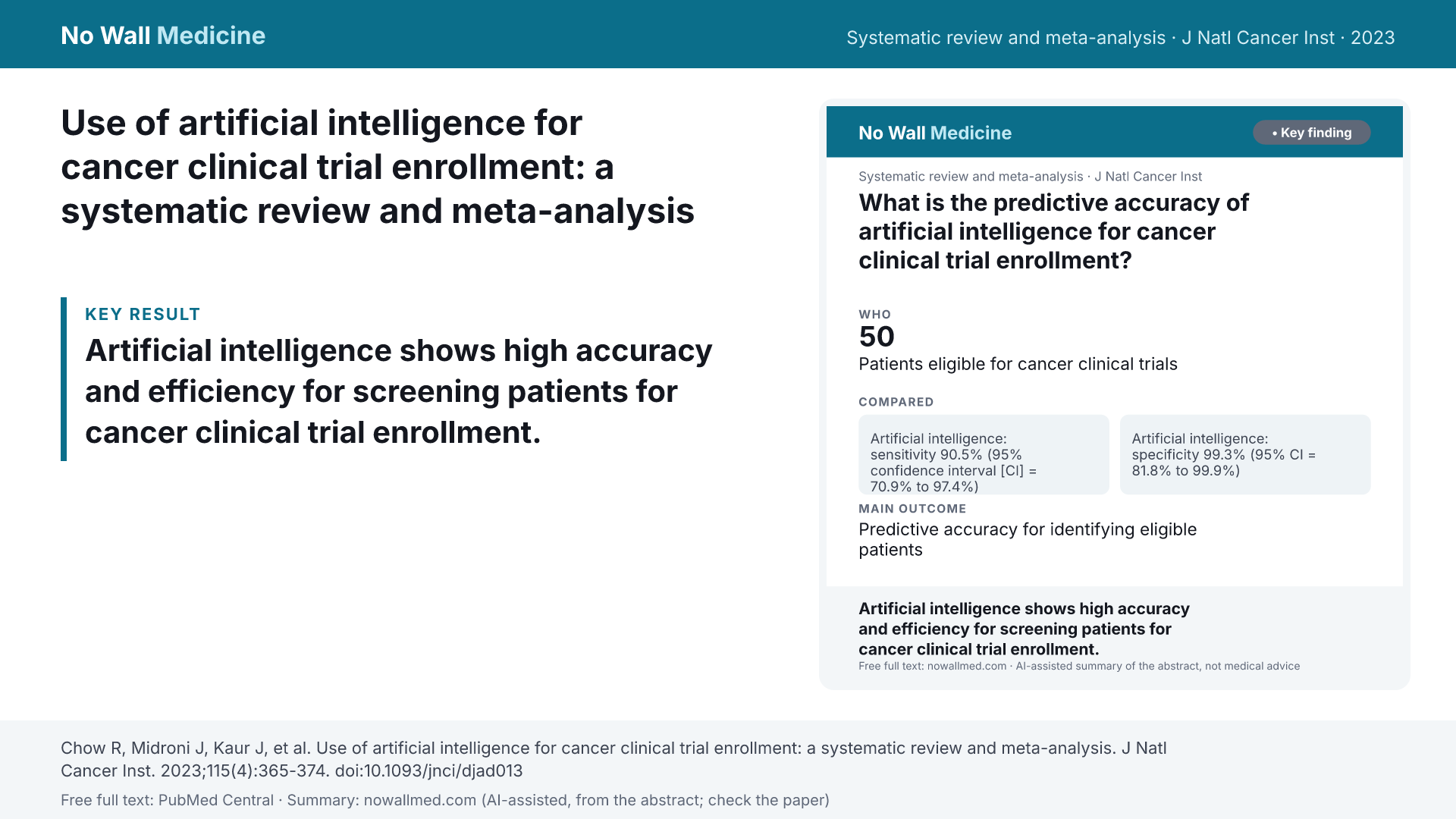
Use of artificial intelligence for cancer clinical trial enrollment: a systematic review and meta-analysis
Systematic review and meta-analysisKey finding
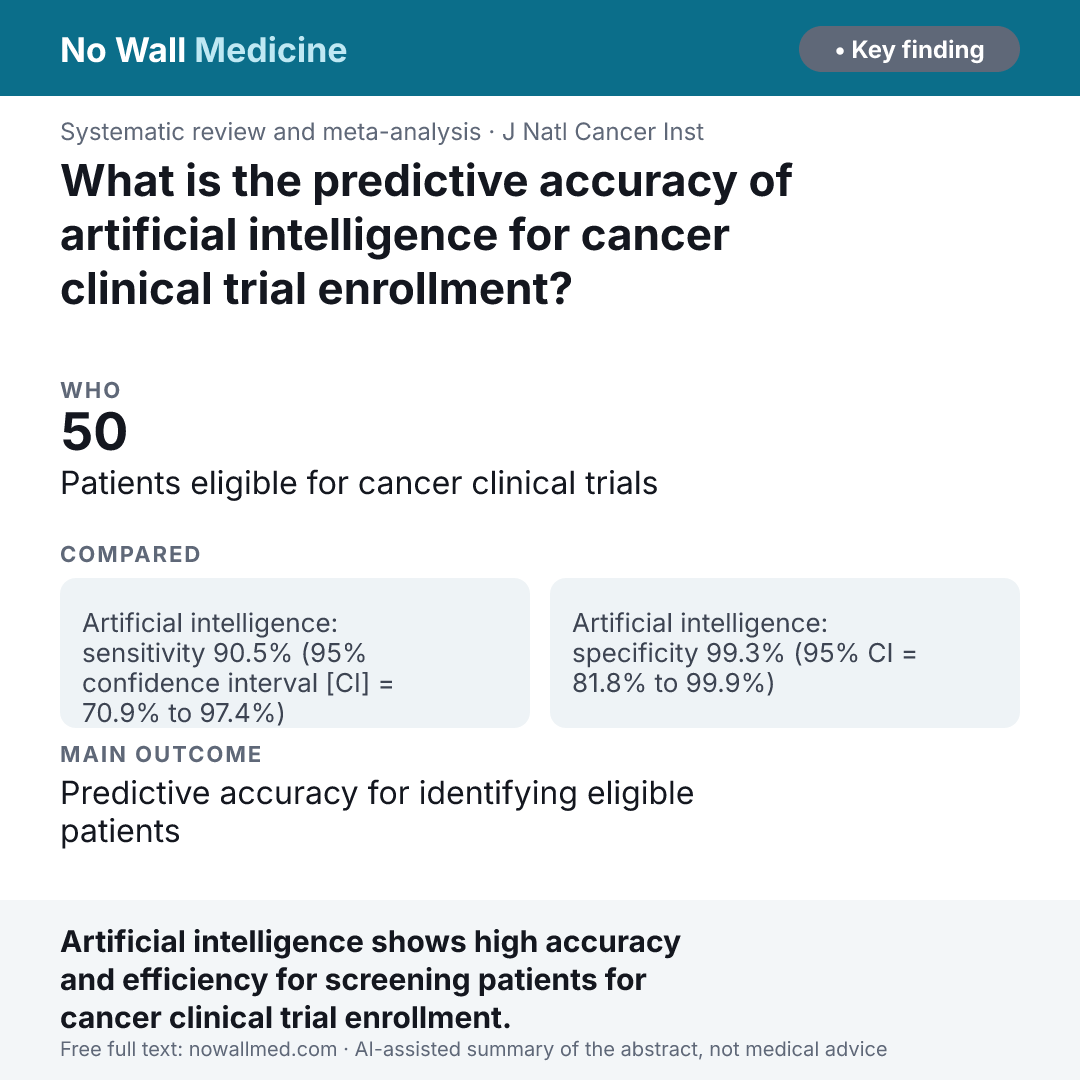
What is the predictive accuracy of artificial intelligence for cancer clinical trial enrollment?
Who
50
Patients eligible for cancer clinical trials
Compared
Artificial intelligence: sensitivity 90.5% (95% confidence interval [CI] = 70.9% to 97.4%)
Artificial intelligence: specificity 99.3% (95% CI = 81.8% to 99.9%)
Main outcome
Predictive accuracy for identifying eligible patients
Result: sensitivity 90.5% (95% CI 70.9% to 97.4%); specificity 99.3% (95% CI 81.8% to 99.9%)
Bottom line: Artificial intelligence shows high accuracy and efficiency for screening patients for cancer clinical trial enrollment.
Limitation: Need to validate use in less resource-rich regions and ensure broad inclusion for generalizability.
J Natl Cancer Inst · 2023-01-24 · Save PNG
Clinical question: What is the predictive accuracy of artificial intelligence for cancer clinical trial enrollment?
Abstract
Background
The aim of this study is to provide a comprehensive understanding of the current landscape of artificial intelligence (AI) for cancer clinical trial enrollment and its predictive accuracy in identifying eligible patients for inclusion in such trials. Methods
Databases of PubMed, Embase, and Cochrane CENTRAL were searched until June 2022. Articles were included if they reported on AI actively being used in the clinical trial enrollment process. Narrative synthesis was conducted among all extracted data: accuracy, sensitivity, specificity, positive predictive value, and negative predictive value. For studies where the 2x2 contingency table could be calculated or supplied by authors, a meta-analysis to calculate summary statistics was conducted using the hierarchical summary receiver operating characteristics curve model. Results
Ten articles reporting on more than 50 000 patients in 19 datasets were included. Accuracy, sensitivity, and specificity exceeded 80% in all but 1 dataset. Positive predictive value exceeded 80% in 5 of 17 datasets. Negative predictive value exceeded 80% in all datasets. Summary sensitivity was 90.5% (95% confidence interval [CI] = 70.9% to 97.4%); summary specificity was 99.3% (95% CI = 81.8% to 99.9%). Conclusions
AI demonstrated comparable, if not superior, performance to manual screening for patient enrollment into cancer clinical trials. As well, AI is highly efficient, requiring less time and human resources to screen patients. AI should be further investigated and implemented for patient recruitment into cancer clinical trials. Future research should validate the use of AI for clinical trials enrollment in less resource-rich regions and ensure broad inclusion for generalizability to all sexes, ages, and ethnicities.
Subject terms
Headline, design, result, key points, caveat and citation as plain text.
Cite this article
Chow R, Midroni J, Kaur J, et al. Use of artificial intelligence for cancer clinical trial enrollment: a systematic review and meta-analysis. J Natl Cancer Inst. 2023;115(4):365-374. doi:10.1093/jnci/djad013
Spotted a mistake? Suggest a correction