Artificial intelligence applications in paediatric anaesthesia focus primarily on predicting patient risk factors
Use of artificial intelligence in paediatric anaesthesia: a systematic review
Systematic reviewUnclear result
What are the current uses and barriers of artificial intelligence in paediatric anaesthesia?
Who
40
Patients under 18 years old in perioperative settings
Compared
Patient risk factor prediction: 24 studies (60%)
Physiological variable monitoring: 6 studies (15%)
Airway device selection: 3 studies (7.5%)
Main outcome
Applications and barriers of artificial intelligence in paediatric anaesthesia
Bottom line: Artificial intelligence shows potential in paediatric anaesthesia, but faces barriers like lack of high-quality data and external validation.
Limitation: Lack of high-quality input data, lack of external validation, and unclear generalisability to diverse settings.
BJA Open · 2023-02-07Download image
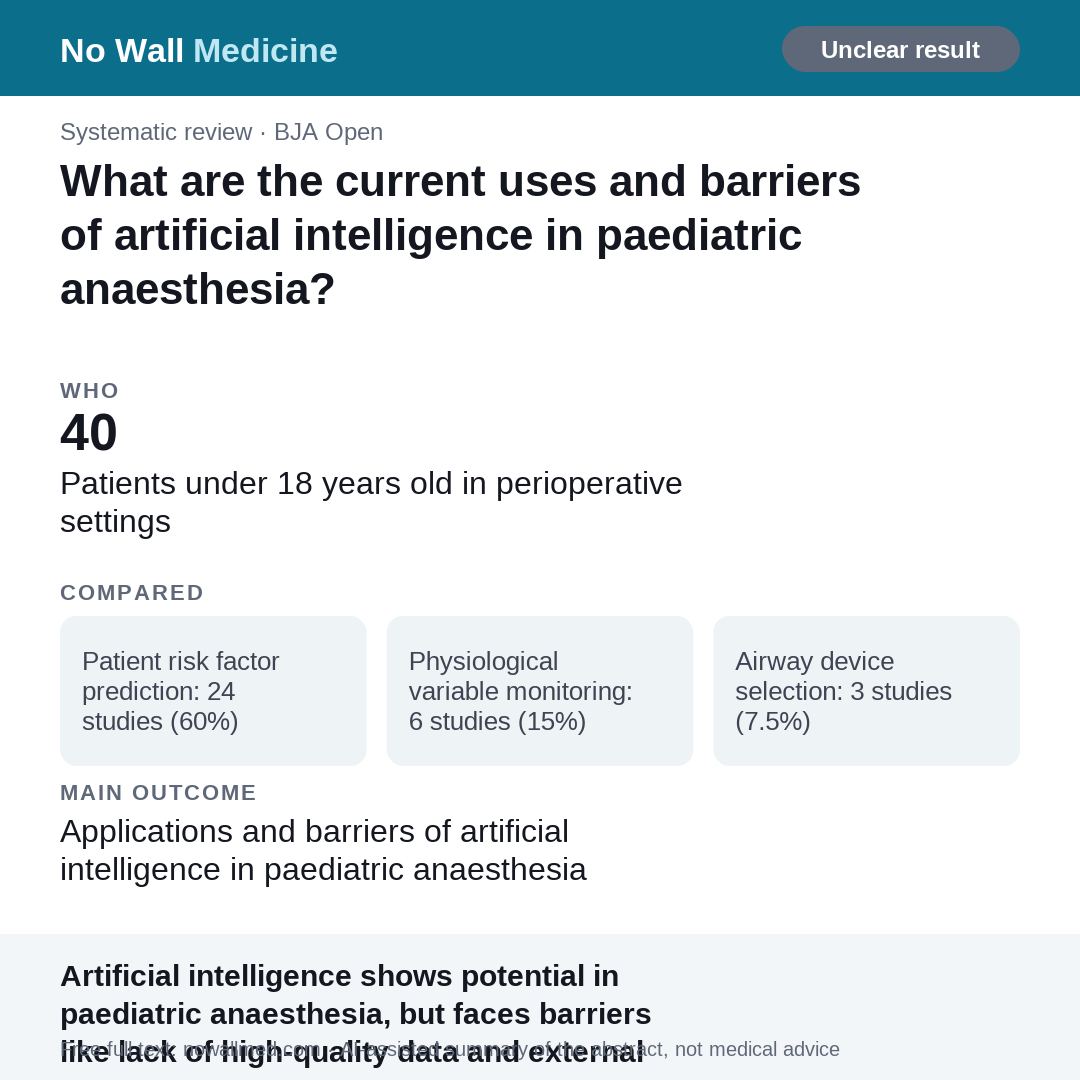
Clinical question: What are the current uses and barriers of artificial intelligence in paediatric anaesthesia?
Why it matters: The current application of artificial intelligence technologies in the field of paediatric anaesthesia is not well characterized.
Key points
- Researchers reviewed 40 studies to characterize how artificial intelligence is used in the care of children under 18 years old during surgery.
- The most common use was patient risk factor prediction in 24 studies (60%), followed by physiological variable monitoring in 6 studies (15%).
- Other applications included airway device selection in 3 studies (7.5%), anaesthetic depth estimation in 2 studies (5%), and medication decision guidance in 2 studies (5%).
Limitation the authors note: Barriers to clinical integration include a lack of high-quality input data, lack of external validation, and unclear generalisability to diverse settings.
Headline and key points written with AI from the paper’s abstract, with every number checked against it. Read the paper before relying on them.
Was this summary helpful?
Cite this article
Antel R, Sahlas E, Gore G, Ingelmo P. Use of artificial intelligence in paediatric anaesthesia: a systematic review. BJA Open. 2023. doi:10.1016/j.bjao.2023.100125
Spotted a mistake? Suggest a correction
Top studies every Monday
The week’s key trials and guidelines in your specialties, plus any topics you follow. By email, free.
Get the weekly digest