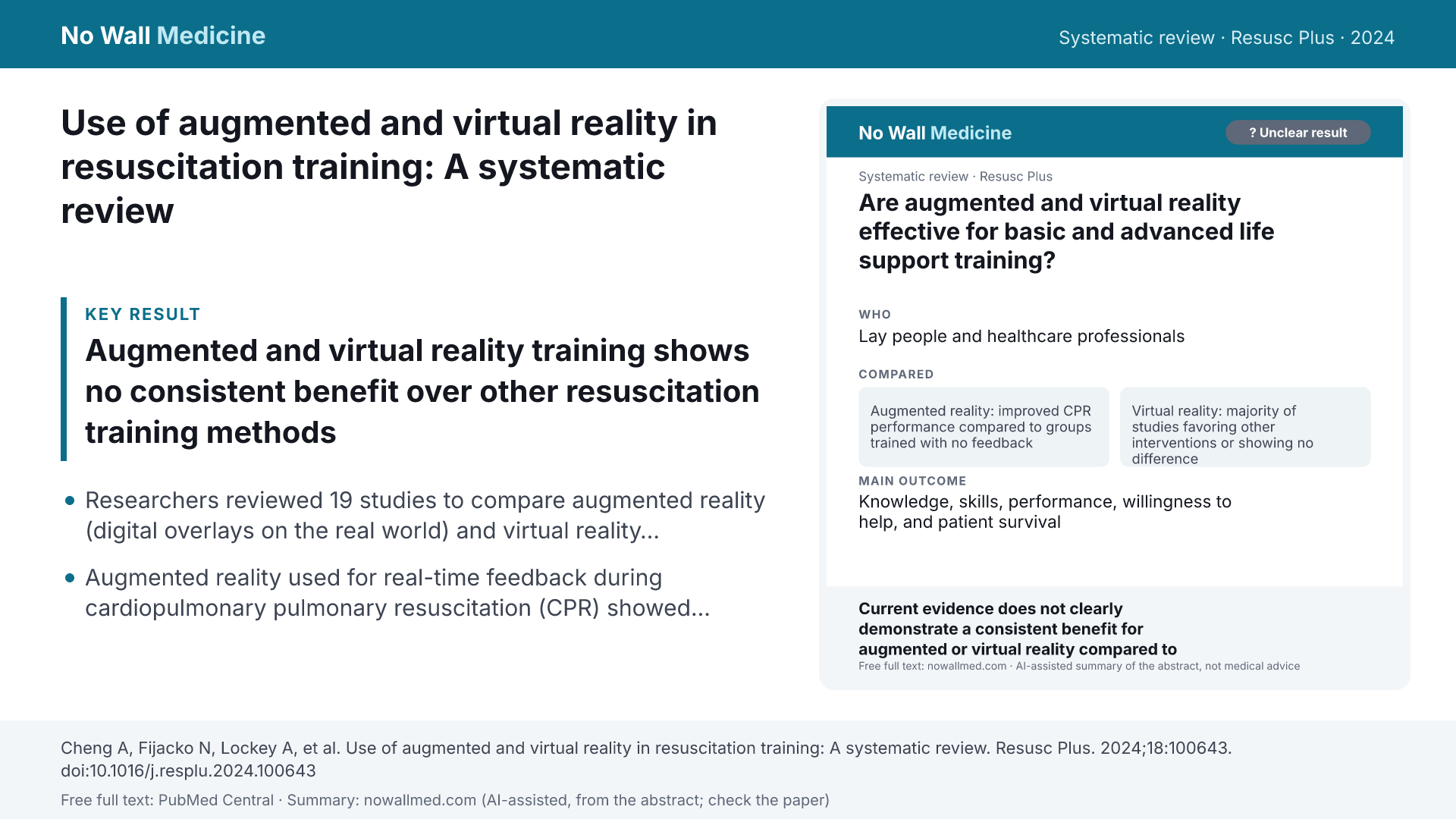
Augmented and virtual reality training shows no consistent benefit over other resuscitation training methods
Use of augmented and virtual reality in resuscitation training: A systematic review
Systematic reviewUnclear result
Are augmented and virtual reality effective for basic and advanced life support training?
Who
19
Lay people and healthcare professionals
Compared
Augmented reality: improved CPR performance compared to groups trained with no feedback
Virtual reality: majority of studies favoring other interventions or showing no difference
Main outcome
Knowledge, skills, performance, willingness to help, and patient survival
Bottom line: Current evidence does not clearly demonstrate a consistent benefit for augmented or virtual reality compared to other training methods.
Resusc Plus · 2024-04-22Download image
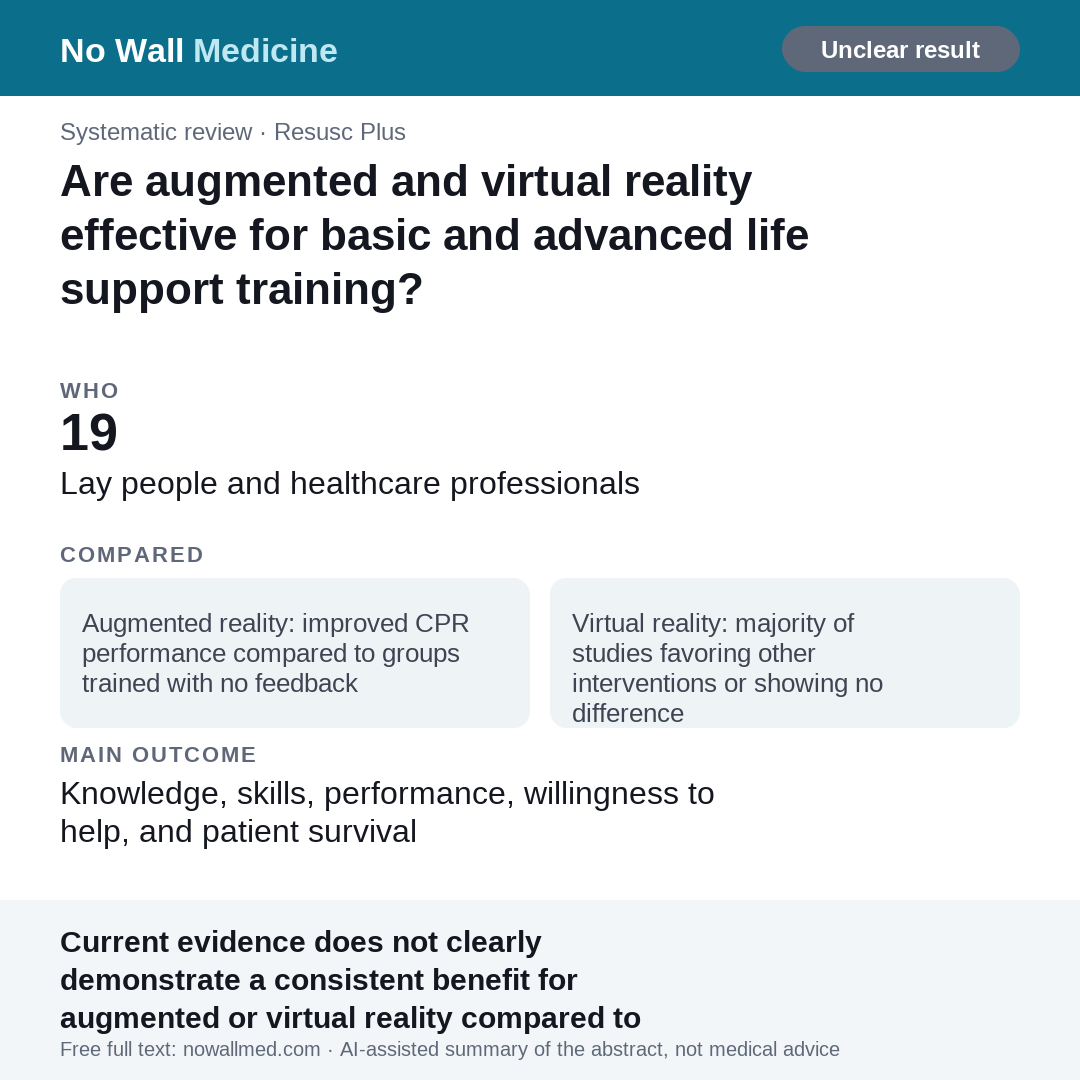
Clinical question: Are augmented and virtual reality effective for basic and advanced life support training?
Why it matters: It is unknown if augmented reality or virtual reality provides a consistent benefit for training lay people and healthcare professionals in resuscitation compared to existing methods.
Key points
- Researchers reviewed 19 studies to compare augmented reality (digital overlays on the real world) and virtual reality (fully digital environments) against other resuscitation training methods.
- Augmented reality used for real-time feedback during cardiopulmonary pulmonary resuscitation (CPR) showed improved performance compared to no feedback, but no difference compared to other feedback sources.
- Most studies evaluating virtual reality for cardiopulmonary pulmonary resuscitation (CPR) skills favored other interventions or showed no difference between groups.
Headline and key points written with AI from the paper’s abstract, with every number checked against it. Read the paper before relying on them.
Was this summary helpful?
Cite this article
Cheng A, Fijacko N, Lockey A, Greif R, Abelairas-Gomez C, Gosak L. Use of augmented and virtual reality in resuscitation training: A systematic review. Resusc Plus. 2024. doi:10.1016/j.resplu.2024.100643
Spotted a mistake? Suggest a correction