Machine learning research in osteoarthritis focuses on knee imaging and lacks external validation
Use of machine learning in osteoarthritis research: a systematic literature review
Systematic literature reviewUnclear result
What is the current use of machine learning in osteoarthritis clinical care research?
Who
Patients with osteoarthritis · MEDLINE PubMed
Compared
85%Knee osteoarthritis
15%Hip osteoarthritis
Main outcome
Use of machine learning in osteoarthritis research
Bottom line: Machine learning research in osteoarthritis focuses on knee osteoarthritis and imaging analyses, but external validation is rare.
RMD Open · 2022-03-17Download image
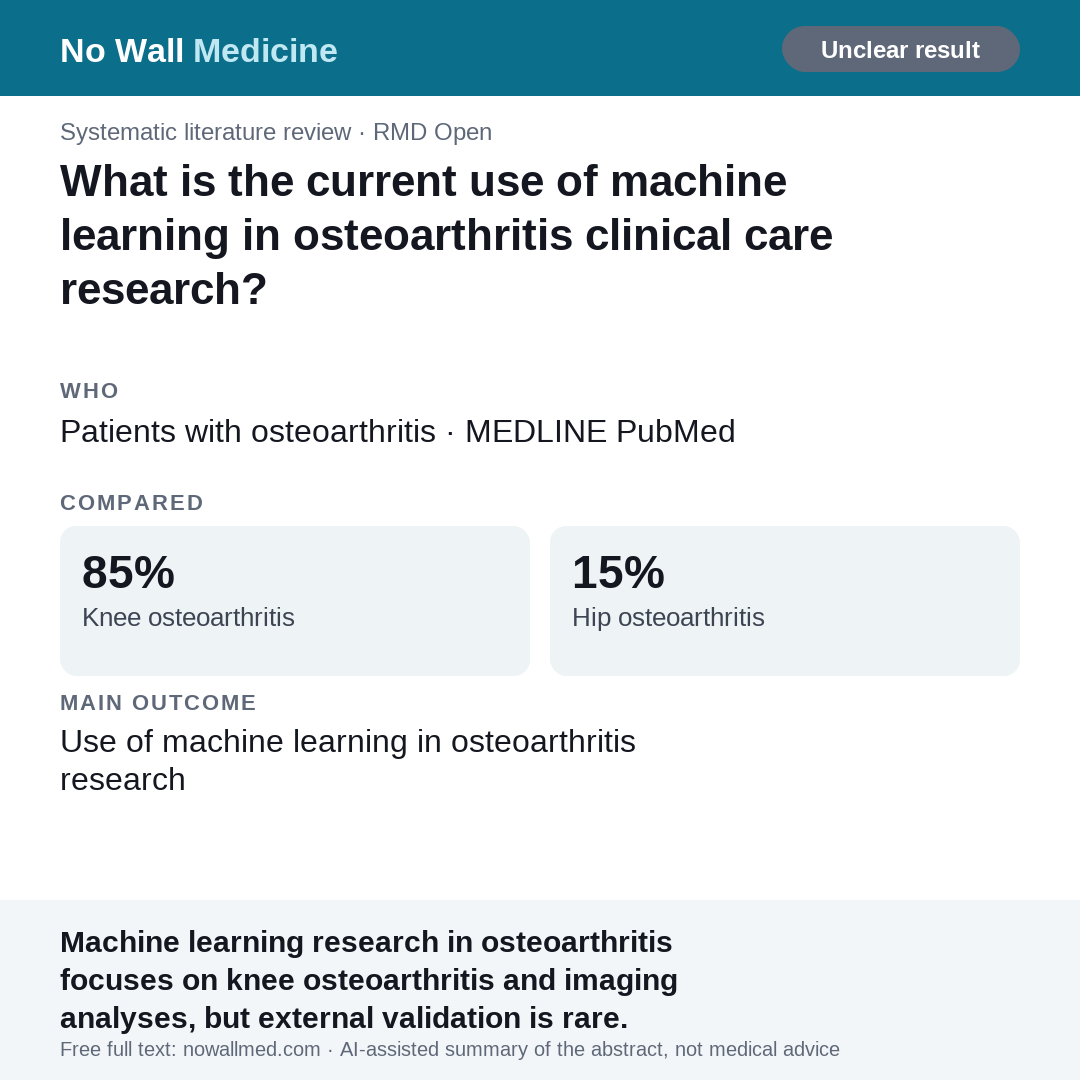
Clinical question: What is the current use of machine learning in osteoarthritis clinical care research?
Why it matters: The current landscape of machine learning applications for diagnosing, predicting, and monitoring osteoarthritis severity and progression is not fully characterized.
Key points
- Researchers reviewed 46 studies involving patient numbers ranging from 18 to 5749 to examine machine learning use in osteoarthritis care.
- Most research focused on knee osteoarthritis at 85%, used imaging analysis in 74% of cases, and utilized deep learning in 35% of studies.
- External validation, which tests a model on a completely new set of data to ensure accuracy, was provided in only 7% of the articles.
Headline and key points written with AI from the paper’s abstract, with every number checked against it. Read the paper before relying on them.
Was this summary helpful?
Abstract
Objective
The aim of this systematic literature review was to provide a comprehensive and exhaustive overview of the use of machine learning (ML) in the clinical care of osteoarthritis (OA). Methods
A systematic literature review was performed in July 2021 using MEDLINE PubMed with key words and MeSH terms. For each selected article, the number of patients, ML algorithms used, type of data analysed, validation methods and data availability were collected. Results
From 1148 screened articles, 46 were selected and analysed; most were published after 2017. Twelve articles were related to diagnosis, 7 to prediction, 4 to phenotyping, 12 to severity and 11 to progression. The number of patients included ranged from 18 to 5749. Overall, 35% of the articles described the use of deep learning And 74% imaging analyses. A total of 85% of the articles involved knee OA and 15% hip OA. No study investigated hand OA. Most of the studies involved the same cohort, with data from the OA initiative described in 46% of the articles and the MOST and Cohort Hip and Cohort Knee cohorts in 11% and 7%. Data and source codes were described as publicly available respectively in 54% and 22% of the articles. External validation was provided in only 7% of the articles. Conclusion
This review proposes an up-to-date overview of ML approaches used in clinical OA research and will help to enhance its application in this field.
Abstract reproduced under the article’s CC BY licence.
Subject terms
Cite this article
Binvignat M, Pedoia V, Butte AJ, Louati K, Klatzmann D, Berenbaum F. Use of machine learning in osteoarthritis research: a systematic literature review. RMD Open. 2022. doi:10.1136/rmdopen-2021-001998
Spotted a mistake? Suggest a correction
Top studies every Monday
The week’s key trials and guidelines in your specialties, plus any topics you follow. By email, free.
Get the weekly digest