Smartphone application for insulin titration resulted in greater HbA1c reduction than written charts
Use of smartphone application versus written titration charts for basal insulin titration in adults with type 2 diabetes and suboptimal glycaemic control (My Dose Coach): multicentre, open-label, parallel, randomised controlled trial
Multicentre, open-label, parallel, randomised controlled trialBenefit found
Does a smartphone application improve glycaemic control compared to written titration charts?
Who
251
Adults with type 2 diabetes and suboptimal glycaemic control · 36 diabetes practices in Germany
Compared
Smartphone application
Written titration chart
Main outcome
Baseline-adjusted change in HbA1c at 12 weeks
Result: -0.31% (95% CI: 0.01%-0.69%; p = 0.0388)
Bottom line: A smartphone application for basal insulin titration resulted in a greater reduction in HbA1c compared to written titration charts.
Funded by: Sanofi-Aventis Deutschland GmbH
Lancet Reg Health Eur · 2023-07-24Download image
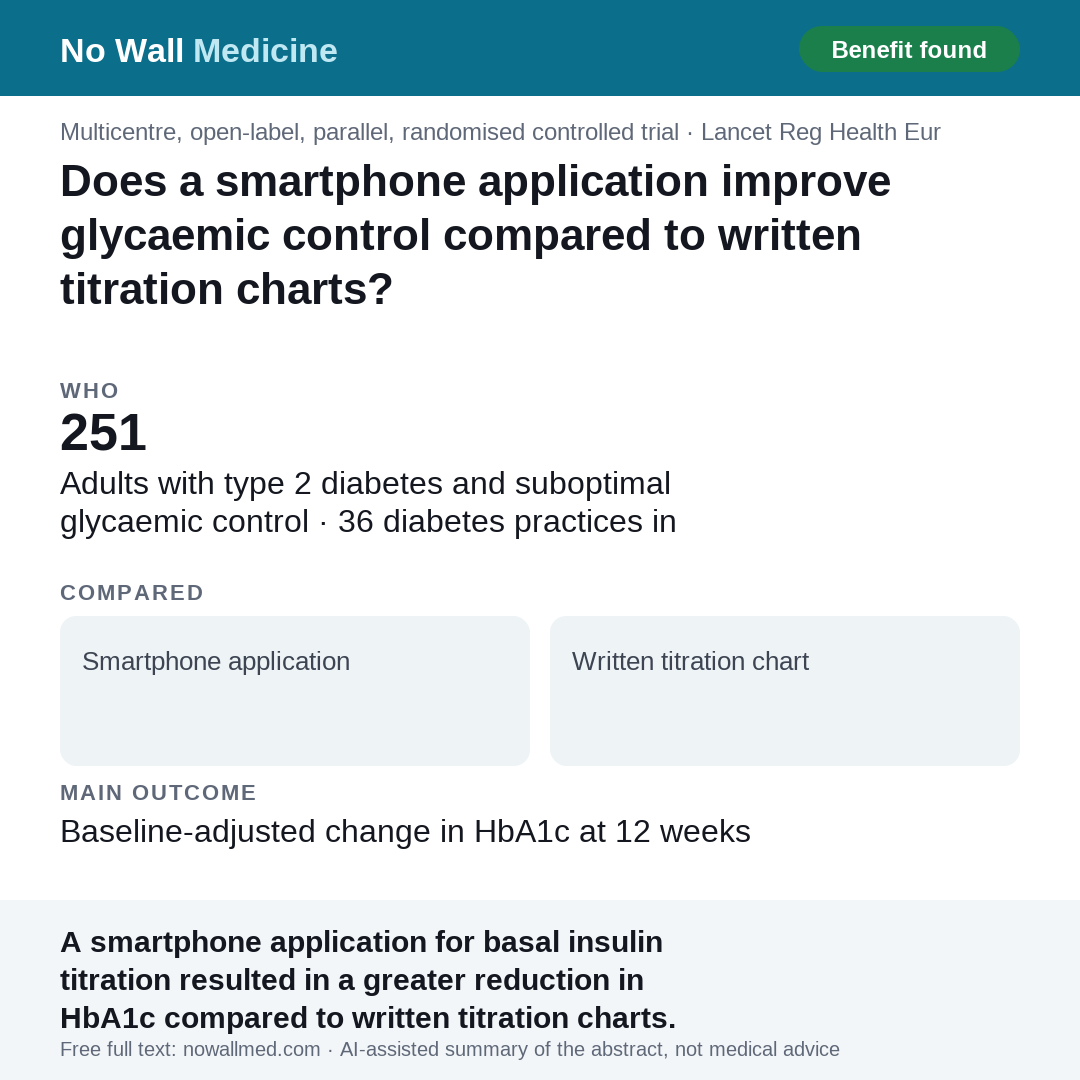
Clinical question: Does a smartphone application improve glycaemic control compared to written titration charts?
Why it matters: It was unknown if using a smartphone application for adjusting basal insulin doses provides better blood sugar control than using traditional written titration charts.
Key points
- Researchers studied 251 adults with type 2 diabetes and suboptimal blood sugar control, comparing a smartphone application to written titration charts for adjusting basal insulin doses.
- The smartphone application group showed a model-based adjusted difference in HbA1c of -0.31% (95% CI: 0.01%-0.69%; p = 0.0388) compared to the control group.
- A total of 30 adverse events were reported, including 15 serious events, but none were considered related to the smartphone application.
Headline and key points written with AI from the paper’s abstract, with every number checked against it. Read the paper before relying on them.
Was this summary helpful?
Cite this article
Hermanns N, Ehrmann D, Finke-Groene K, Krichbaum M, Roos T, Haak T. Use of smartphone application versus written titration charts for basal insulin titration in adults with type 2 diabetes and suboptimal glycaemic control (My Dose Coach): multicentre, open-label, parallel, randomised controlled trial. Lancet Reg Health Eur. 2023. doi:10.1016/j.lanepe.2023.100702
Spotted a mistake? Suggest a correction
Top studies every Monday
The week’s key trials and guidelines in your specialties, plus any topics you follow. By email, free.
Get the weekly digest