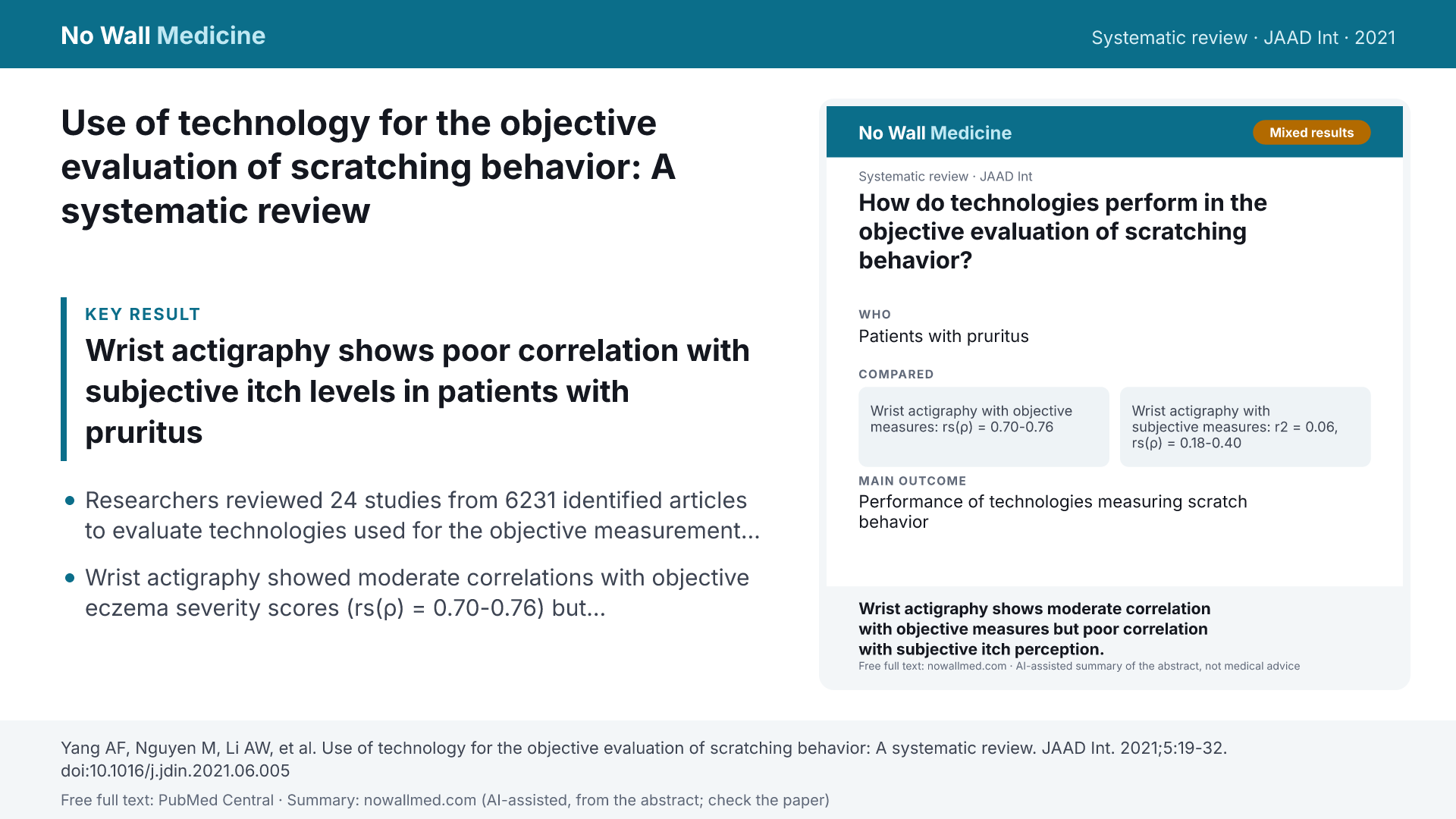
Wrist actigraphy shows poor correlation with subjective itch levels in patients with pruritus
Use of technology for the objective evaluation of scratching behavior: A systematic review
Systematic reviewMixed results
How do technologies perform in the objective evaluation of scratching behavior?
Who
Patients with pruritus
Compared
Wrist actigraphy with objective measures: rs(ρ) = 0.70-0.76
Wrist actigraphy with subjective measures: r2 = 0.06, rs(ρ) = 0.18-0.40
Main outcome
Performance of technologies measuring scratch behavior
Bottom line: Wrist actigraphy shows moderate correlation with objective measures but poor correlation with subjective itch perception.
Limitation: Large variability in performance and limited understanding of specificity for scratch.
JAAD Int · 2021-08-17 · Save PNG

Clinical question: How do technologies perform in the objective evaluation of scratching behavior?
Key points
- Researchers reviewed 24 studies from 6231 identified articles to evaluate technologies used for the objective measurement of scratching behavior.
- Wrist actigraphy showed moderate correlations with objective eczema severity scores (rs(ρ) = 0.70-0.76) but poor correlations with subjective itch measured by a visual analog scale (r2 = 0.06, rs(ρ) = 0.18-0.40).
- The performance of wrist actigraphy was found to be poorer in patients with pruritus, which is the medical term for itching.
Limitation the authors note: The authors note a limited understanding of the specificity of actigraphy for scratch and a need for larger studies to validate data analysis algorithms.
Headline and key points written with AI from the paper’s abstract, with every number checked against it. Read the paper before relying on them.
Was this summary helpful?
Headline, design, result, key points, caveat and citation as plain text.
Cite this article
Yang AF, Nguyen M, Li AW, et al. Use of technology for the objective evaluation of scratching behavior: A systematic review. JAAD Int. 2021. doi:10.1016/j.jdin.2021.06.005
Spotted a mistake? Suggest a correction