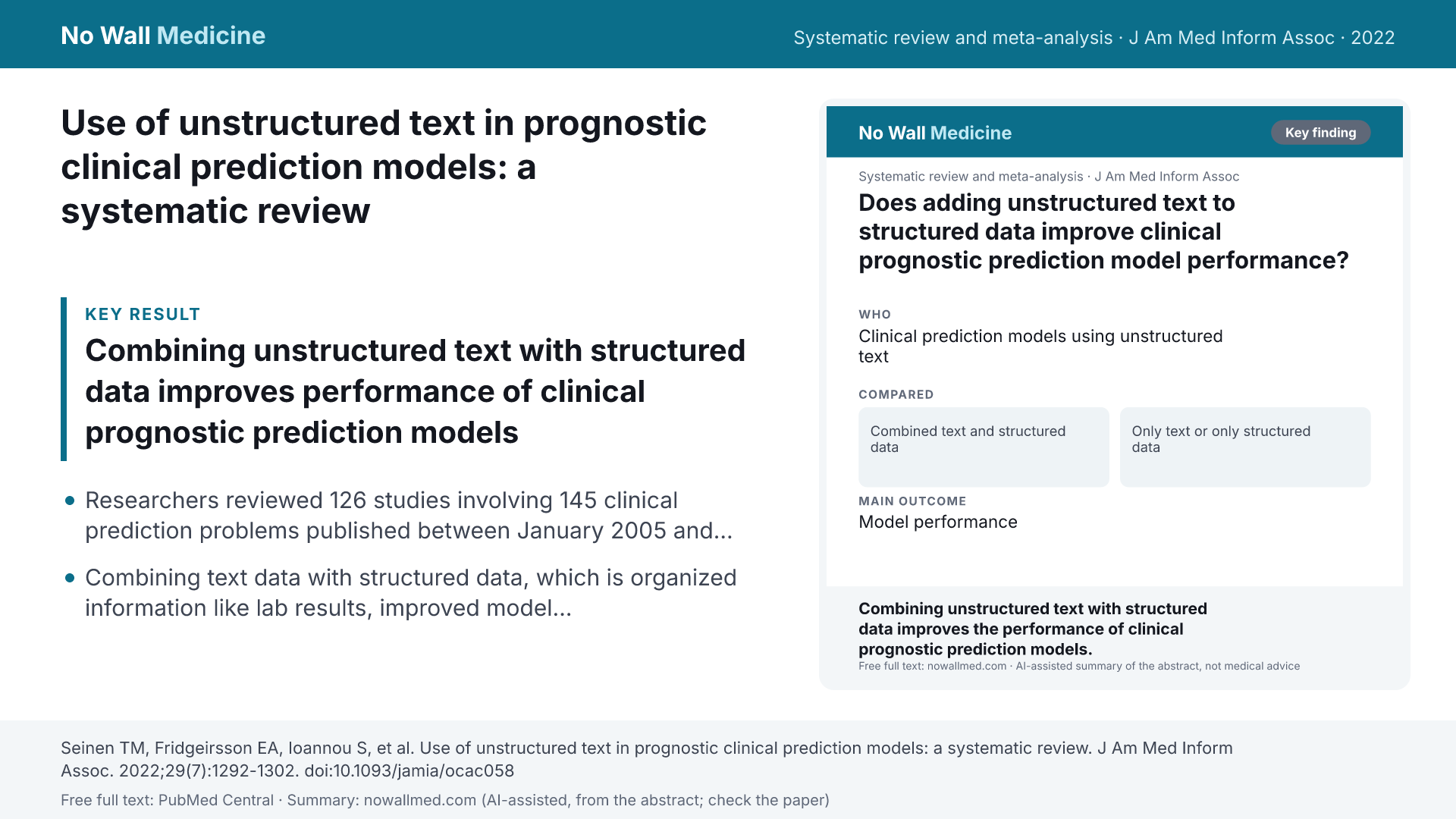
Use of unstructured text in prognostic clinical prediction models: a systematic review
Key result: Combining unstructured text with structured data improves performance of clinical prognostic prediction models
Systematic review and meta-analysisKey finding
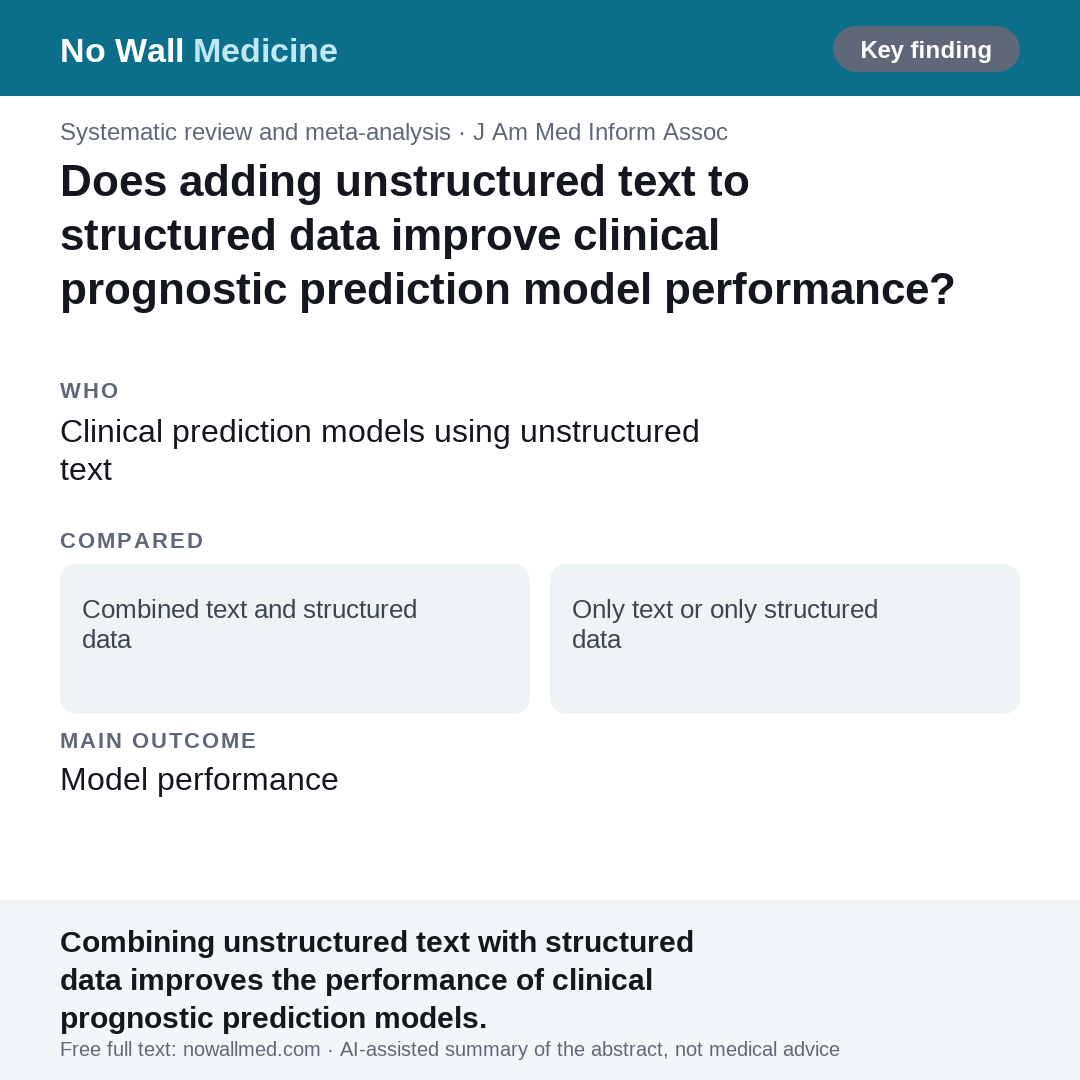
Does adding unstructured text to structured data improve clinical prognostic prediction model performance?
Who
Clinical prediction models using unstructured text
Compared
Combined text and structured data
Only text or only structured data
Main outcome
Model performance
Bottom line: Combining unstructured text with structured data improves the performance of clinical prognostic prediction models.
Limitation: External validation, public availability, and model explainability were limited.
J Am Med Inform Assoc · 2022-04-28Download image
Key points
- Researchers reviewed 126 studies involving 145 clinical prediction problems published between January 2005 and March 2021.
- Combining text data with structured data, which is organized information like lab results, improved model performance compared to using only text or only structured data.
- The reviewed studies used various machine learning methods, but external validation and model explainability were limited.
Limitation the authors note: External validation, public availability, and attention for the explainability of the developed models were limited.
Discussion prompts
- Would these patients look like yours? Who was left out?
- Is the main outcome one that matters to patients?
- Is the difference large enough to change what you do?
Cite: Seinen TM, Fridgeirsson EA, Ioannou S, et al. Use of unstructured text in prognostic clinical prediction models: a systematic review. J Am Med Inform Assoc. 2022. doi:10.1093/jamia/ocac058
Free full text: PubMed Central · Summary and visual abstract: nowallmed.com/a/use-of-unstructured-text-in-prognostic-clinical-prediction-models-a-bclvn2/ (AI-assisted from the abstract; check the paper before relying on it).