Machine learning models show varying accuracy in predicting hospital death for patients with acute kidney injury
Using artificial intelligence to predict mortality in AKI patients: a systematic review/meta-analysis
Systematic review and meta-analysisMixed results
How effective is artificial intelligence at predicting in-hospital mortality in acute kidney injury patients?
Who
37032
Patients with acute kidney injury
Compared
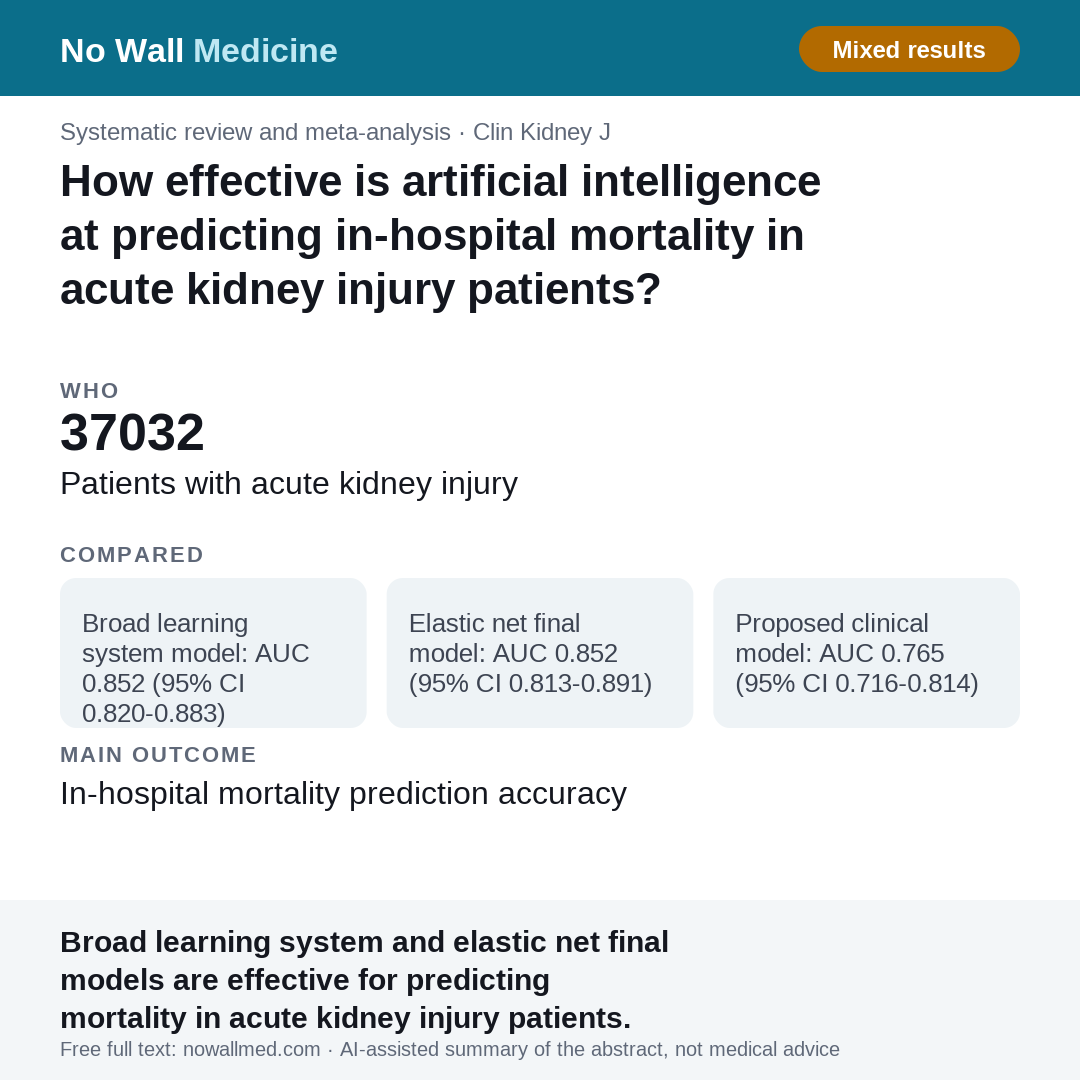
Broad learning system model: AUC 0.852 (95% CI 0.820-0.883)
Elastic net final model: AUC 0.852 (95% CI 0.813-0.891)
Proposed clinical model: AUC 0.765 (95% CI 0.716-0.814)
Main outcome
In-hospital mortality prediction accuracy
Bottom line: Broad learning system and elastic net final models are effective for predicting mortality in acute kidney injury patients.
Clin Kidney J · 2024-05-17Download image
Clinical question: How effective is artificial intelligence at predicting in-hospital mortality in acute kidney injury patients?
Why it matters: It is unknown how different machine learning algorithms compare in their ability to predict in-hospital mortality for patients with acute kidney injury.
Key points
- Researchers analyzed eight studies involving 37,032 patients with acute kidney injury, an abrupt loss of kidney function, with a mean age of 65.3 years.
- The broad learning system and elastic net final models had the highest pooled area under the curve of 0.852, while the proposed clinical model was lowest at 0.765.
- The proposed clinical model had the highest negative predictive value, which may support its use as a tool to rule out mortality.
Headline and key points written with AI from the paper’s abstract, with every number checked against it. Read the paper before relying on them.
Cite this article
Raina R, Shah R, Nemer P, Fehlmen J, Nemer L, Murra A. Using artificial intelligence to predict mortality in AKI patients: a systematic review/meta-analysis. Clin Kidney J. 2024. doi:10.1093/ckj/sfae150
Spotted a mistake? Suggest a correction
Top studies every Monday
The week’s key trials and guidelines in your specialties, plus any topics you follow. By email, free.
Get the weekly digest