Digital phenotyping shows potential for distinguishing bipolar disorder from unipolar depression using smartphone and wearable data
Using Digital Phenotyping to Discriminate Unipolar Depression and Bipolar Disorder: Systematic Review
Systematic reviewBenefit found
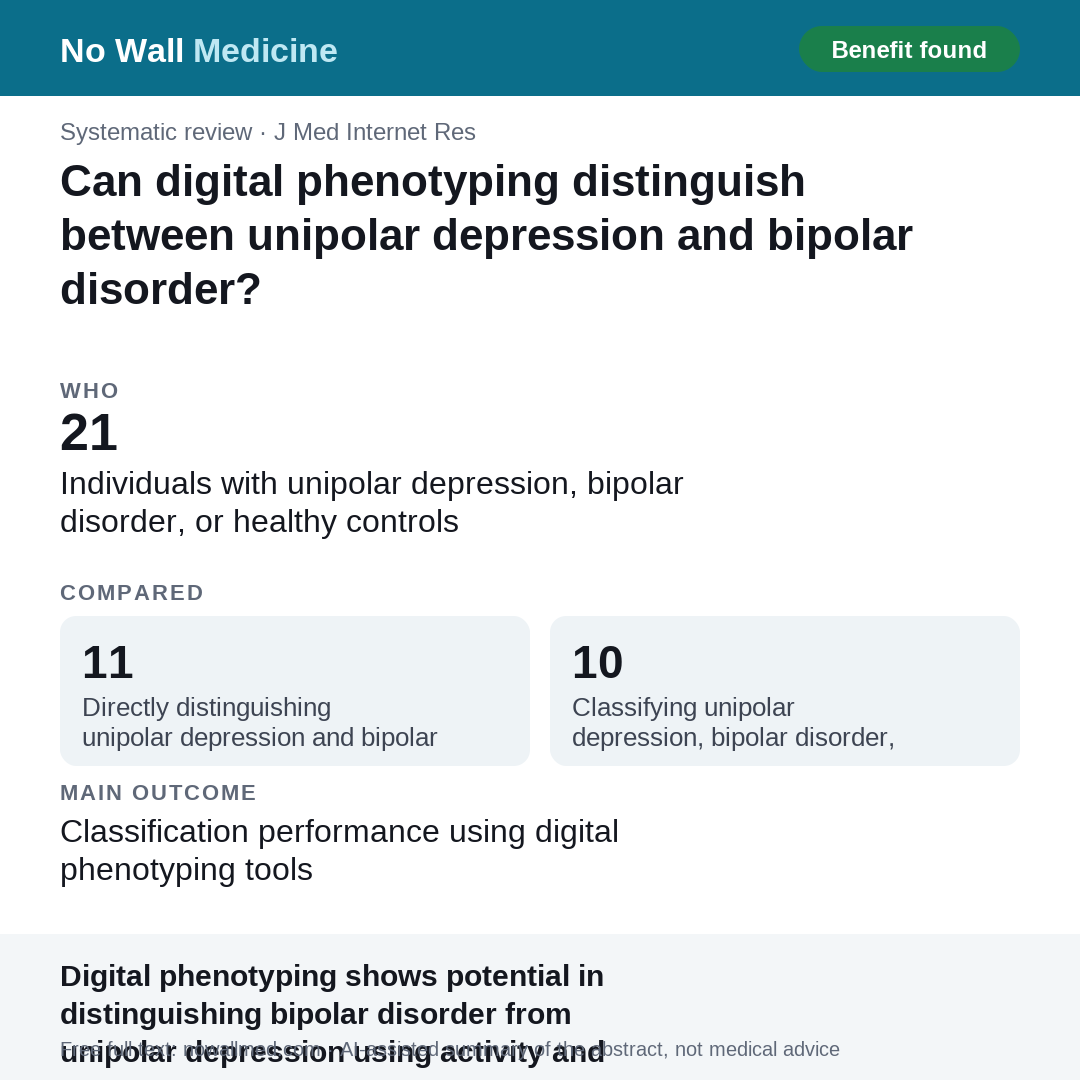
Can digital phenotyping distinguish between unipolar depression and bipolar disorder?
Who
21
Individuals with unipolar depression, bipolar disorder, or healthy controls
Compared
11Directly distinguishing unipolar depression and bipolar disorder (52%)
10Classifying unipolar depression, bipolar disorder, and healthy control (48%)
Main outcome
Classification performance using digital phenotyping tools
Bottom line: Digital phenotyping shows potential in distinguishing bipolar disorder from unipolar depression using activity and speech data.
J Med Internet Res · 2025-05-23Download image
Clinical question: Can digital phenotyping distinguish between unipolar depression and bipolar disorder?
Why it matters: Differentiating bipolar disorder from unipolar depression is essential because the two conditions differ in how they progress and how they are treated.
Key points
- Researchers reviewed 21 studies to evaluate how digital phenotyping, which uses data from digital devices, distinguishes between unipolar depression, bipolar disorder, and healthy controls.
- Patients with bipolar disorder were associated with lower activity levels and different daily activity patterns compared to those with unipolar depression.
- Using speech data or combining multiple types of digital data achieved better performance when classifying the three different groups.
Headline and key points written with AI from the paper’s abstract, with every number checked against it. Read the paper before relying on them.
Topics
Cite this article
Zhong R, Wu X, Chen J, Fang Y. Using Digital Phenotyping to Discriminate Unipolar Depression and Bipolar Disorder: Systematic Review. J Med Internet Res. 2025. doi:10.2196/72229
Spotted a mistake? Suggest a correction
Top studies every Monday
The week’s key trials and guidelines in your specialties, plus any topics you follow. By email, free.
Get the weekly digest