Game performance metrics show varying reliability and validity for assessing upper limb function in children
Using game performance measure to assess upper limb motor function in children with neuromotor disorders: a systematic review
Systematic reviewUnclear result
Can game metrics assess upper limb function
Who
443
Children with neuromotor disorders
Compared
Children with cerebral palsy
Control participants
Main outcome
Upper limb function
Bottom line: Game metrics lack validation for assessing upper limb function
J Neuroeng Rehabil · 2025-08-12Download image
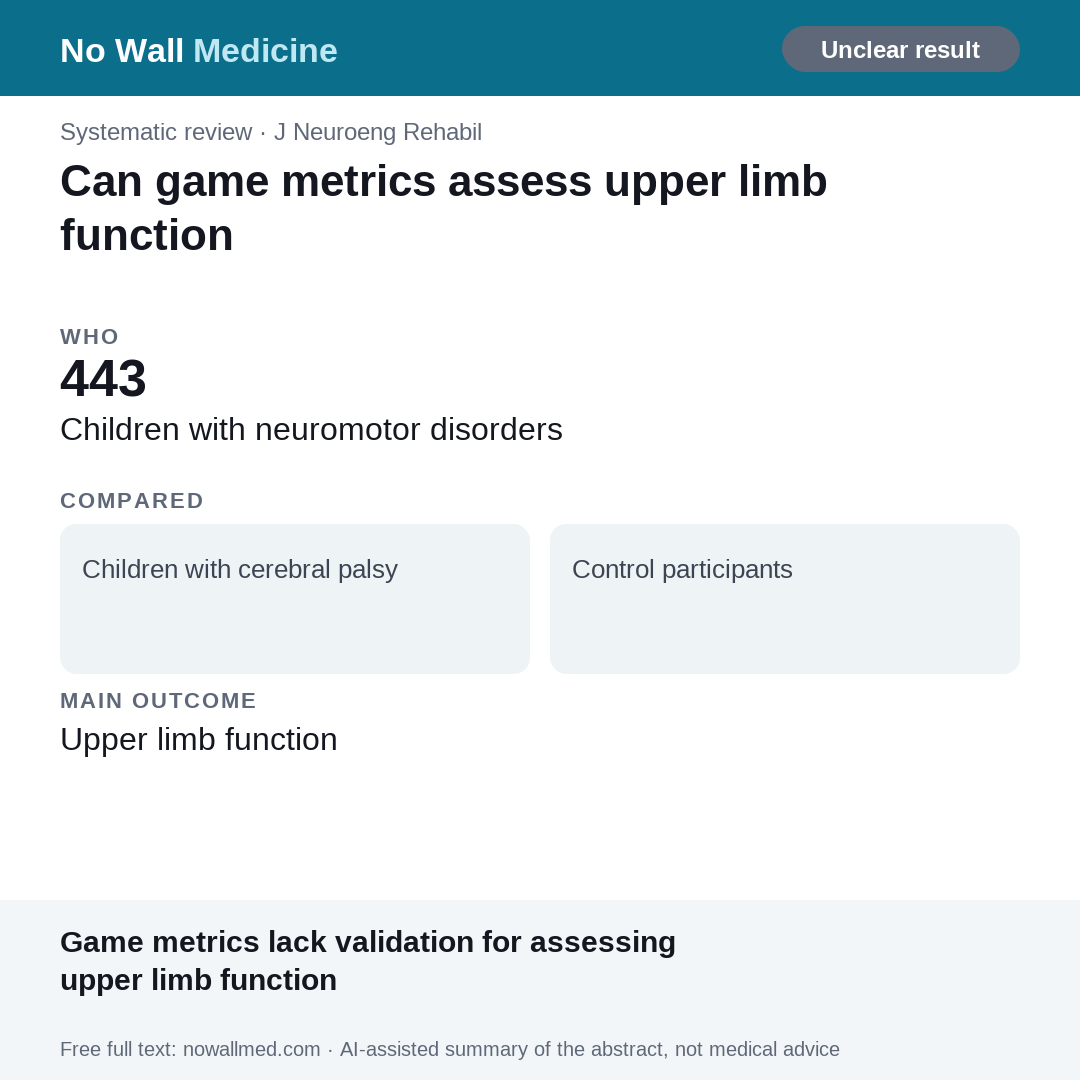
Why it matters: It is unclear if metrics from video games can serve as valid and reliable measures to evaluate upper limb impairments in children with neuromotor disorders.
Key points
- Researchers reviewed 26 studies involving 443 children, mostly with cerebral palsy, to evaluate how video games measure upper limb movement.
- Out of 112 game-based outcomes, 13 of 20 assessed for discriminant validity—the ability to distinguish between groups—showed the ability to differentiate groups.
- While 6 studies reported moderate to high correlations with clinical assessments, only 29 of 52 outcomes showed significant improvements after intervention.
Headline and key points written with AI from the paper’s abstract, with every number checked against it. Read the paper before relying on them.
Topics
Cite this article
Rose-Dulcina K, Armand S, Cacioppo M. Using game performance measure to assess upper limb motor function in children with neuromotor disorders: a systematic review. J Neuroeng Rehabil. 2025. doi:10.1186/s12984-025-01699-5
Spotted a mistake? Suggest a correction
Top studies every Monday
The week’s key trials and guidelines in your specialties, by email. Free.
Get the weekly digest