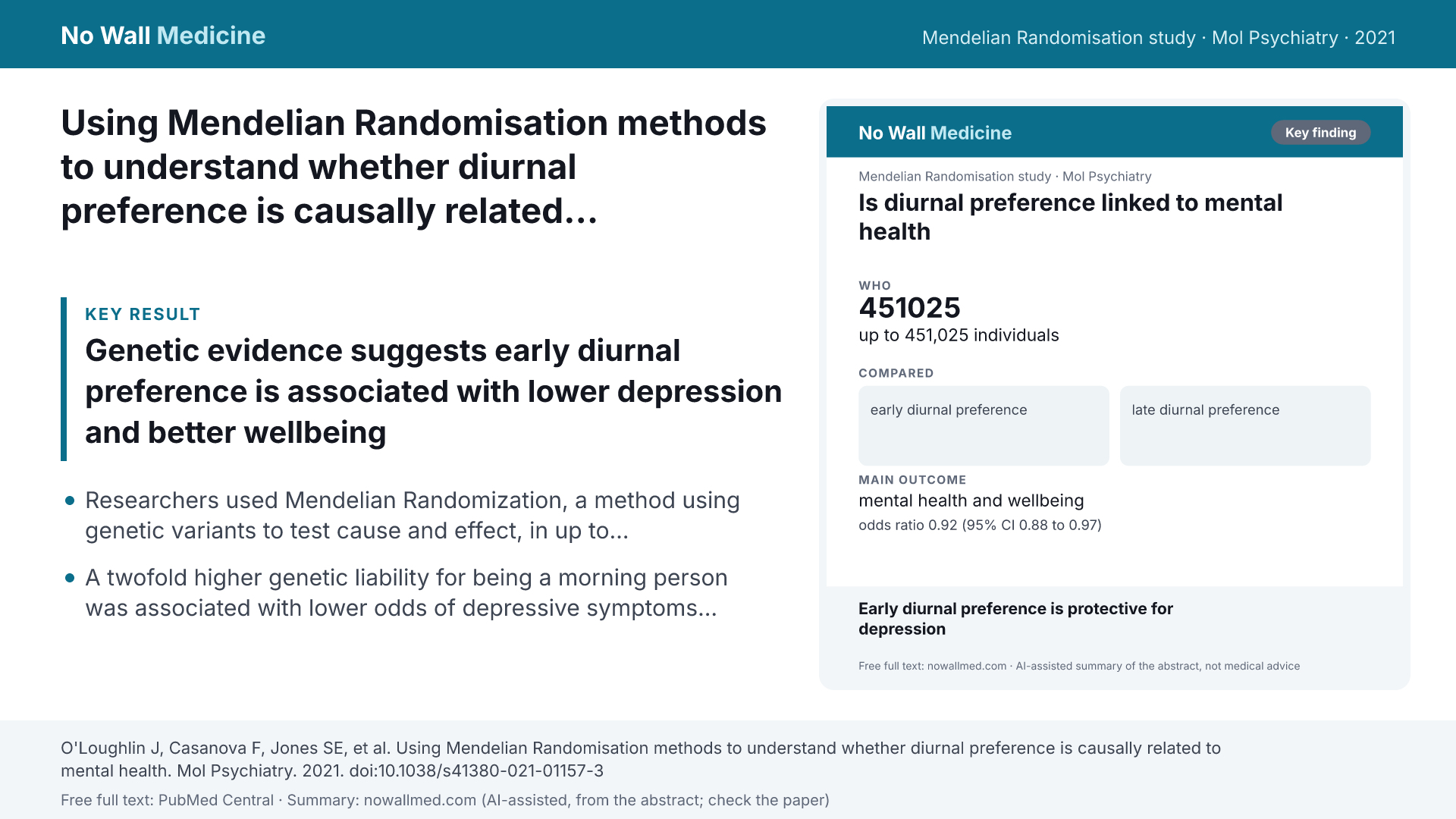
Genetic evidence suggests early diurnal preference is associated with lower depression and better wellbeing
Using Mendelian Randomisation methods to understand whether diurnal preference is causally related to mental health
Mendelian Randomisation studyKey finding
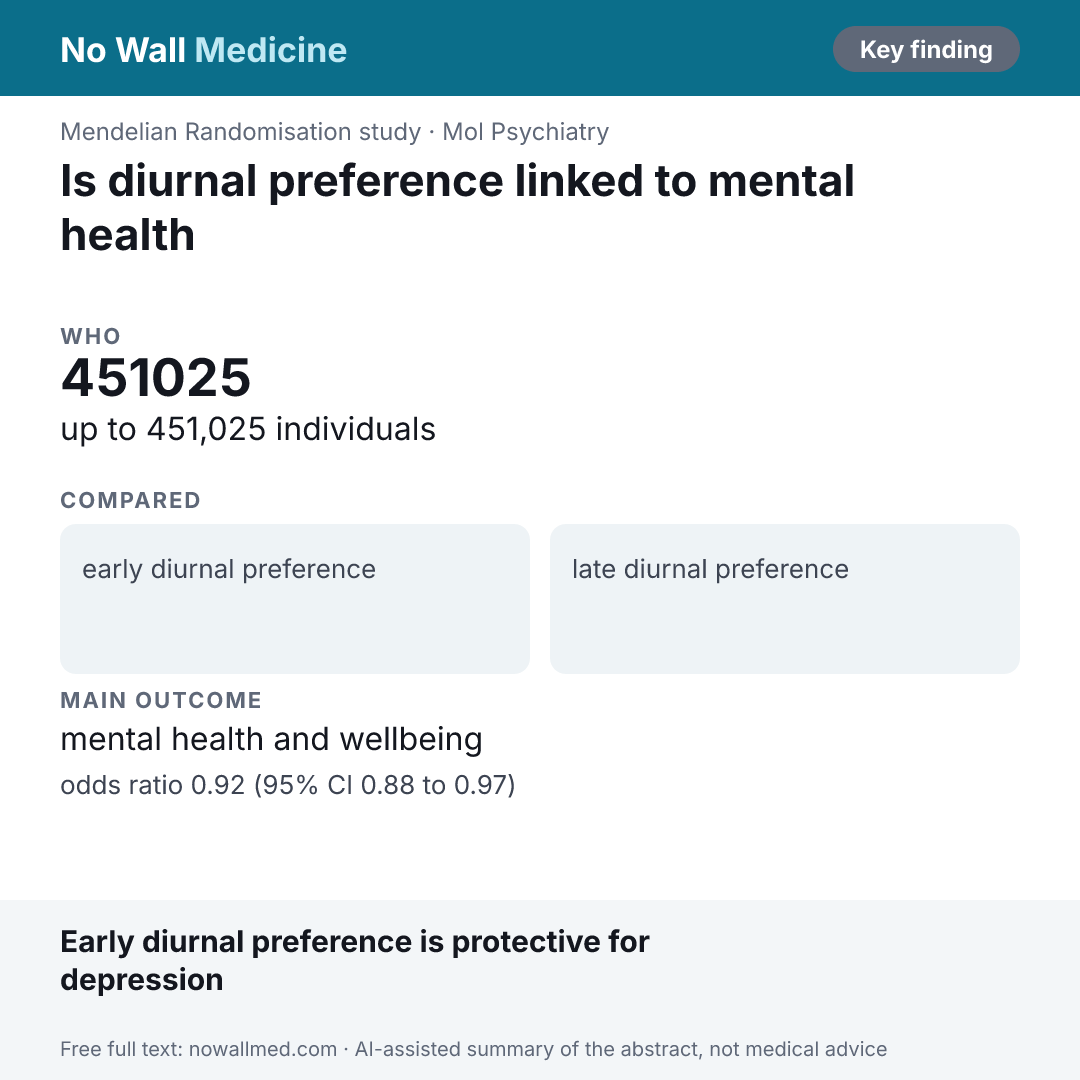
Is diurnal preference linked to mental health
Who
451025
up to 451,025 individuals
Compared
early diurnal preference
late diurnal preference
Main outcome
mental health and wellbeing
Result: odds ratio 0.92 (95% CI 0.88 to 0.97)
Bottom line: Early diurnal preference is protective for depression
Limitation: further work is needed
Mol Psychiatry · 2021-06-08 · Save PNG
Why it matters: It is currently limited whether diurnal preference, or the tendency to be a morning or evening person, plays a causal role in mental health outcomes.
Key points
- Researchers used Mendelian Randomization, a method using genetic variants to test cause and effect, in up to 451,025 individuals.
- A twofold higher genetic liability for being a morning person was associated with lower odds of depressive symptoms (OR: 0.92, 95% CI: 0.88, 0.97).
- The study also found that early diurnal preference was associated with improved wellbeing.
Headline and key points written with AI from the paper’s abstract, with every number checked against it. Read the paper before relying on them.
Was this summary helpful?
Subject terms
Headline, design, result, key points, caveat and citation as plain text.
Cite this article
O'Loughlin J, Casanova F, Jones SE, et al. Using Mendelian Randomisation methods to understand whether diurnal preference is causally related to mental health. Mol Psychiatry. 2021. doi:10.1038/s41380-021-01157-3
Spotted a mistake? Suggest a correction