Using Mendelian randomization analysis to better understand the relationship between mental health and substance use: a systematic review
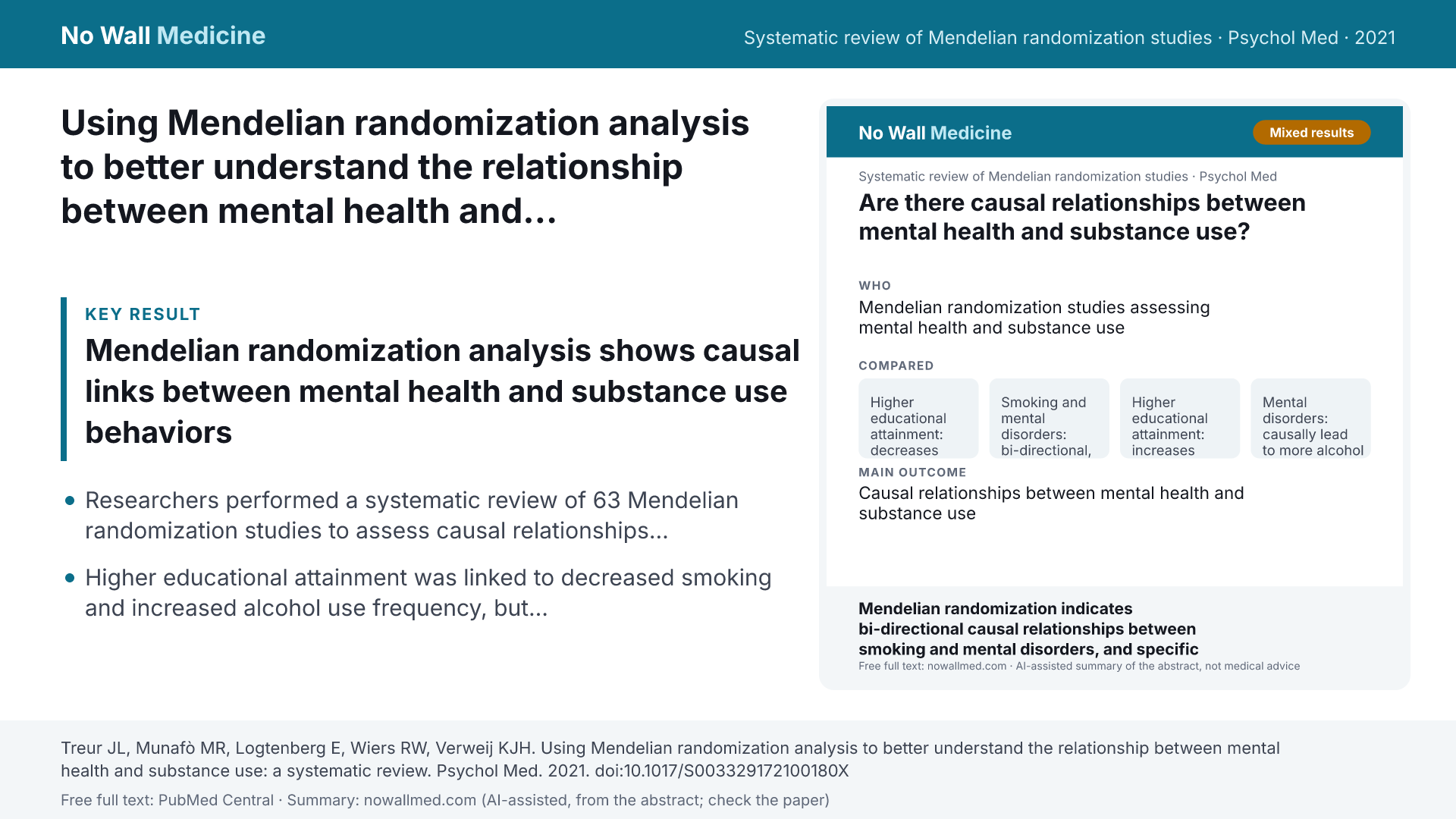
Key result: Mendelian randomization analysis shows causal links between mental health and substance use behaviors
Systematic review of Mendelian randomization studiesMixed results
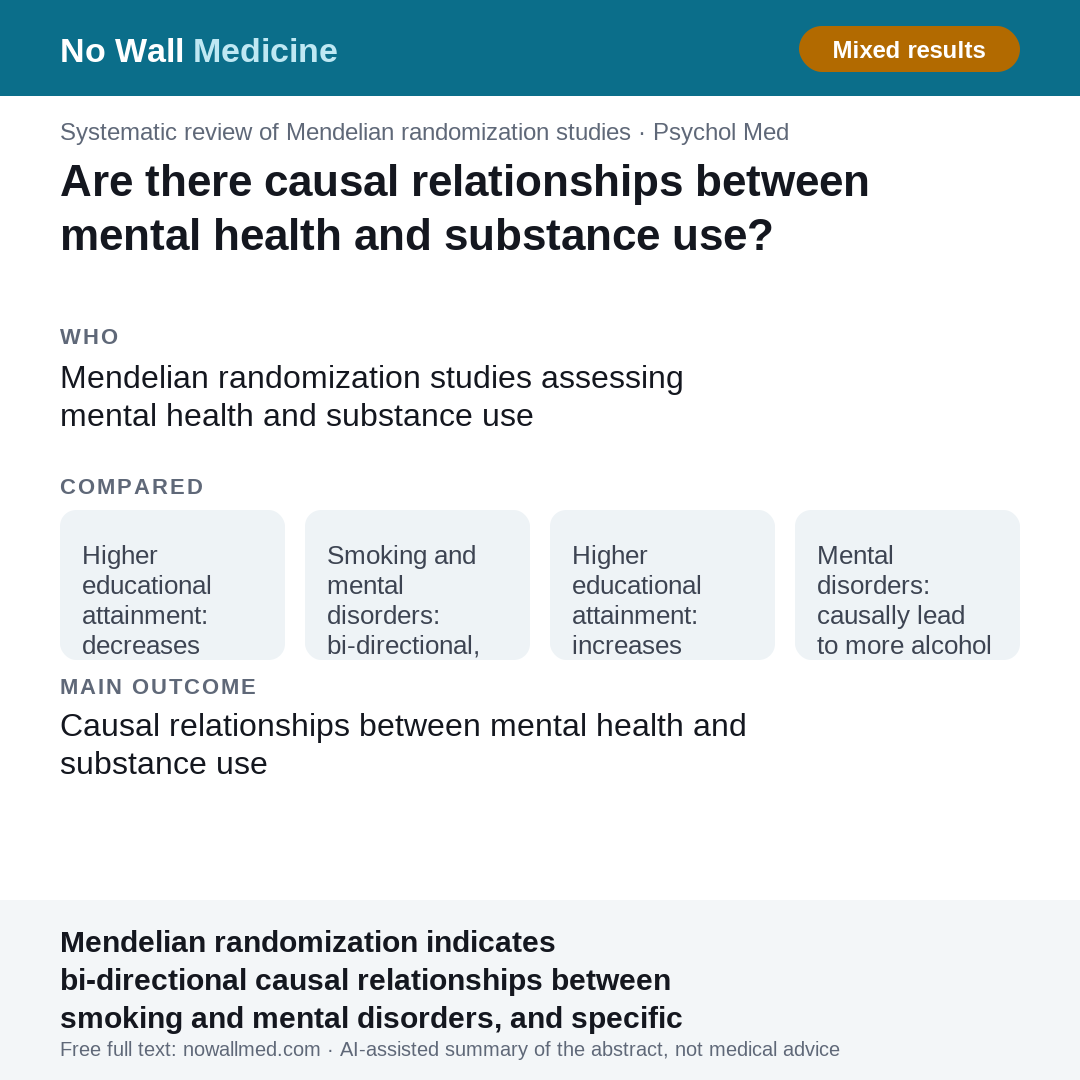
Are there causal relationships between mental health and substance use?
Who
Mendelian randomization studies assessing mental health and substance use
Compared
Higher educational attainment: decreases smoking
Smoking and mental disorders: bi-directional, increasing relationship
Higher educational attainment: increases alcohol use frequency, but decreases binge-drinking and alcohol use problems
Mental disorders: causally lead to more alcohol drinking
Main outcome
Causal relationships between mental health and substance use
Bottom line: Mendelian randomization indicates bi-directional causal relationships between smoking and mental disorders, and specific links for education and alcohol.
Psychol Med · 2021-05-25Download image
Key points
- Researchers performed a systematic review of 63 Mendelian randomization studies to assess causal relationships between mental health and substance use.
- Higher educational attainment was linked to decreased smoking and increased alcohol use frequency, but decreased binge-drinking and alcohol use problems.
- A bi-directional relationship was found between smoking and mental disorder symptoms, while mental disorders were linked to more alcohol drinking without evidence for the reverse.
Why it matters: It is unclear whether the associations between poor mental health and substance use are causal or merely linked.
Discussion prompts
- Would these patients look like yours? Who was left out?
- Is the main outcome one that matters to patients?
- Is the difference large enough to change what you do?
Cite: Treur JL, Munafò MR, Logtenberg E, Wiers RW, Verweij KJH. Using Mendelian randomization analysis to better understand the relationship between mental health and substance use: a systematic review. Psychol Med. 2021. doi:10.1017/S003329172100180X
Free full text: PubMed Central · Summary and visual abstract: nowallmed.com/a/using-mendelian-randomization-analysis-to-better-understand-the-bifr0q/ (AI-assisted from the abstract; check the paper before relying on it).