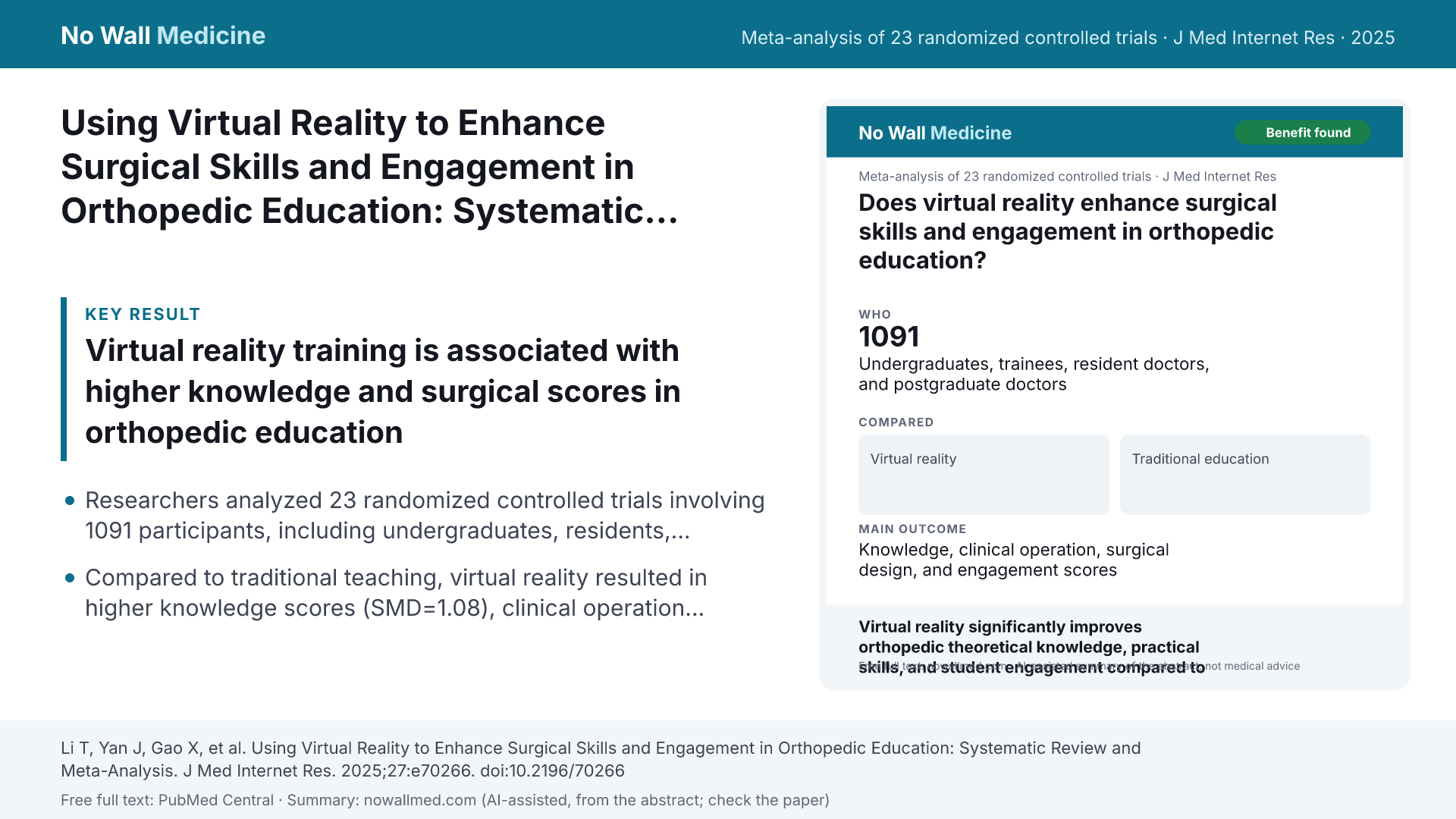
Virtual reality training is associated with higher knowledge and surgical scores in orthopedic education
Using Virtual Reality to Enhance Surgical Skills and Engagement in Orthopedic Education: Systematic Review and Meta-Analysis
Meta-analysis of 23 randomized controlled trialsBenefit found
Does virtual reality enhance surgical skills and engagement in orthopedic education?
Who
1091
Undergraduates, trainees, resident doctors, and postgraduate doctors
Compared
Virtual reality
Traditional education
Main outcome
Knowledge, clinical operation, surgical design, and engagement scores
Result: standardized mean difference 1.08 (95% CI 0.71-1.46) for knowledge scores
Bottom line: Virtual reality significantly improves orthopedic theoretical knowledge, practical skills, and student engagement compared to traditional teaching methods.
Limitation: Notable heterogeneity in terms of virtual reality platforms used.
J Med Internet Res · 2025-05-30 · Save PNG
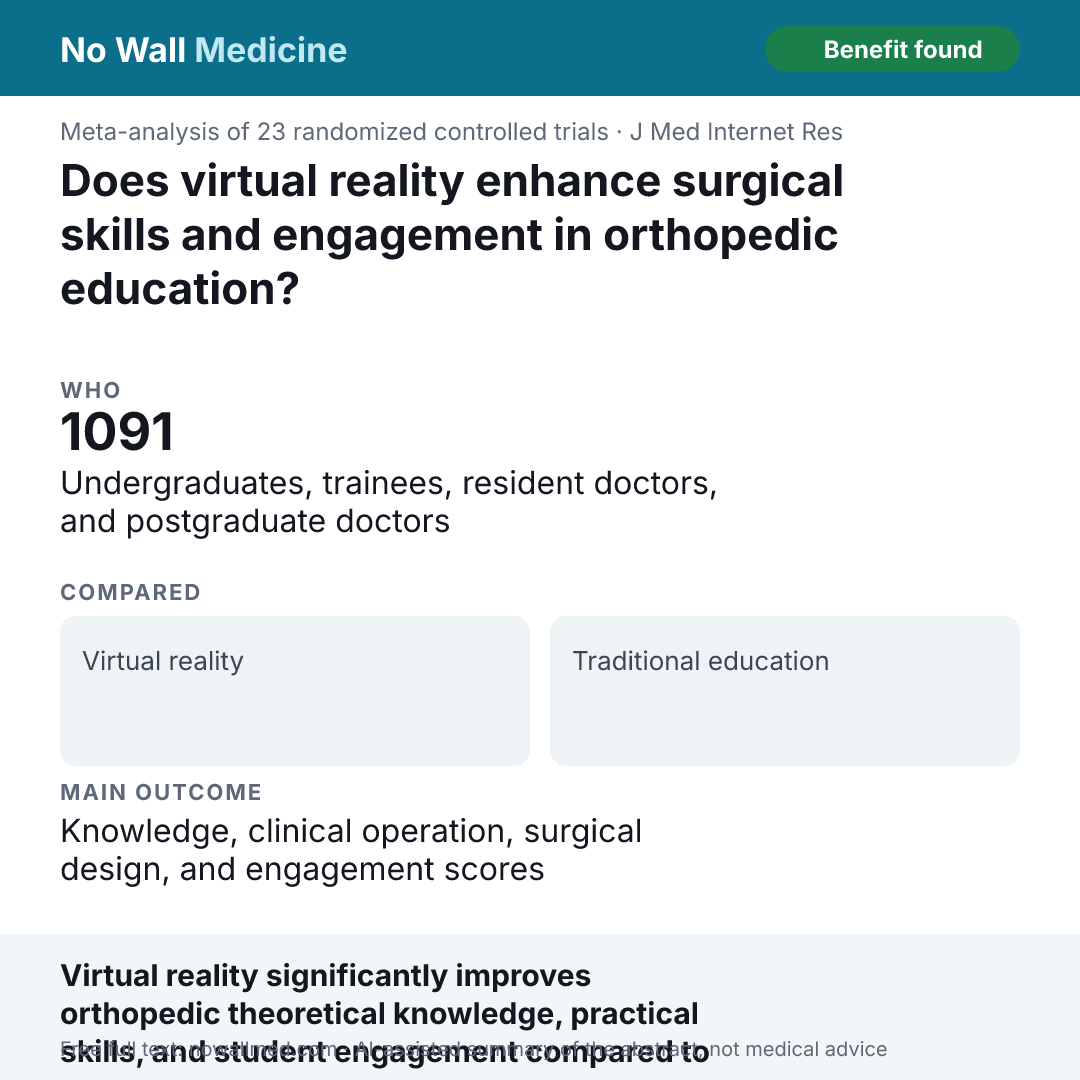
Clinical question: Does virtual reality enhance surgical skills and engagement in orthopedic education?
Why it matters: There is currently no systematic review exploring the advantages and disadvantages of virtual reality in orthopedic education.
Key points
- Researchers analyzed 23 randomized controlled trials involving 1091 participants, including undergraduates, residents, and postgraduate doctors.
- Compared to traditional teaching, virtual reality resulted in higher knowledge scores (SMD=1.08), clinical operation scores (SMD=1.44), and surgical design scores (SMD=1.75).
- Virtual reality was also associated with higher teaching interest (OR=4.17) and teaching satisfaction (OR=4.13) than traditional approaches.
Limitation the authors note: The quality of this meta-analysis was limited by notable heterogeneity in terms of virtual reality platforms used.
Headline and key points written with AI from the paper’s abstract, with every number checked against it. Read the paper before relying on them.
Was this summary helpful?
Subject terms
Headline, design, result, key points, caveat and citation as plain text.
Cite this article
Li T, Yan J, Gao X, et al. Using Virtual Reality to Enhance Surgical Skills and Engagement in Orthopedic Education: Systematic Review and Meta-Analysis. J Med Internet Res. 2025;27:e70266. doi:10.2196/70266
Spotted a mistake? Suggest a correction