Web-based guided self-help helped patients with eating disorders achieve symptom relief faster than waiting
Using web-based, guided self-help to bridge the waiting time for face-to-face out-patient treatment for bulimic-spectrum disorders: randomised controlled trial
Randomised controlled trialBenefit found
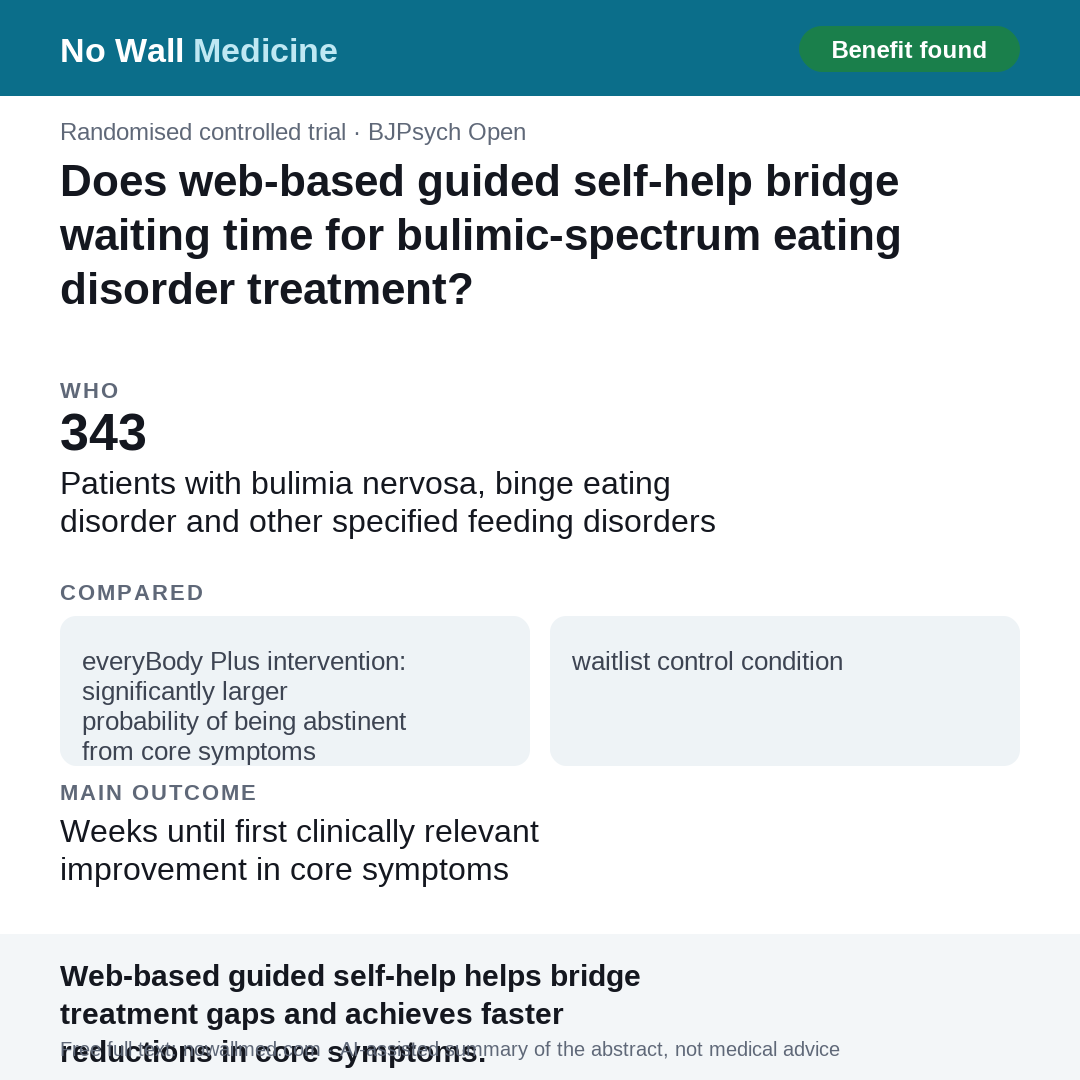
Does web-based guided self-help bridge waiting time for bulimic-spectrum eating disorder treatment?
Who
343
Patients with bulimia nervosa, binge eating disorder and other specified feeding disorders · Germany and the United Kingdom
Compared
everyBody Plus intervention: significantly larger probability of being abstinent from core symptoms
waitlist control condition
Main outcome
Weeks until first clinically relevant improvement in core symptoms
Result: hazard ratio 1.997, 95% CI 1.09-3.65
Bottom line: Web-based guided self-help helps bridge treatment gaps and achieves faster reductions in core symptoms.
BJPsych Open · 2024-02-26Download image
Clinical question: Does web-based guided self-help bridge waiting time for bulimic-spectrum eating disorder treatment?
Why it matters: Access to face-to-face outpatient treatment for bulimic-spectrum eating disorders is often delayed due to limited therapist availability and long waiting lists.
Key points
- Researchers conducted a randomized controlled trial with 343 patients with bulimia nervosa, binge eating disorder, or other specified feeding and eating disorders.
- The intervention group had a higher probability of being abstinent from core symptoms at 6- and 12-month follow-up compared to the waitlist control group (hazard ratio: 1.997, 95% CI 1.09-3.65; P = 0.0249).
- The web-based group also showed larger improvements in eating disorder attitudes, behaviors, anxiety, depression, and quality of life at most assessment points.
Headline and key points written with AI from the paper’s abstract, with every number checked against it. Read the paper before relying on them.
Was this summary helpful?
Cite this article
Vollert B, Yim SH, Görlich D, Beintner I, Gordon G, Musiat P. Using web-based, guided self-help to bridge the waiting time for face-to-face out-patient treatment for bulimic-spectrum disorders: randomised controlled trial. BJPsych Open. 2024. doi:10.1192/bjo.2023.629
Spotted a mistake? Suggest a correction
Top studies every Monday
The week’s key trials and guidelines in your specialties, plus any topics you follow. By email, free.
Get the weekly digest