Risk aversion messaging increased vaccination intention among Ukrainian refugee mothers in Poland
"Vaccinating your child during an emergency is more important than ever": a randomised controlled trial on message framing among Ukrainian refugees in Poland, 2023
Randomized controlled trialBenefit found
Do different message frames affect vaccination intention among Ukrainian refugee mothers in Poland?
Who
1,910
Ukrainian refugee mothers residing in Poland · Poland
Compared
Control group
Trust in the Polish health system
Ease of access to vaccination
Risk aversion: increased vaccination intention and clicking on the vaccine scheduling link
Main outcome
Intention to vaccinate a child and clicking a scheduling link
Result: adjusted odds ratio 2.35 (95% confidence interval 1.25-4.42)
Bottom line: A risk aversion message significantly increased vaccination intention and clicking on a vaccination scheduling link among Ukrainian refugee mothers.
Euro Surveill · 2024-09-27Download image
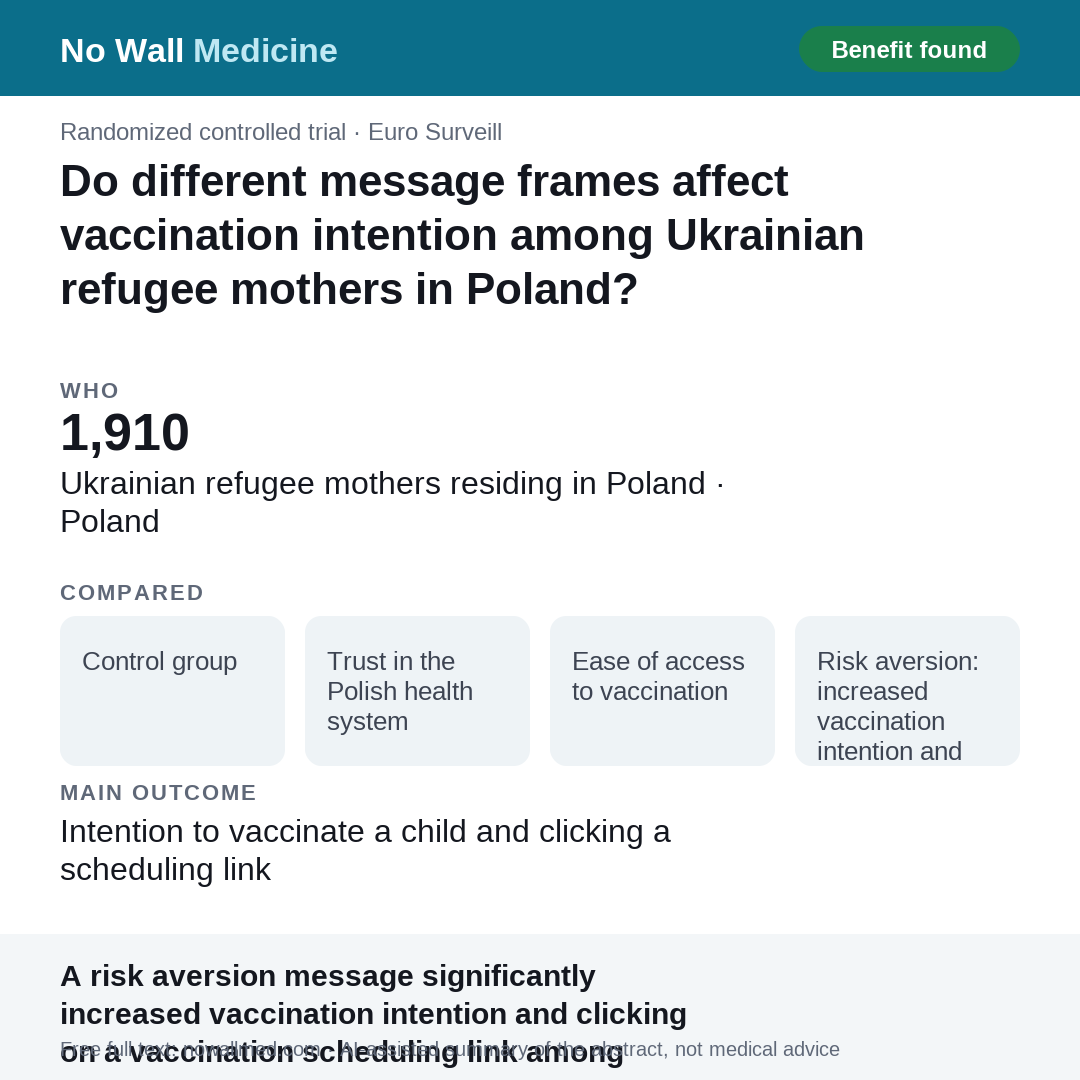
Clinical question: Do different message frames affect vaccination intention among Ukrainian refugee mothers in Poland?
Why it matters: It is unknown which types of communication messages are most effective at encouraging vaccination intention among refugee populations.
Key points
- Researchers randomized 1,910 Ukrainian refugee mothers in Poland into a control group or three groups receiving messages about trust, ease of access, or risk aversion.
- The risk aversion message was associated with higher vaccination intention (adjusted odds ratio: 2.35, 95% confidence interval: 1.25-4.42) and more clicks on scheduling links (adjusted odds ratio: 1.53, 95% confidence interval: 1.12-2.09).
- Trusting social media (adjusted odds ratio: 2.09, 95% confidence interval: 1.33-3.27) and official health institutes (adjusted odds ratio: 1.40, 95% confidence interval: 1.06-1.83) were linked to vaccination intention.
Headline and key points written with AI from the paper’s abstract, with every number checked against it. Read the paper before relying on them.
Was this summary helpful?
Subject terms
Cite this article
Winters M, Sochoń-Latuszek A, Nurzhynska A, Yoruk K, Kukuła K, Bahruddinov M. "Vaccinating your child during an emergency is more important than ever": a randomised controlled trial on message framing among Ukrainian refugees in Poland, 2023. Euro Surveill. 2024. doi:10.2807/1560-7917.ES.2024.29.39.2400159
Spotted a mistake? Suggest a correction
Top studies every Monday
The week’s key trials and guidelines in your specialties, plus any topics you follow. By email, free.
Get the weekly digest