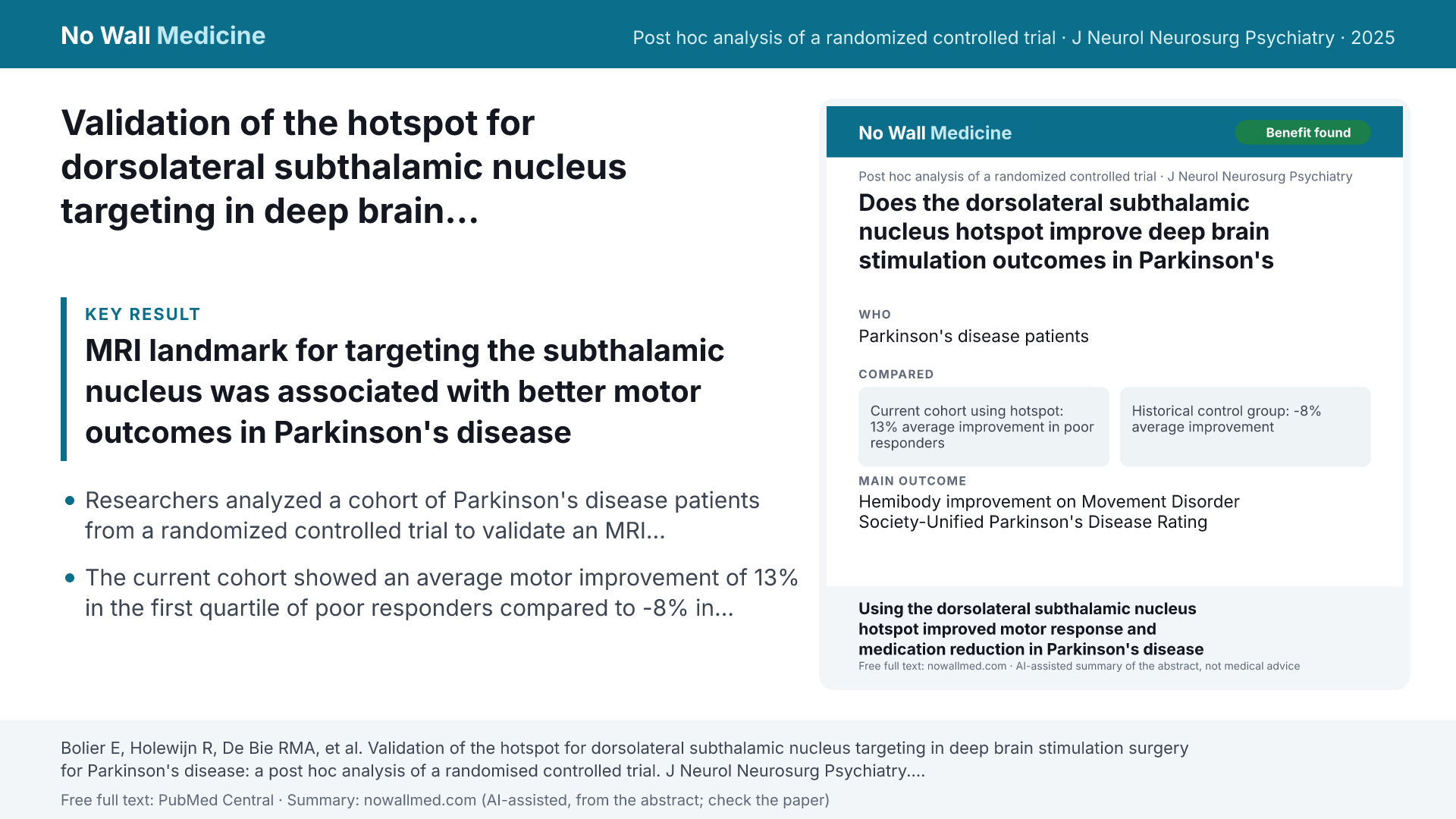
MRI landmark for targeting the subthalamic nucleus was associated with better motor outcomes in Parkinson's disease
Validation of the hotspot for dorsolateral subthalamic nucleus targeting in deep brain stimulation surgery for Parkinson's disease: a post hoc analysis of a randomised controlled trial
Post hoc analysis of a randomized controlled trialBenefit found
Does the dorsolateral subthalamic nucleus hotspot improve deep brain stimulation outcomes in Parkinson's disease?
Who
Parkinson's disease patients
Compared
Current cohort using hotspot: 13% average improvement in poor responders
Historical control group: -8% average improvement
Main outcome
Hemibody improvement on Movement Disorder Society-Unified Parkinson's Disease Rating Scale
Bottom line: Using the dorsolateral subthalamic nucleus hotspot improved motor response and medication reduction in Parkinson's disease patients.
J Neurol Neurosurg Psychiatry · 2025-03-13Download image
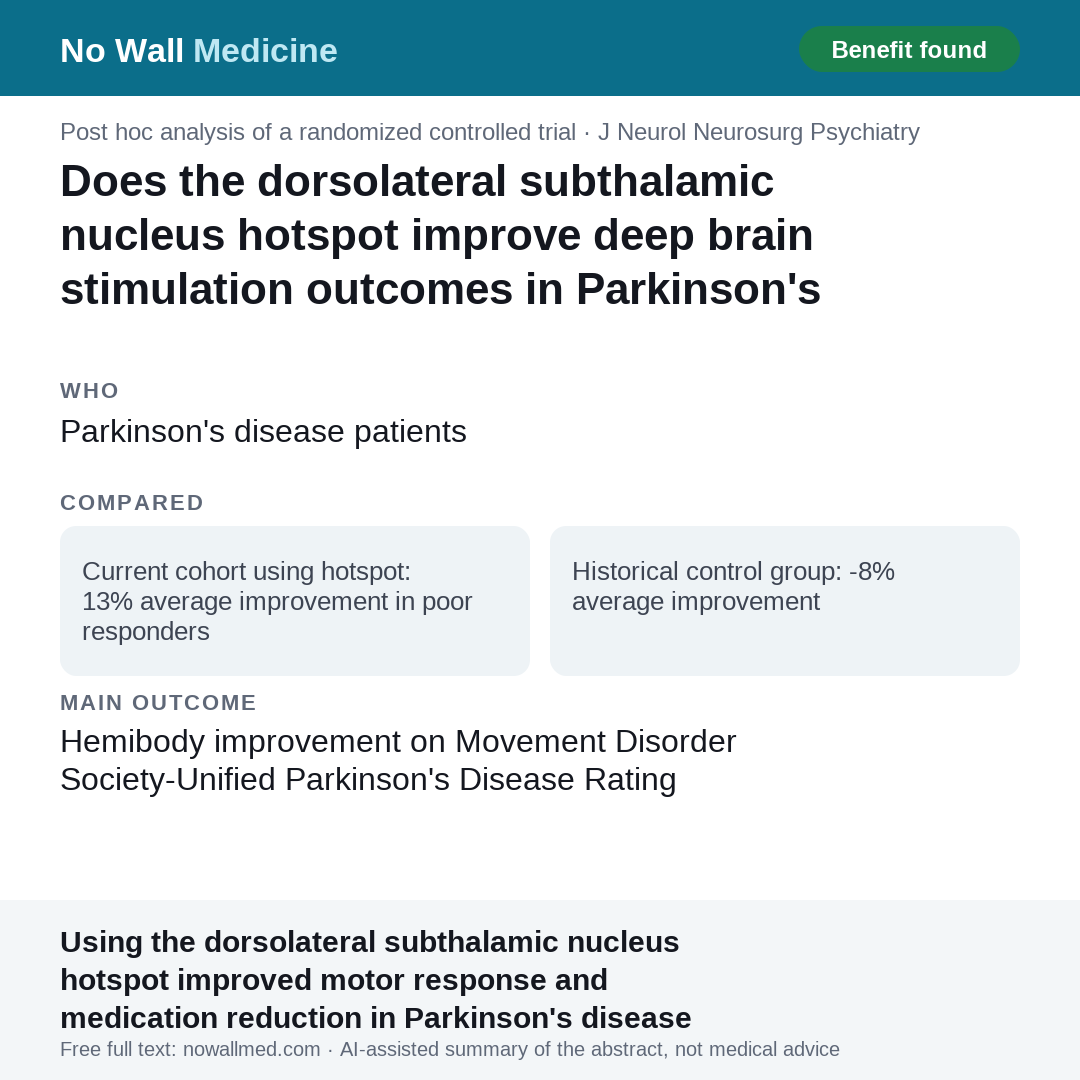
Clinical question: Does the dorsolateral subthalamic nucleus hotspot improve deep brain stimulation outcomes in Parkinson's disease?
Why it matters: Visualizing the dorsolateral subthalamic nucleus is difficult on 1.5 and 3Tesla T2-weighted MRI scans.
Key points
- Researchers analyzed a cohort of Parkinson's disease patients from a randomized controlled trial to validate an MRI landmark for deep brain stimulation targeting.
- The current cohort showed an average motor improvement of 13% in the first quartile of poor responders compared to -8% in a historical control group.
- Motor improvement was correlated with the distance to a refined target located 2.8 mm lateral, 1.1 mm anterior, and 2.2 mm superior to the medial subthalamic nucleus border.
Headline and key points written with AI from the paper’s abstract, with every number checked against it. Read the paper before relying on them.
Was this summary helpful?
Abstract
Background
Visualisation of the dorsolateral subthalamic nucleus (STN) remains challenging on 1.5 and 3Tesla T2-weighted MRI. Our previously defined hotspot, relative to the well-visualised medial STN border, serves as an MRI landmark for dorsolateral STN identification in deep brain stimulation (DBS). We aimed to validate this hotspot in a separate trial cohort of Parkinson's disease (PD) patients and refine its location. Methods
In this post hoc analysis of a randomised controlled trial, in which the hotspot was taken into account during target planning, responses to DBS were evaluated using hemibody improvement on the Movement Disorder Society-Unified Parkinson's Disease Rating Scale motor examination and compared with our historical cohort, as well as dopaminergic medication reduction. Then, a refined hotspot was calculated and the Euclidean distance from individual active contacts to the refined hotspot was correlated with motor improvement. Results
The first quartile of the hemibodies (poor responders) showed an average improvement of 13%, which was higher than the -8% in the historical control group (p=0.044). Dopaminergic medication reduction was greater in the current cohort compared with the historical cohort (p=0.020). Overall variability of hemibody motor improvement was reduced in the current cohort compared with the historical control group (p=0.003). Motor improvement correlated to the Euclidean distance from active contact to the refined hotspot (2.8 mm lateral, 1.1 mm anterior and 2.2 mm superior to the medial STN border) (p=0.001). Conclusion
We validated the hotspot for dorsolateral STN targeting in DBS for patients with PD and showed an improved motor response in poor responders, a reduced variability in motor improvement and a greater dopaminergic medication reduction. We then refined the hotspot at 2.8 mm lateral, 1.1 mm anterior and 2.2 mm superior relative to the medial STN border, which visualises a readily implementable target within the dorsolateral STN on lower field strength MRI.
Abstract reproduced under the article’s CC BY NC licence.
Subject terms
Cite this article
Bolier E, Holewijn R, De Bie RMA, Beudel M, van den Munckhof P, Schuurman R. Validation of the hotspot for dorsolateral subthalamic nucleus targeting in deep brain stimulation surgery for Parkinson's disease: a post hoc analysis of a randomised controlled trial. J Neurol Neurosurg Psychiatry. 2025. doi:10.1136/jnnp-2023-333164
Spotted a mistake? Suggest a correction
Top studies every Monday
The week’s key trials and guidelines in your specialties, plus any topics you follow. By email, free.
Get the weekly digest