STOP-Bang questionnaire shows high sensitivity for screening obstructive sleep apnoea in patients with cardiovascular risk
Validation of the STOP-Bang questionnaire as a screening tool for obstructive sleep apnoea in patients with cardiovascular risk factors: a systematic review and meta-analysis
Systematic review and meta-analysisBenefit found
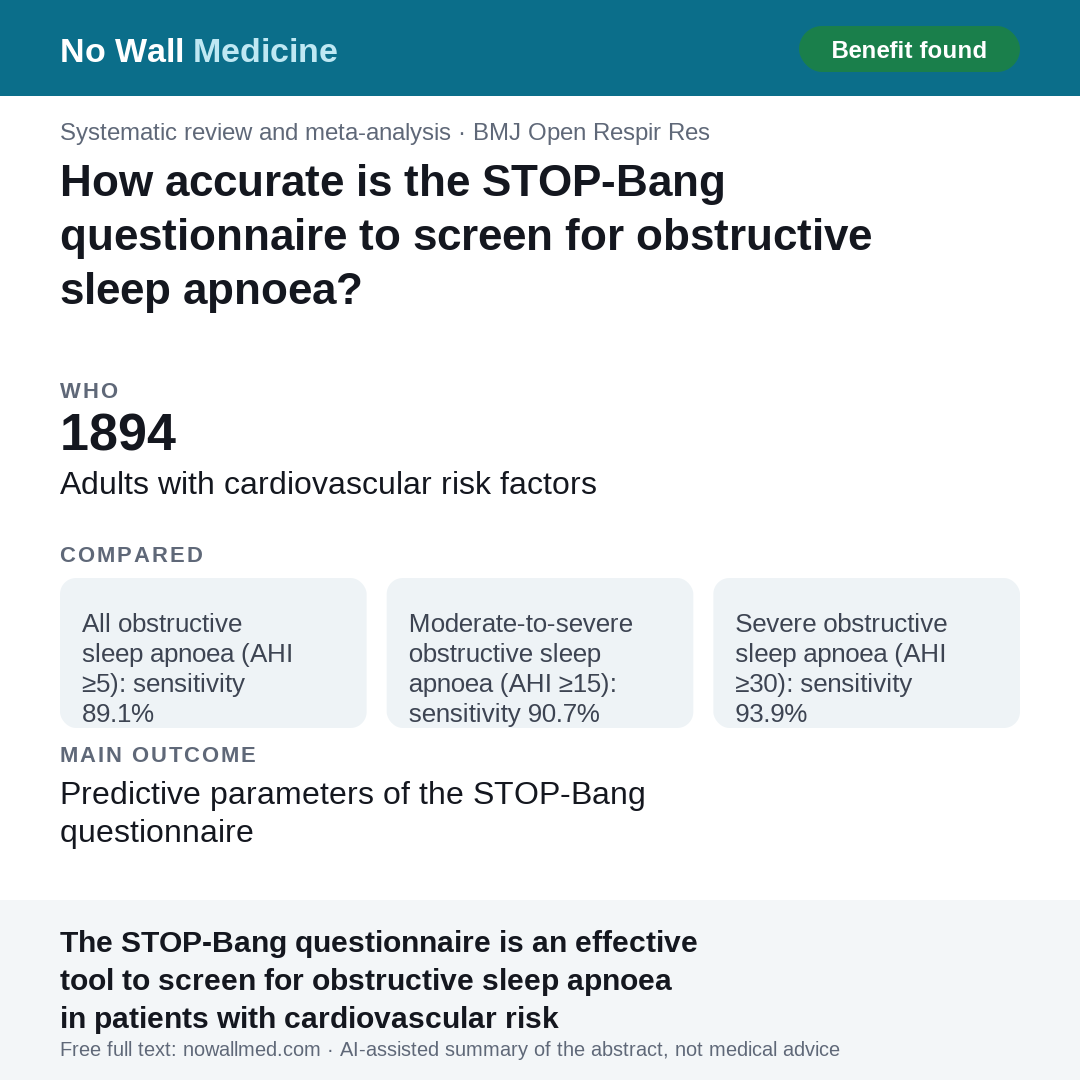
How accurate is the STOP-Bang questionnaire to screen for obstructive sleep apnoea?
Who
1894
Adults with cardiovascular risk factors
Compared
All obstructive sleep apnoea (AHI ≥5): sensitivity 89.1%
Moderate-to-severe obstructive sleep apnoea (AHI ≥15): sensitivity 90.7%
Severe obstructive sleep apnoea (AHI ≥30): sensitivity 93.9%
Main outcome
Predictive parameters of the STOP-Bang questionnaire
Result: area under the curve 0.86 for all obstructive sleep apnoea
Bottom line: The STOP-Bang questionnaire is an effective tool to screen for obstructive sleep apnoea in patients with cardiovascular risk factors.
BMJ Open Respir Res · 2021-03-05Download image
Clinical question: How accurate is the STOP-Bang questionnaire to screen for obstructive sleep apnoea?
Why it matters: The predictive accuracy of the STOP-Bang questionnaire for identifying obstructive sleep apnoea in adults with cardiovascular risk factors was not fully established.
Key points
- Researchers analyzed 9 studies involving 1894 patients with cardiovascular risk factors to evaluate the STOP-Bang questionnaire for screening obstructive sleep apnoea.
- The questionnaire had a sensitivity of 89.1% for all cases, 90.7% for moderate-to-severe cases, and 93.9% for severe cases.
- The specificity was 32.3% for all cases, 22.5% for moderate-to-severe cases, and 18.3% for severe cases.
Headline and key points written with AI from the paper’s abstract, with every number checked against it. Read the paper before relying on them.
Was this summary helpful?
Abstract
Introduction
Obstructive sleep apnoea (OSA) is highly prevalent in patients with cardiovascular risk factors and is associated with increased morbidity and mortality. This review presents the predictive parameters of the STOP-Bang questionnaire as a screening tool for OSA in this population. Methods
A search of databases was performed. The inclusion criteria were: (1) use of the STOP-Bang questionnaire to screen for OSA in adults (>18 years) with cardiovascular risk factors; (2) polysomnography or home sleep apnoea testing performed as a reference standard; (3) OSA defined by either Apnoea-Hypopnoea Index (AHI) or Respiratory Disturbance Index; and (4) data on predictive parameters of the STOP-Bang questionnaire. A random-effects model was used to obtain pooled predictive parameters of the STOP-Bang questionnaire. Results
The literature search resulted in 3888 articles, of which 9 papers met the inclusion criteria, involving 1894 patients. The average age of the included patients was 58±13 years with body mass index (BMI) of 30±6 kg/m2, and 64% were male. The STOP-Bang questionnaire has a sensitivity of 89.1%, 90.7% and 93.9% to screen for all (AHI ≥5), moderate-to-severe (AHI ≥15) and severe (AHI≥30) OSA, respectively. The specificity was 32.3%, 22.5% and 18.3% and the area under the curve (AUC) was 0.86, 0.65 and 0.52 for all, moderate-to-severe and severe OSA, respectively. Conclusion
The STOP-Bang questionnaire is an effective tool to screen for OSA (AHI≥5) with AUC of 0.86 in patients with cardiovascular risk factors.
Abstract reproduced under the article’s CC BY NC licence.
Subject terms
Cite this article
Hwang M, Zhang K, Nagappa M, Saripella A, Englesakis M, Chung F. Validation of the STOP-Bang questionnaire as a screening tool for obstructive sleep apnoea in patients with cardiovascular risk factors: a systematic review and meta-analysis. BMJ Open Respir Res. 2021. doi:10.1136/bmjresp-2020-000848
Spotted a mistake? Suggest a correction
Top studies every Monday
The week’s key trials and guidelines in your specialties, plus any topics you follow. By email, free.
Get the weekly digest