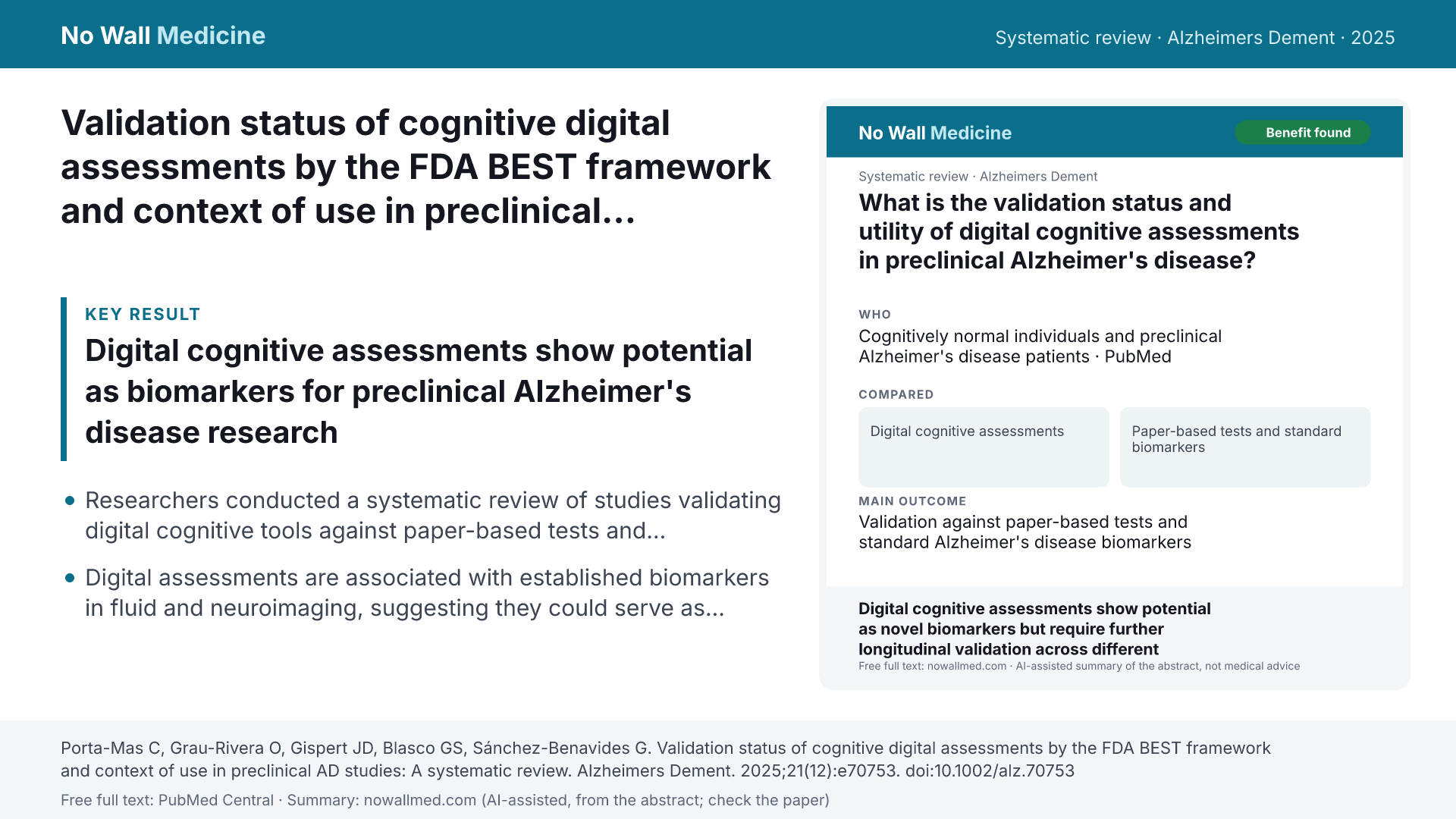
Digital cognitive assessments show potential as biomarkers for preclinical Alzheimer's disease research
Validation status of cognitive digital assessments by the FDA BEST framework and context of use in preclinical AD studies: A systematic review
Systematic reviewBenefit found
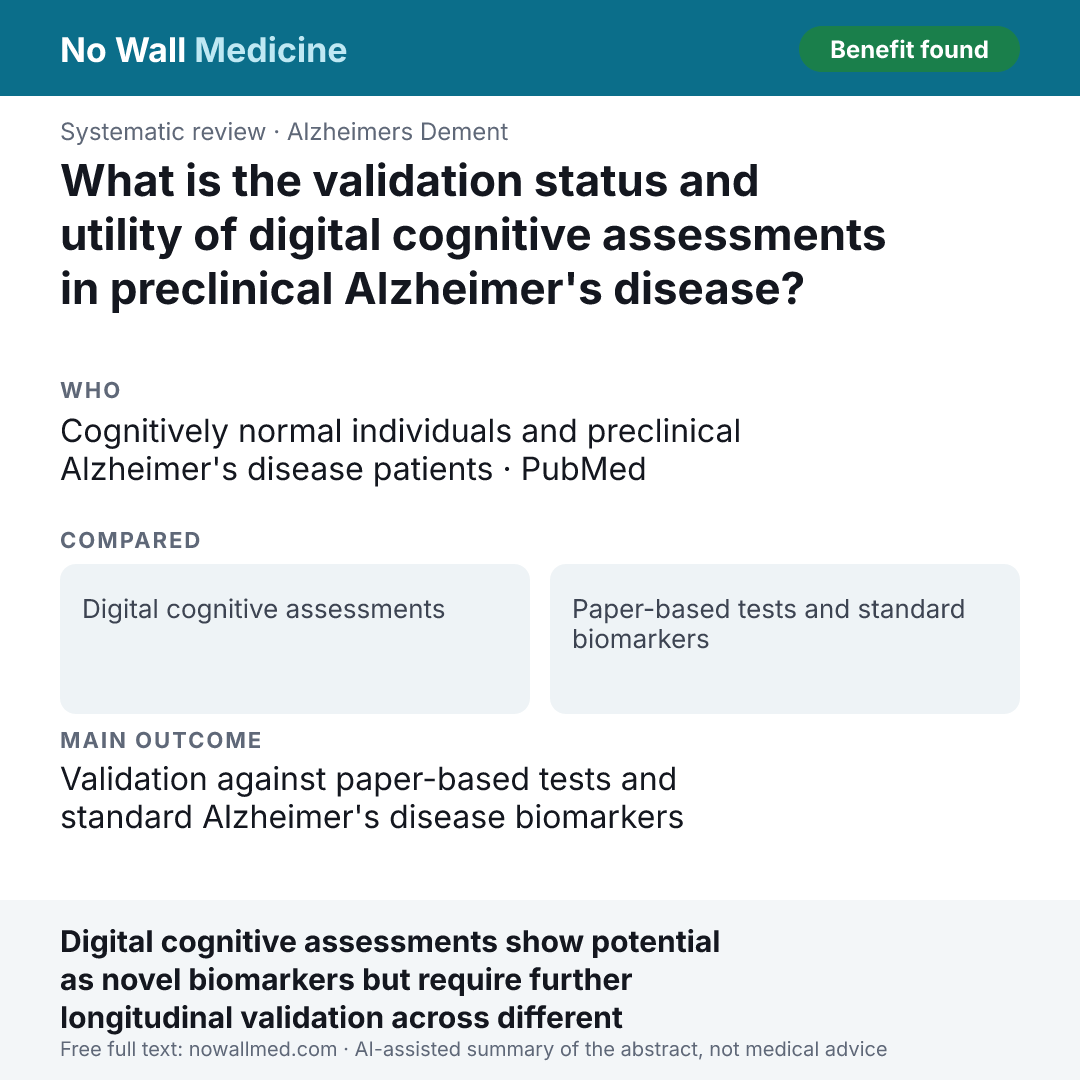
What is the validation status and utility of digital cognitive assessments in preclinical Alzheimer's disease?
Who
Cognitively normal individuals and preclinical Alzheimer's disease patients · PubMed
Compared
Digital cognitive assessments
Paper-based tests and standard biomarkers
Main outcome
Validation against paper-based tests and standard Alzheimer's disease biomarkers
Bottom line: Digital cognitive assessments show potential as novel biomarkers but require further longitudinal validation across different disease stages.
Limitation: Long-term studies spanning different disease stages are needed to fully establish validity.
Alzheimers Dement · 2025-12-10 · Save PNG
Clinical question: What is the validation status and utility of digital cognitive assessments in preclinical Alzheimer's disease?
Why it matters: Digital cognitive assessments are expanding in Alzheimer's disease research as alternatives to traditional neuropsychological tests, but their validation status remains to be fully established.
Key points
- Researchers conducted a systematic review of studies validating digital cognitive tools against paper-based tests and standard Alzheimer's disease biomarkers like amyloid beta and tau.
- Digital assessments are associated with established biomarkers in fluid and neuroimaging, suggesting they could serve as risk or monitoring biomarkers.
- The review notes that long-term studies spanning different disease stages are required to fully establish validity for certain biomarker categories.
Headline and key points written with AI from the paper’s abstract, with every number checked against it. Read the paper before relying on them.
Was this summary helpful?
Subject terms
Headline, design, result, key points, caveat and citation as plain text.
Cite this article
Porta-Mas C, Grau-Rivera O, Gispert JD, Blasco GS, Sánchez-Benavides G. Validation status of cognitive digital assessments by the FDA BEST framework and context of use in preclinical AD studies: A systematic review. Alzheimers Dement. 2025;21(12):e70753. doi:10.1002/alz.70753
Spotted a mistake? Suggest a correction