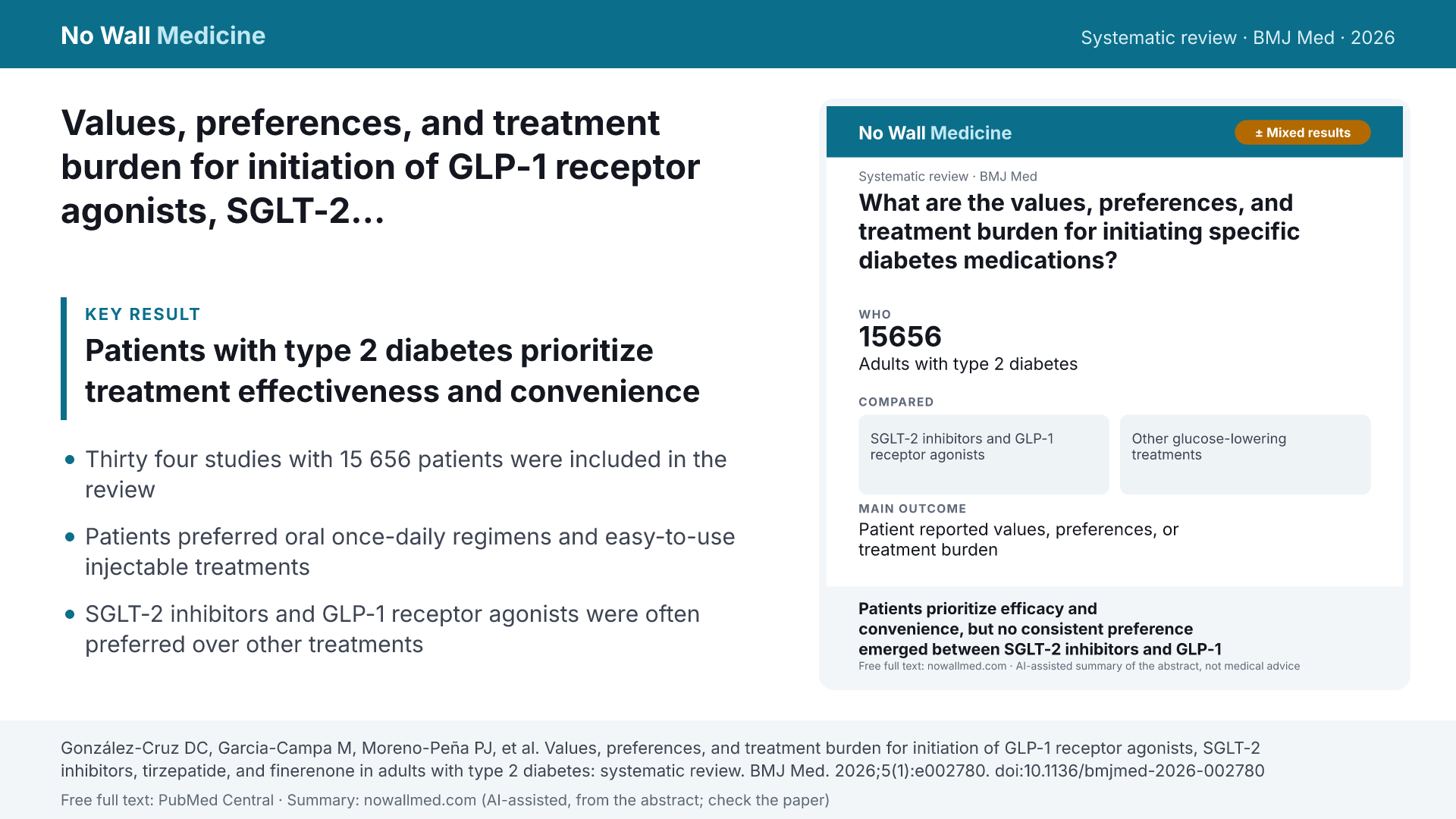
Patients with type 2 diabetes prioritize treatment effectiveness and convenience
Values, preferences, and treatment burden for initiation of GLP-1 receptor agonists, SGLT-2 inhibitors, tirzepatide, and finerenone in adults with type 2 diabetes: systematic review
Systematic reviewMixed results
What are the values, preferences, and treatment burden for initiating specific diabetes medications?
Who
15656
Adults with type 2 diabetes
Compared
SGLT-2 inhibitors and GLP-1 receptor agonists
Other glucose-lowering treatments
Main outcome
Patient reported values, preferences, or treatment burden
Bottom line: Patients prioritize efficacy and convenience, but no consistent preference emerged between SGLT-2 inhibitors and GLP-1 receptor agonists.
Limitation: Certainty of evidence for all comparisons was low or very low certainty.
BMJ Med · 2026-10-08 · PROSPERO CRD42023429170

Headline and visual abstract written with AI from the paper’s abstract, with every number checked against it. Read the paper before relying on them.
Was this summary helpful?
Abstract
Objectives
To summarise existing evidence regarding the values, preferences, and perceived treatment burden of adults with type 2 diabetes when considering initiation of glucagon-like peptide-1 receptor agonists (GLP-1 RA), sodium-glucose cotransporter-2 inhibitors (SGLT-2i), finerenone, or tirzepatide. Design
Systematic review. Data sources
Medline, Embase, Scopus, Web of Science, and Cochrane Central Register of Controlled Trials were searched from database inception to 7 January 2025 (updating a previous systematic review that captured literature up to 23 May 2020). Eligibility criteria
Quantitative or qualitative studies were included if they reported patient reported values, preferences, or treatment burden among adults with type 2 diabetes and compared initiation of GLP-1 RA, SGLT-2i, tirzepatide, or finerenone with each other or with other glucose-lowering treatments. Data extraction and synthesis
Paired reviewers independently screened studies, extracted data, and assessed risk of bias. Certainty of evidence was evaluated using GRADE. Findings were synthesised narratively. Results
Thirty four studies (15 656 patients) were included, 17 of which were new since the previous 2021 review (8360 patients). Of the newly included studies, 10 evaluated GLP-1 RA, seven evaluated SGLT-2i, and one evaluated tirzepatide; no studies evaluated finerenone (because several studies compared multiple drug classes, these categories are not mutually exclusive). Across comparisons, patients consistently reported glycaemic efficacy, cardiovascular risk reduction, and simplicity of administration as their priorities. Oral once-daily regimens and once-weekly injectable treatments with easy-to-use devices were generally preferred. Weight loss was valued but was typically secondary to glycaemic and cardiovascular benefits. SGLT-2i and GLP-1 RA were often preferred over dipeptidyl peptidase 4-inhibitors (DPP-4i), thiazolidinediones, and insulins, but no consistent preference emerged for SGLT-2i over GLP-1 RA. Tirzepatide was favoured over semaglutide in a single study, largely due to greater haemoglobin A1c reduction and lower hypoglycaemia risk. Certainty of evidence for all comparisons was low or very low certainty. Conclusion
Adults with type 2 diabetes prioritise treatment effectiveness and convenience among glucose-lowering treatments. Current evidence does not support a clear preference between SGLT-2i and GLP-1 RA, and data for finerenone are absent. These findings underscore the importance of shared decision making informed by individual patient priorities. Prospero registration
CRD42023429170.
Abstract reproduced under the article’s CC BY NC licence.
Subject terms
Cite this article
González-Cruz DC, Garcia-Campa M, Moreno-Peña PJ, et al. Values, preferences, and treatment burden for initiation of GLP-1 receptor agonists, SGLT-2 inhibitors, tirzepatide, and finerenone in adults with type 2 diabetes: systematic review. BMJ Med. 2026;5(1):e002780. doi:10.1136/bmjmed-2026-002780
Spotted a mistake? Suggest a correction