High prevalence of vancomycin-resistant Enterococcus found in poultry and linked to human colonization
Vancomycin-resistant Enterococcus prevalence and its association along the food chain: a systematic review and meta-analysis
Systematic review and meta-analysisBenefit found
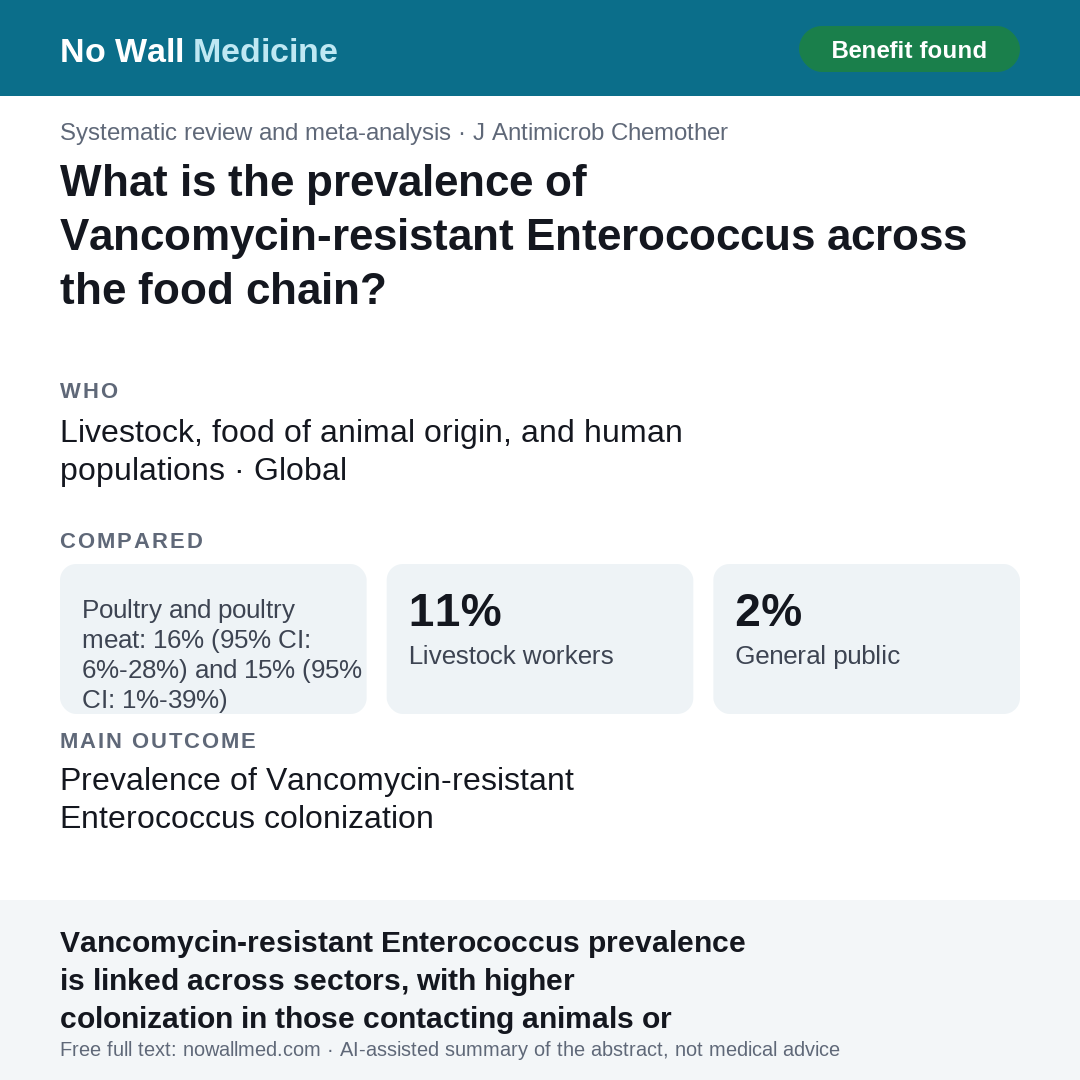
What is the prevalence of Vancomycin-resistant Enterococcus across the food chain?
Who
Livestock, food of animal origin, and human populations · Global
Compared
Poultry and poultry meat: 16% (95% CI: 6%-28%) and 15% (95% CI: 1%-39%)
11%Livestock workers (95% CI: 2%-25%)
2%General public (95% CI: 0%-3%)
Main outcome
Prevalence of Vancomycin-resistant Enterococcus colonization
Result: 0.75% (95% CI 0.46%-1.04%) increase in human prevalence per 1% livestock increase
Bottom line: Vancomycin-resistant Enterococcus prevalence is linked across sectors, with higher colonization in those contacting animals or contaminated food.
Limitation: Quality of evidence was limited by publication bias and heterogeneity.
J Antimicrob Chemother · 2025-01-24Download image
Clinical question: What is the prevalence of Vancomycin-resistant Enterococcus across the food chain?
Why it matters: The prevalence of vancomycin-resistant Enterococcus across the food chain and its connection to human populations was not fully quantified.
Key points
- Researchers analyzed 54 studies to estimate the prevalence of vancomycin-resistant Enterococcus, a type of antibiotic-resistant bacteria, in livestock, food, and humans.
- The highest prevalence was found in poultry at 16% (95% CI: 6%-28%) and poultry meat at 15% (95% CI: 1%-39%).
- Human colonization was highest in livestock workers at 11% (95% CI: 2%-25%) and lowest in the general public at 2% (95% CI: 0%-3%).
Limitation the authors note: The quality of evidence was limited by publication bias and heterogeneity.
Headline and key points written with AI from the paper’s abstract, with every number checked against it. Read the paper before relying on them.
Topics
Cite this article
Caddey B, Shaukat W, Tang KL, Barkema HW. Vancomycin-resistant Enterococcus prevalence and its association along the food chain: a systematic review and meta-analysis. J Antimicrob Chemother. 2025. doi:10.1093/jac/dkaf008
Spotted a mistake? Suggest a correction