Changes in perfusion index may help predict if patients will respond to fluid administration
Variation of perfusion index to evaluate fluid responsiveness during the preload challenge tests: a systematic review and meta-analysis
Systematic review and meta-analysisBenefit found
Does variation of perfusion index predict fluid responsiveness during preload challenge tests?
Who
419
Adult patients undergoing preload challenge tests · Intensive care unit and operating room
Compared
Variation of perfusion index
Fluid responsiveness prediction
Main outcome
Predicting fluid responsiveness
Result: AUROC 0.88 (95% CI 0.85 to 0.90)
Bottom line: Variation of perfusion index is a promising non-invasive marker for predicting fluid responsiveness during preload challenge tests.
Limitation: The current evidence base remains limited, heterogeneous, and at risk of bias.
Ann Intensive Care · 2026-08-21Download image
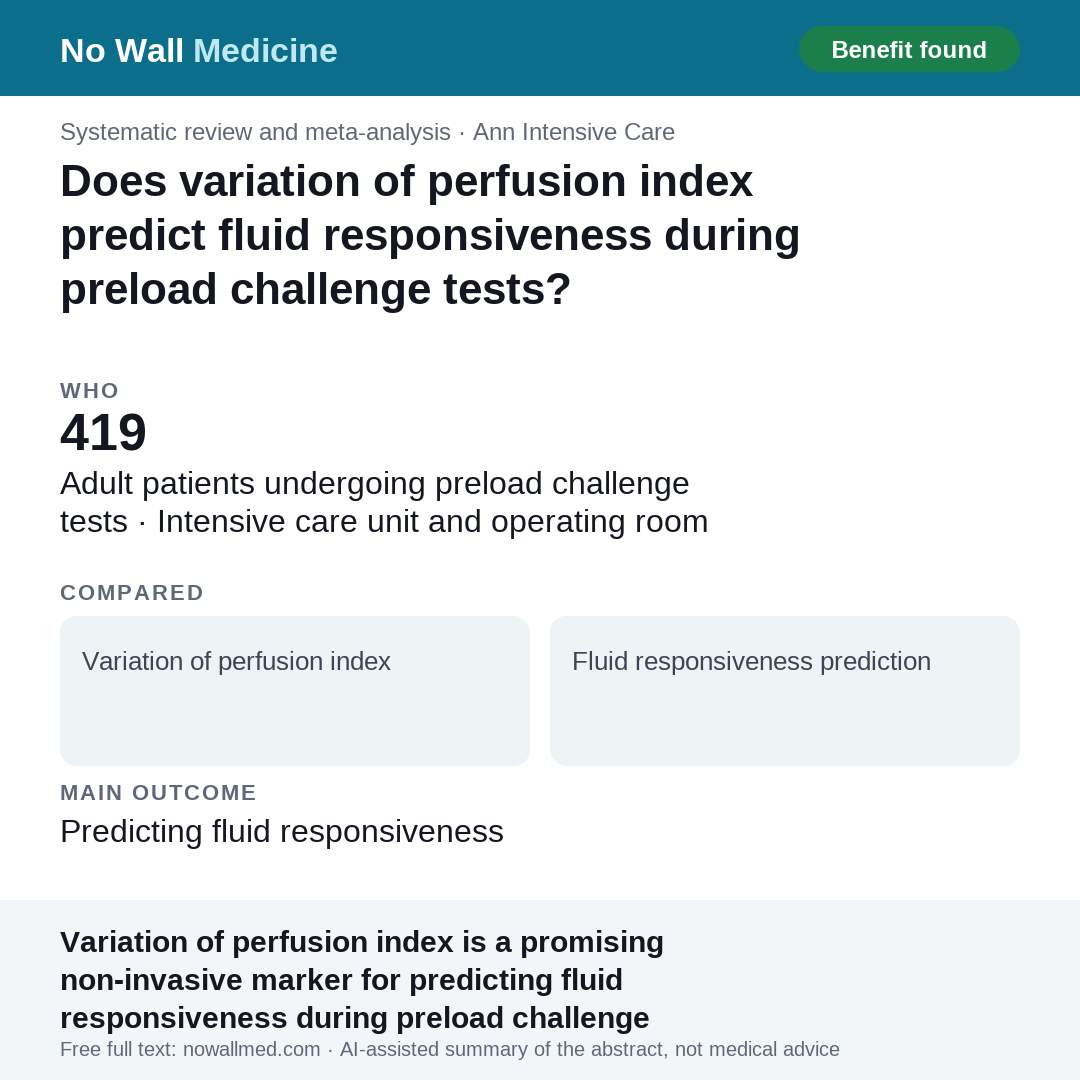
Clinical question: Does variation of perfusion index predict fluid responsiveness during preload challenge tests?
Why it matters: The ability of perfusion index to predict fluid responsiveness has been studied extensively but has produced conflicting results.
Key points
- Researchers analyzed nine studies involving 419 patients and 492 preload challenge tests to evaluate the accuracy of perfusion index variation.
- The pooled sensitivity was 0.79 and specificity was 0.82, with an area under the receiver operator characteristic curve of 0.88.
- The performance of the perfusion index variation remained consistent across intensive care units, operating rooms, and different ventilation statuses.
Limitation the authors note: The authors state that the current evidence base remains limited, heterogeneous, and at risk of bias.
Headline and key points written with AI from the paper’s abstract, with every number checked against it. Read the paper before relying on them.
Cite this article
Huang H, Liu L, Feng T, Shen Q, Xu H, Wu J. Variation of perfusion index to evaluate fluid responsiveness during the preload challenge tests: a systematic review and meta-analysis. Ann Intensive Care. 2026. doi:10.1016/j.aicoj.2026.100136
Spotted a mistake? Suggest a correction