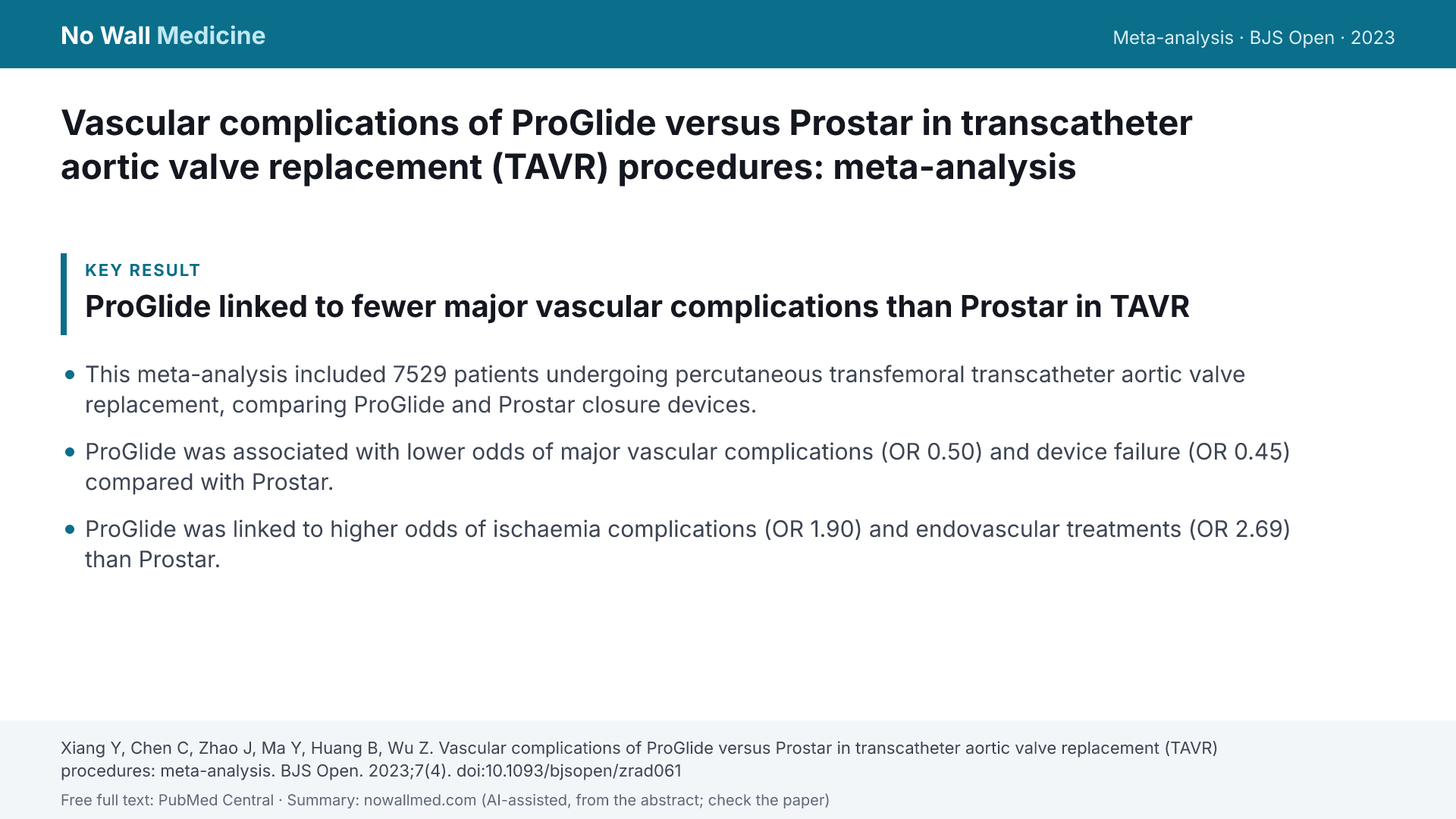
ProGlide linked to fewer major vascular complications than Prostar in TAVR
Vascular complications of ProGlide versus Prostar in transcatheter aortic valve replacement (TAVR) procedures: meta-analysis
Why it matters: Applies to patients undergoing percutaneous transfemoral transcatheter aortic valve replacement; suggests ProGlide may offer better safety regarding major vascular events.
Key points
- This meta-analysis included 7529 patients undergoing percutaneous transfemoral transcatheter aortic valve replacement, comparing ProGlide and Prostar closure devices.
- ProGlide was associated with lower odds of major vascular complications (OR 0.50) and device failure (OR 0.45) compared with Prostar.
- ProGlide was linked to higher odds of ischaemia complications (OR 1.90) and endovascular treatments (OR 2.69) than Prostar.
Limitation the authors note: The study pooled data from non-randomized comparative studies, which may introduce bias.
Headline and key points written with AI from the paper’s abstract, with every number checked against it. Read the paper before relying on them.
Was this summary helpful?
Subject terms
Headline, design, result, key points, caveat and citation as plain text.
Cite this article
Xiang Y, Chen C, Zhao J, Ma Y, Huang B, Wu Z. Vascular complications of ProGlide versus Prostar in transcatheter aortic valve replacement (TAVR) procedures: meta-analysis. BJS Open. 2023;7(4). doi:10.1093/bjsopen/zrad061
Spotted a mistake? Suggest a correction