Venetoclax and decitabine vs intensive chemotherapy as induction for young patients with newly diagnosed AML
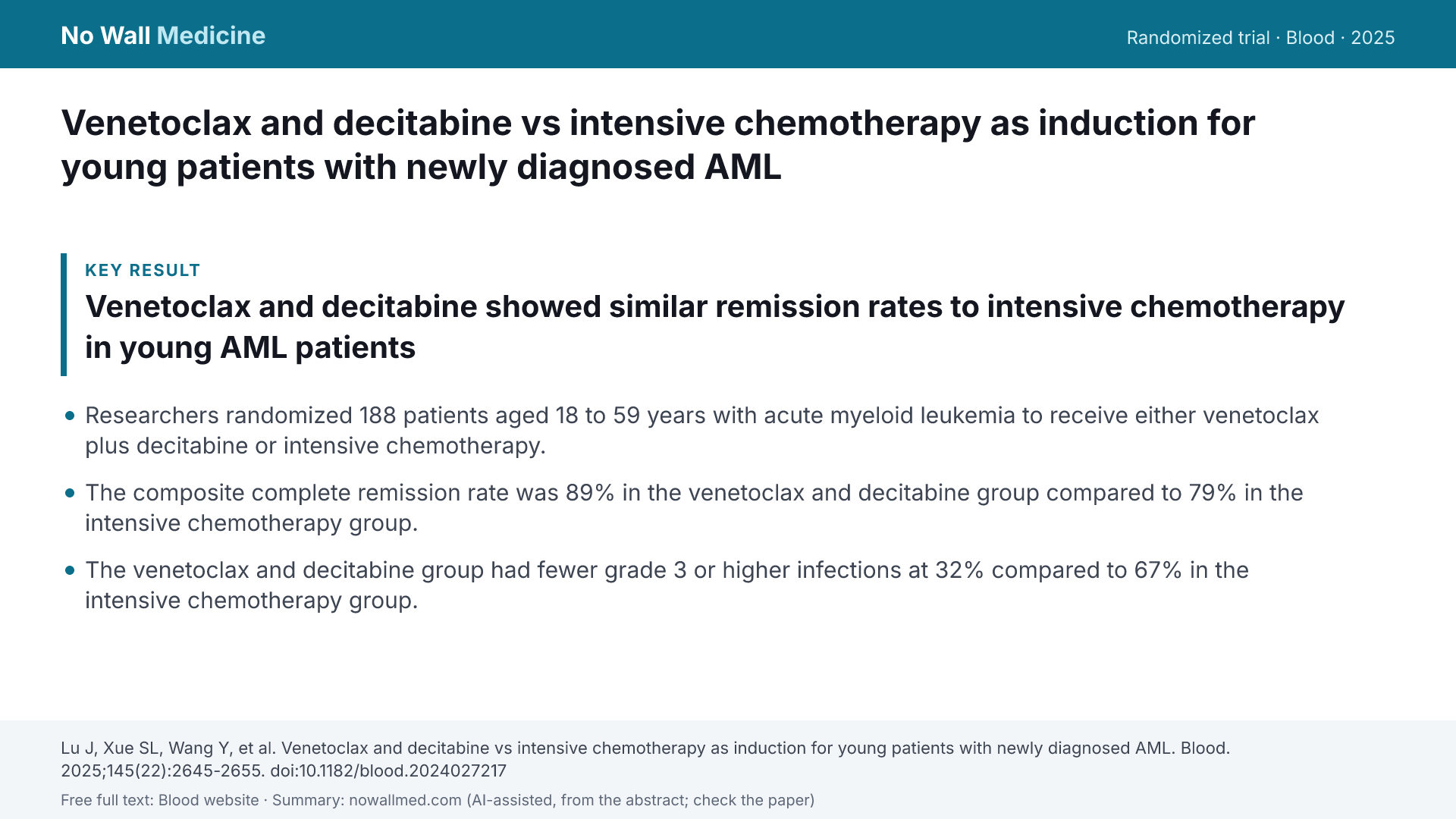
Key result: Venetoclax and decitabine showed similar remission rates to intensive chemotherapy in young AML patients
Key points
- Researchers randomized 188 patients aged 18 to 59 years with acute myeloid leukemia to receive either venetoclax plus decitabine or intensive chemotherapy.
- The composite complete remission rate was 89% in the venetoclax and decitabine group compared to 79% in the intensive chemotherapy group.
- The venetoclax and decitabine group had fewer grade 3 or higher infections at 32% compared to 67% in the intensive chemotherapy group.
Why it matters: Prospective data on using low-intensity therapy instead of intensive chemotherapy is lacking for young, fit patients with newly diagnosed acute myeloid leukemia.
Discussion prompts
- Would these patients look like yours? Who was left out?
- Is the main outcome one that matters to patients?
- Is the difference large enough to change what you do?
Cite: Lu J, Xue SL, Wang Y, et al. Venetoclax and decitabine vs intensive chemotherapy as induction for young patients with newly diagnosed AML. Blood. 2025;145(22):2645-2655. doi:10.1182/blood.2024027217
Free full text: Blood website · Summary and visual abstract: nowallmed.com/a/venetoclax-and-decitabine-vs-intensive-chemotherapy-as-induction-for-992o0a/ (AI-assisted from the abstract; check the paper before relying on it).