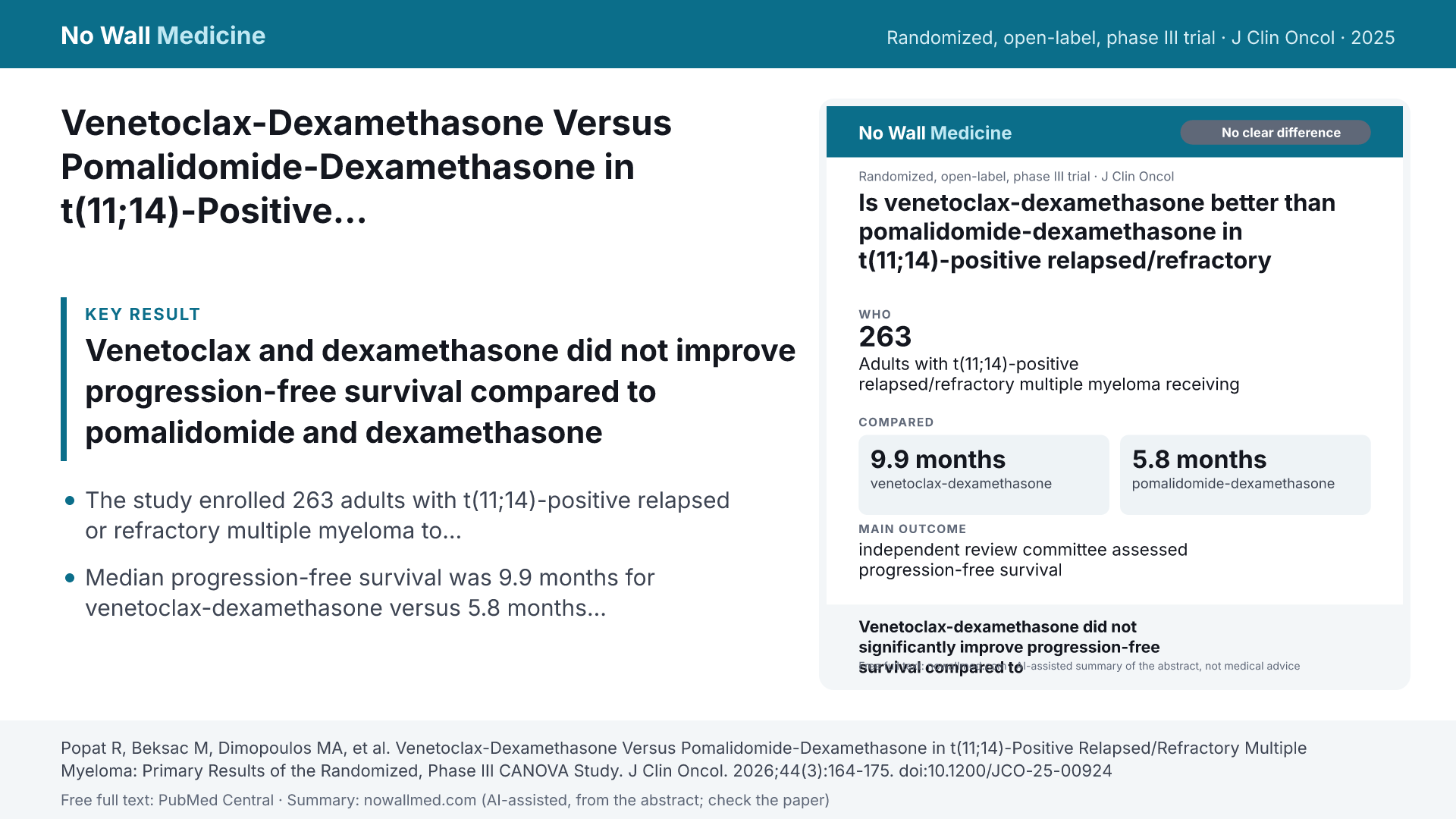
Venetoclax and dexamethasone did not improve progression-free survival compared to pomalidomide and dexamethasone
Venetoclax-Dexamethasone Versus Pomalidomide-Dexamethasone in t(11;14)-Positive Relapsed/Refractory Multiple Myeloma: Primary Results of the Randomized, Phase III CANOVA Study
Randomized, open-label, phase III trialNo clear difference
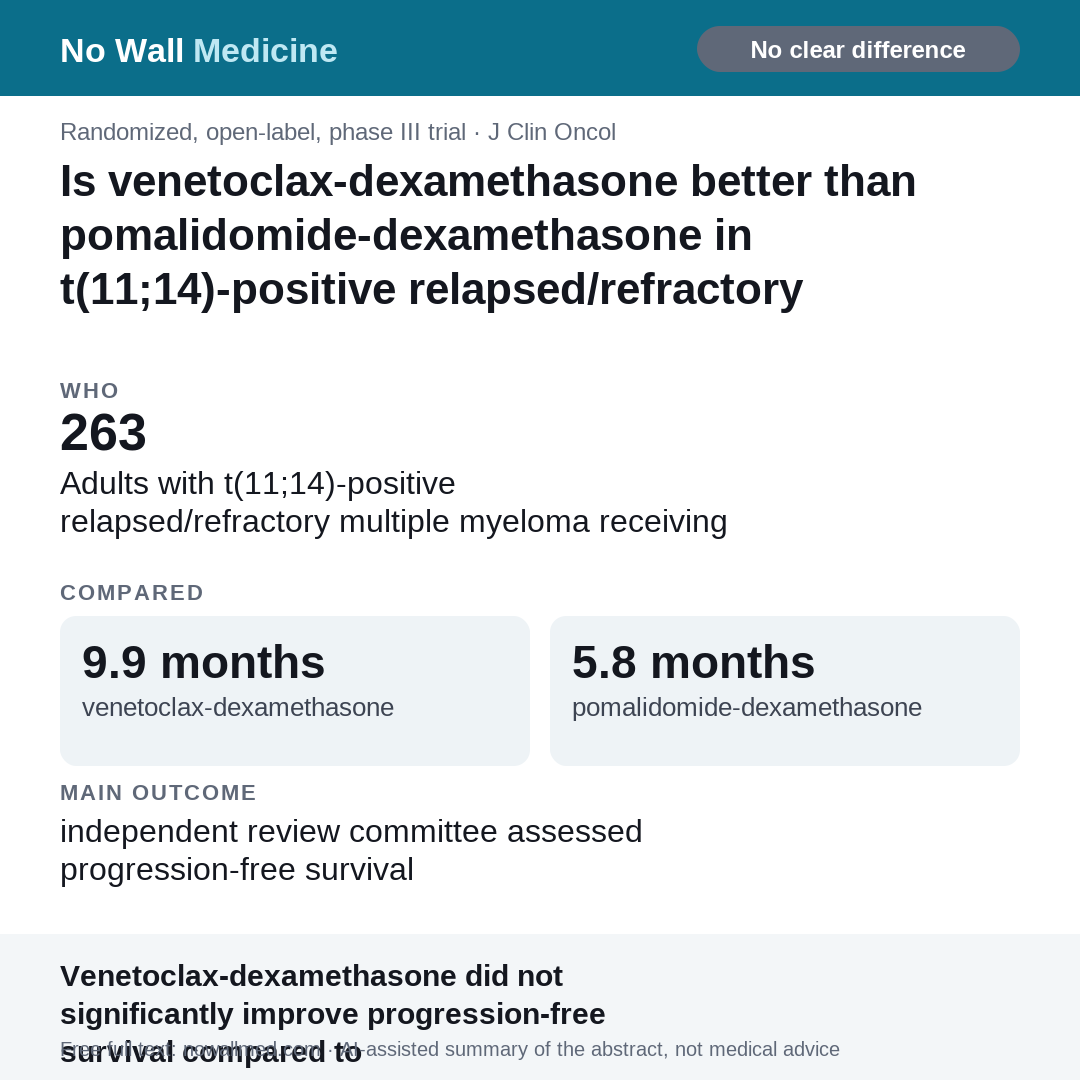
Is venetoclax-dexamethasone better than pomalidomide-dexamethasone in t(11;14)-positive relapsed/refractory multiple myeloma?
Who
263
Adults with t(11;14)-positive relapsed/refractory multiple myeloma receiving 2 or more previous therapies
Compared
9.9 monthsvenetoclax-dexamethasone
5.8 monthspomalidomide-dexamethasone
Main outcome
independent review committee assessed progression-free survival
Result: hazard ratio 0.823 (95% CI 0.596 to 1.136)
Bottom line: Venetoclax-dexamethasone did not significantly improve progression-free survival compared to pomalidomide-dexamethasone in this population.
J Clin Oncol · 2025-12-10Download image
Clinical question: Is venetoclax-dexamethasone better than pomalidomide-dexamethasone in t(11;14)-positive relapsed/refractory multiple myeloma?
Why it matters: Doctors needed to determine if the BCL-2 inhibitor venetoclax could improve outcomes for patients with a specific genetic subtype of multiple myeloma.
Key points
- The study enrolled 263 adults with t(11;14)-positive relapsed or refractory multiple myeloma to compare venetoclax-dexamethasone against pomalidomide-dexamethasone.
- Median progression-free survival was 9.9 months for venetoclax-dexamethasone versus 5.8 months for pomalidomide-dexamethasone, but this difference was not statistically significant.
- Grade 3 or higher treatment-emergent adverse events occurred in 67% of the venetoclax group and 83% of the pomalidomide group.
Headline and key points written with AI from the paper’s abstract, with every number checked against it. Read the paper before relying on them.
Was this summary helpful?
Subject terms
Headline, design, result, key points, caveat and citation as plain text.
Cite this article
Popat R, Beksac M, Dimopoulos MA, et al. Venetoclax-Dexamethasone Versus Pomalidomide-Dexamethasone in t(11;14)-Positive Relapsed/Refractory Multiple Myeloma: Primary Results of the Randomized, Phase III CANOVA Study. J Clin Oncol. 2025. doi:10.1200/JCO-25-00924
Spotted a mistake? Suggest a correction