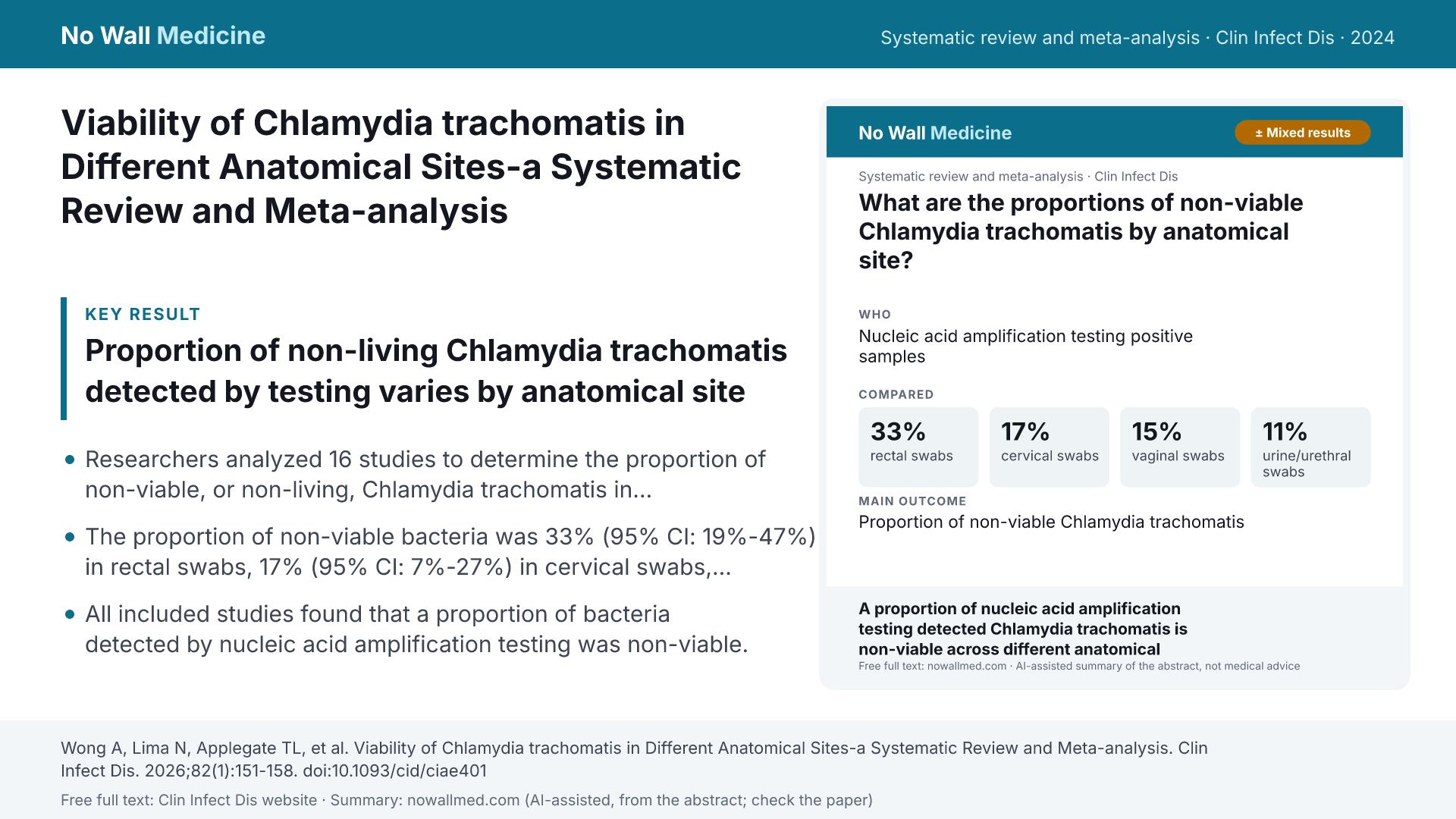
Proportion of non-living Chlamydia trachomatis detected by testing varies by anatomical site
Viability of Chlamydia trachomatis in Different Anatomical Sites-a Systematic Review and Meta-analysis
Systematic review and meta-analysisMixed results
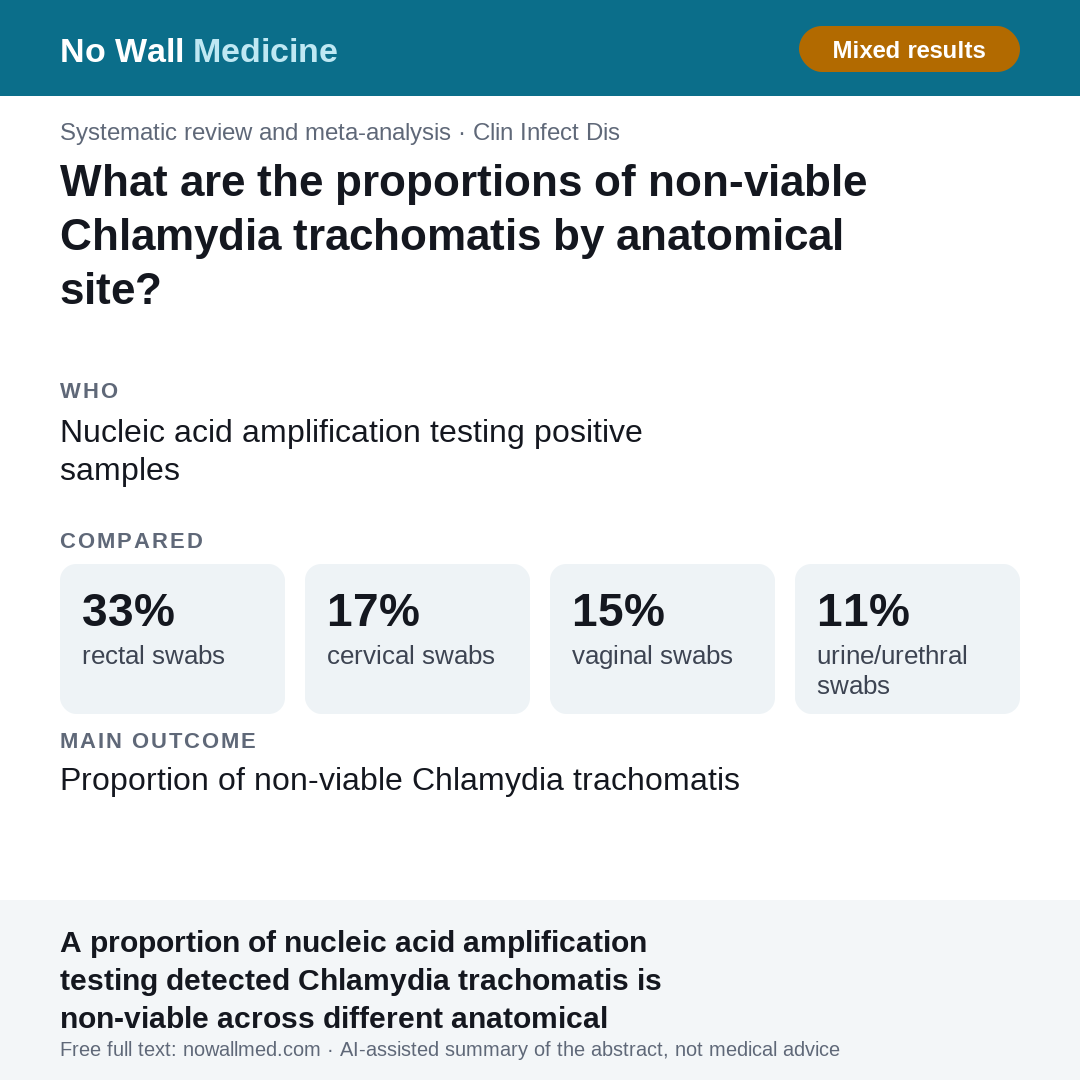
What are the proportions of non-viable Chlamydia trachomatis by anatomical site?
Who
Nucleic acid amplification testing positive samples
Compared
33%rectal swabs (95% confidence interval [CI]: 19%-47%)
17%cervical swabs (95% CI: 7%-27%)
15%vaginal swabs (95% CI: 6%-25%)
11%urine/urethral swabs (95% CI: 9%-17%)
Main outcome
Proportion of non-viable Chlamydia trachomatis
Bottom line: A proportion of nucleic acid amplification testing detected Chlamydia trachomatis is non-viable across different anatomical sites.
Clin Infect Dis · 2024-08-06Download image
Clinical question: What are the proportions of non-viable Chlamydia trachomatis by anatomical site?
Why it matters: It is unknown how much of the Chlamydia trachomatis detected by modern DNA or RNA testing consists of non-living bacteria across different body sites.
Key points
- Researchers analyzed 16 studies to determine the proportion of non-viable, or non-living, Chlamydia trachomatis in samples that tested positive using nucleic acid amplification testing.
- The proportion of non-viable bacteria was 33% (95% CI: 19%-47%) in rectal swabs, 17% (95% CI: 7%-27%) in cervical swabs, 15% (95% CI: 6%-25%) in vaginal swabs, and 11% (95% CI: 9%-17%) in urine or urethral swabs.
- All included studies found that a proportion of bacteria detected by nucleic acid amplification testing was non-viable.
Headline and key points written with AI from the paper’s abstract, with every number checked against it. Read the paper before relying on them.
Was this summary helpful?
Subject terms
Cite this article
Wong A, Lima N, Applegate TL, et al. Viability of Chlamydia trachomatis in Different Anatomical Sites-a Systematic Review and Meta-analysis. Clin Infect Dis. 2024. doi:10.1093/cid/ciae401
Spotted a mistake? Suggest a correction