Video call peer support did not increase exclusive breastfeeding rates at six months postpartum
Video-Based Peer Support and Exclusive Breastfeeding and Maternal Self-Efficacy: A Randomized Clinical Trial
Multicenter, randomized clinical trialMixed results
Does video-based peer support improve exclusive breastfeeding and maternal self-efficacy?
Who
442
First-time mothers with low breastfeeding confidence · 4 public postnatal wards in Hong Kong
Compared
20.1%Intervention group
15.6%Control group
Main outcome
Proportion of infants exclusively breastfed at 6 months post partum
Result: adjusted odds ratio 1.57 (95% CI 0.85-2.89)
Bottom line: Video-based peer support improved breastfeeding at 2 months and self-efficacy, but not exclusive breastfeeding at 6 months.
JAMA Netw Open · 2026-05-01Download image
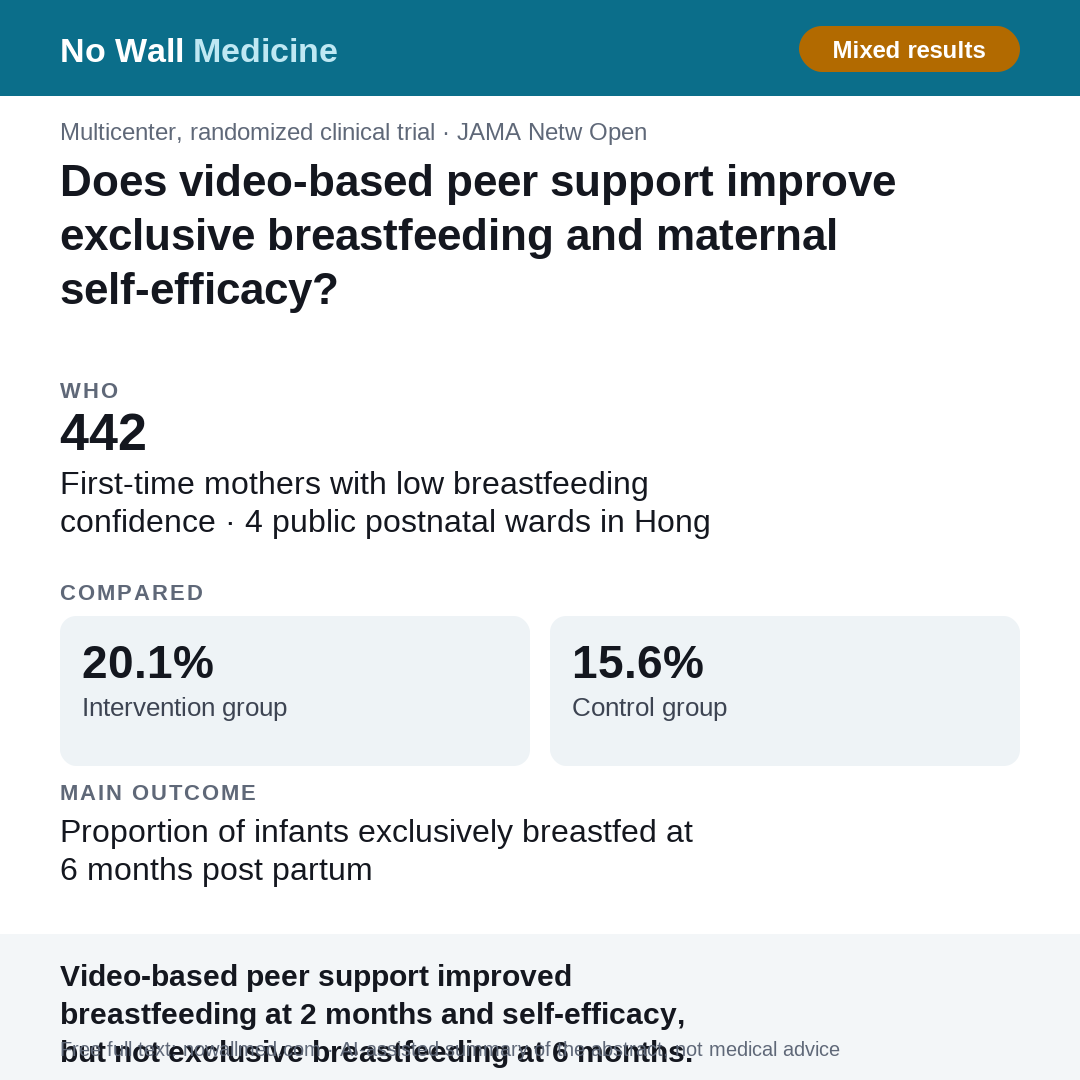
Clinical question: Does video-based peer support improve exclusive breastfeeding and maternal self-efficacy?
Why it matters: Evidence is limited regarding whether online peer support formats can improve breastfeeding outcomes.
Key points
- Researchers studied 442 first-time mothers with low breastfeeding confidence in Hong Kong, comparing standard care to care including at least 2 video calls with trained volunteers.
- Exclusive breastfeeding at 6 months did not differ significantly between groups (20.1% in the intervention group versus 15.6% in the control group).
- The intervention group showed significantly higher rates of exclusive breastfeeding at 2 months and improved maternal breastfeeding self-efficacy, which is a mother's confidence in her ability to breastfeed.
Headline and key points written with AI from the paper’s abstract, with every number checked against it. Read the paper before relying on them.
Topics
Spotted a mistake? Suggest a correction