Language barriers are associated with lower video care use among adults in high-income countries
Virtual Care Among Adults Facing Language Barriers: A Systematic Review and Meta-Analysis
Meta-analysis of 41 studiesNo clear difference
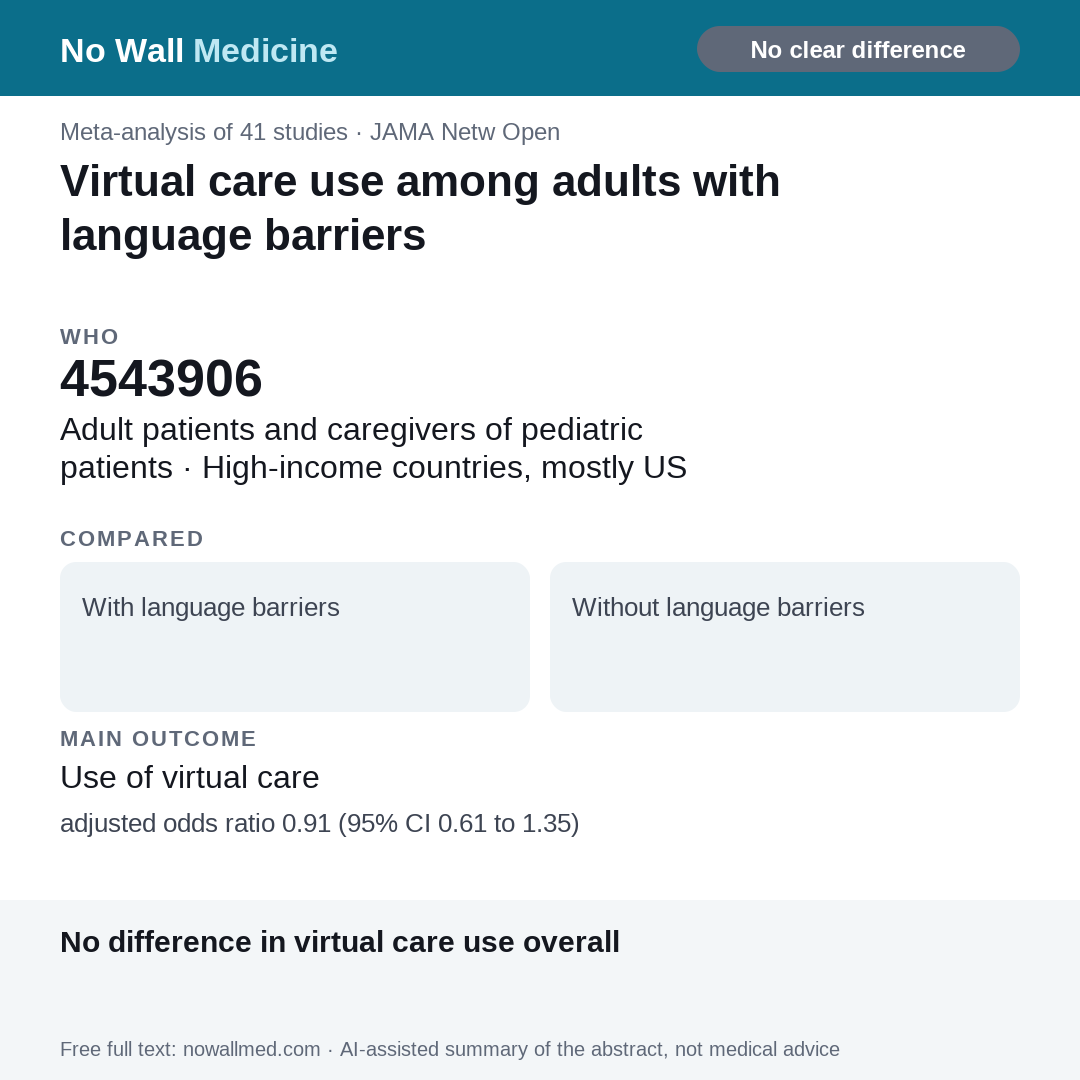
Virtual care use among adults with language barriers
Who
4543906
Adult patients and caregivers of pediatric patients · High-income countries, mostly US
Compared
With language barriers
Without language barriers
Main outcome
Use of virtual care
Result: adjusted odds ratio 0.91 (95% CI 0.61 to 1.35)
Bottom line: No difference in virtual care use overall
Limitation: High heterogeneity and limited studies
JAMA Netw Open · 2025-06-02Download image
Why it matters: It is unclear how language barriers affect the use of and satisfaction with virtual care among adults and pediatric caregivers.
Key points
- Researchers analyzed 41 studies involving 4,543,906 adult patients and 7,921 pediatric caregivers to examine virtual care use and satisfaction.
- Adults with language barriers had significantly lower adjusted pooled odds of using video versus telephone care (AOR, 0.66 [95% CI, 0.52-0.85]).
- In specialist care, adults with language barriers had significantly lower adjusted pooled odds of using virtual versus in-person care (AOR, 0.78 [95% CI, 0.70-0.87]).
Limitation the authors note: Results for primary care and patient satisfaction were limited or inconclusive due to a small number of studies.
Headline and key points written with AI from the paper’s abstract, with every number checked against it. Read the paper before relying on them.
Topics
Cite this article
Wennberg E, Mohmand Z, D'Arienzo D, Majeed Grant S, Uleryk E, Vyas MV. Virtual Care Among Adults Facing Language Barriers: A Systematic Review and Meta-Analysis. JAMA Netw Open. 2025. doi:10.1001/jamanetworkopen.2025.13906
Spotted a mistake? Suggest a correction
Top studies every Monday
The week’s key trials and guidelines in your specialties, by email. Free.
Get the weekly digest