Two virtual culturally grounded interventions reduced substance use among urban American Indian and Alaska Native young adults
Virtual Culturally Grounded Interventions for Substance Use in Urban American Indian and Alaska Native Emerging Adults: A Randomized Clinical Trial
Randomized clinical trialMixed results
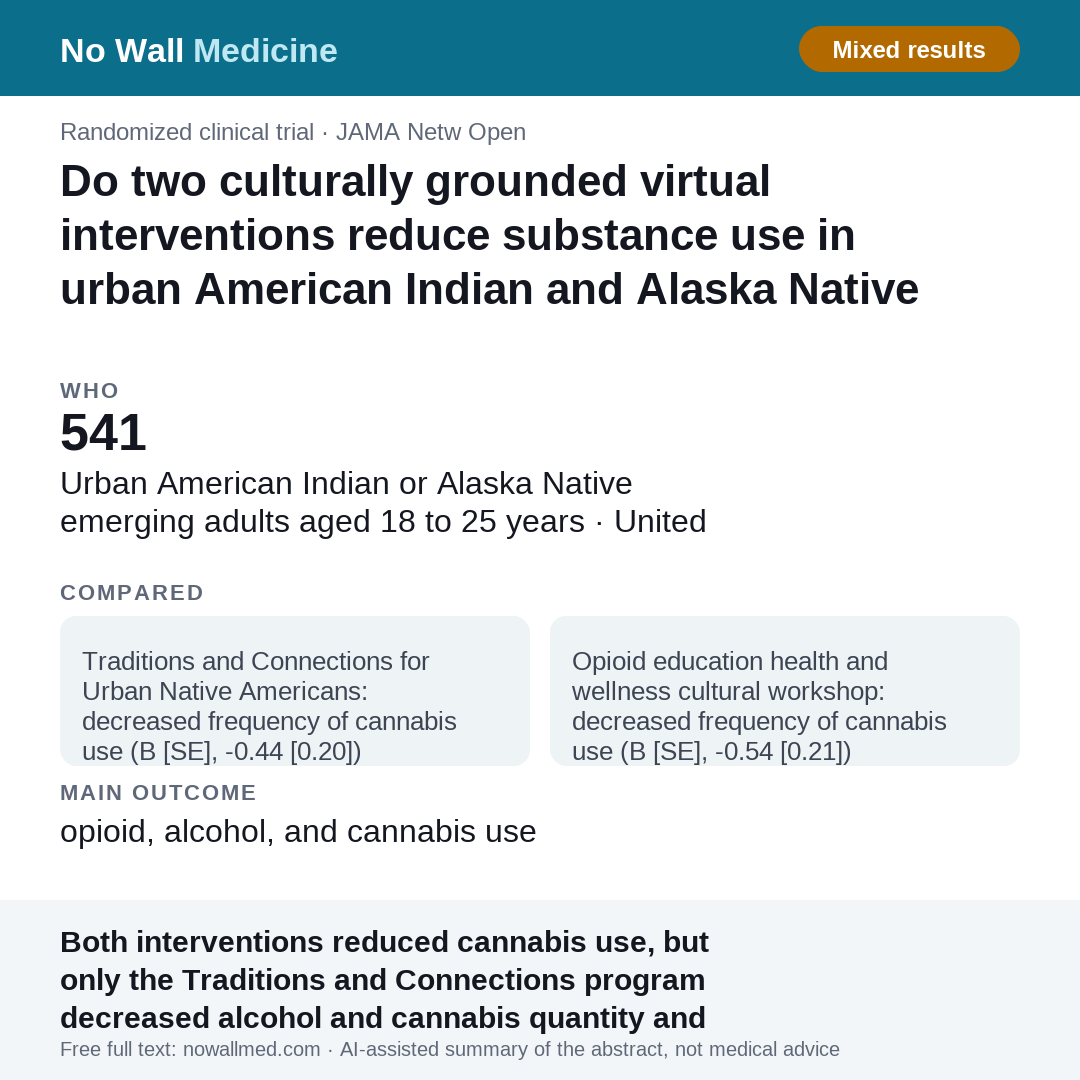
Do two culturally grounded virtual interventions reduce substance use in urban American Indian and Alaska Native emerging adults?
Who
541
Urban American Indian or Alaska Native emerging adults aged 18 to 25 years · United States
Compared
Traditions and Connections for Urban Native Americans: decreased frequency of cannabis use (B [SE], -0.44 [0.20])
Opioid education health and wellness cultural workshop: decreased frequency of cannabis use (B [SE], -0.54 [0.21])
Main outcome
opioid, alcohol, and cannabis use
Bottom line: Both interventions reduced cannabis use, but only the Traditions and Connections program decreased alcohol and cannabis quantity and anxiety.
JAMA Netw Open · 2026-08-03Download image
Clinical question: Do two culturally grounded virtual interventions reduce substance use in urban American Indian and Alaska Native emerging adults?
Why it matters: Few evidence-based, culturally grounded programs exist to address substance use and mental health for urban American Indian and Alaska Native emerging adults.
Key points
- Researchers studied 541 participants aged 18 to 25 years, comparing a specific workshop program called TACUNA to a usual care opioid education workshop.
- Both groups showed decreased cannabis use and fewer positive screens for alcohol and cannabis use disorders.
- Only the TACUNA group reported decreases in the quantity of alcohol and cannabis used, time spent with peers using substances, and levels of anxiety.
Headline and key points written with AI from the paper’s abstract, with every number checked against it. Read the paper before relying on them.
Topics
Cite this article
D'Amico EJ, Dickerson DL, Rodriguez A, Klein DJ, Arvizu-Sanchez V, Schweigman K. Virtual Culturally Grounded Interventions for Substance Use in Urban American Indian and Alaska Native Emerging Adults: A Randomized Clinical Trial. JAMA Netw Open. 2026. doi:10.1001/jamanetworkopen.2026.27878
Spotted a mistake? Suggest a correction