Virtual reality cue exposure therapy reduces methamphetamine craving in men with use disorder
Virtual reality-based cue exposure therapy reduces psychological craving in men with methamphetamine use disorder: a randomized controlled trial
Randomized controlled trialBenefit found
Does virtual reality cue exposure therapy reduce methamphetamine craving in men?
Who
89
Men with methamphetamine use disorder
Compared
Virtual reality-based cue exposure therapy: significant reductions in tonic craving (p = 0.001)
Virtual reality-based cue exposure combined with aversion therapy: significant reductions in tonic craving (p = 0.010)
Neutral scenes: no change (p = 0.217)
Main outcome
Tonic craving and cue-induced craving
Bottom line: Virtual reality-based cue exposure therapy effectively reduces psychological craving and improves drug refusal self-efficacy in methamphetamine use disorder.
Limitation: larger-scale trials are needed to confirm long-term efficacy
Transl Psychiatry · 2025-08-26Download image
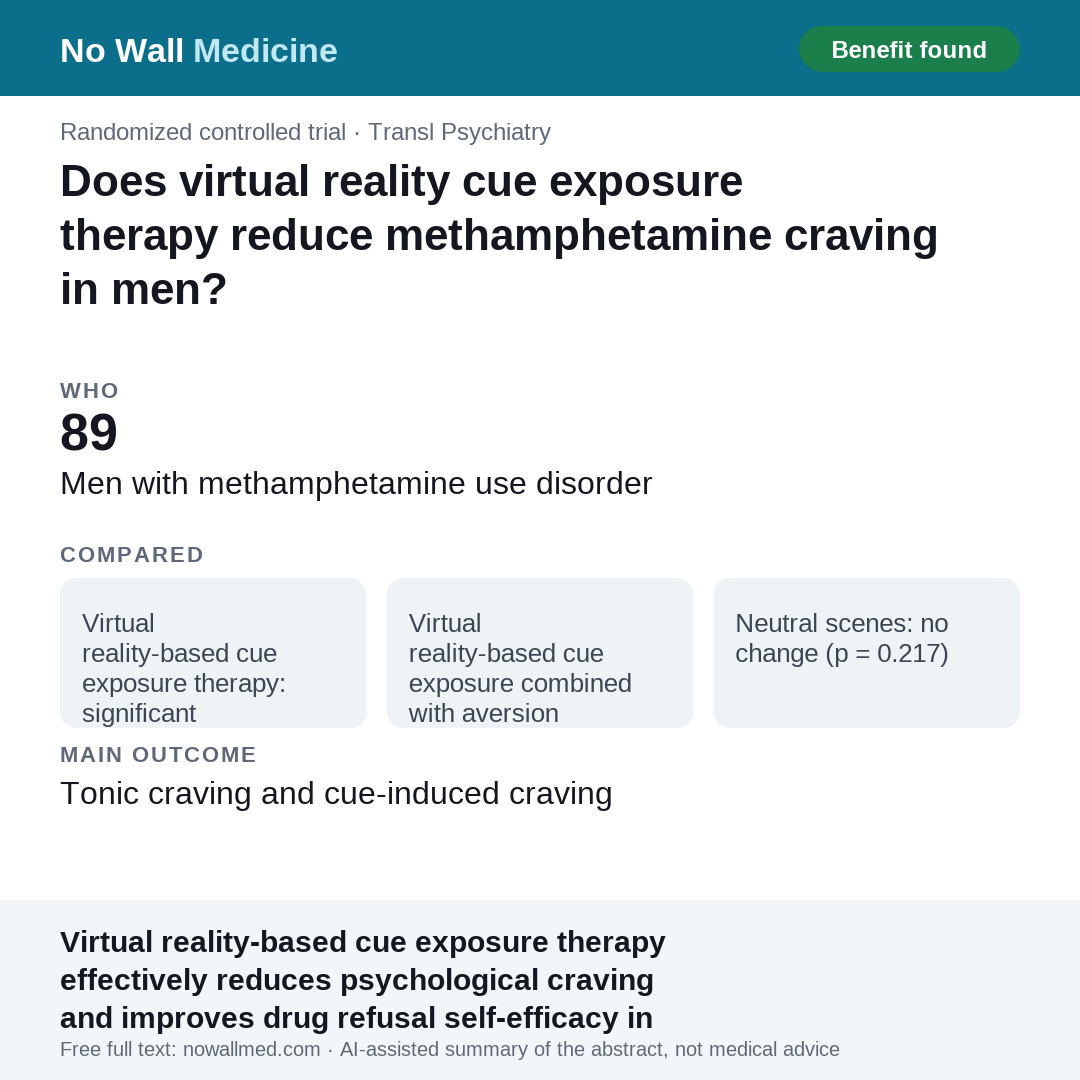
Clinical question: Does virtual reality cue exposure therapy reduce methamphetamine craving in men?
Why it matters: Reducing psychological craving is critical for preventing relapse in methamphetamine use disorder.
Key points
- Researchers studied 89 men with methamphetamine use disorder assigned to virtual reality cue exposure therapy, cue exposure with aversion therapy, or neutral scenes over 8 weeks.
- The virtual reality cue exposure therapy group showed significant reductions in tonic craving (p = 0.001) and lower tonic craving compared to the neutral scenes group (p = 0.047).
- The group receiving cue exposure combined with aversion therapy showed significantly improved drug refusal self-efficacy compared to baseline (p = 0.001) and the neutral scenes group (p = 0.018).
Limitation the authors note: Larger-scale trials are needed to confirm long-term efficacy.
Headline and key points written with AI from the paper’s abstract, with every number checked against it. Read the paper before relying on them.
Topics
Cite this article
Huang Q, Chen X, Wang X, Tang Y, Wang W, Chao L. Virtual reality-based cue exposure therapy reduces psychological craving in men with methamphetamine use disorder: a randomized controlled trial. Transl Psychiatry. 2025. doi:10.1038/s41398-025-03553-7
Spotted a mistake? Suggest a correction