Virtual reality reduced pain and anxiety for children undergoing procedures in emergency departments
Virtual Reality Interventions for Pediatric Pain and Anxiety Management During Emergency Department Procedures: A Systematic Review and Meta-Analysis
Systematic review and meta-analysisBenefit found
Does virtual reality reduce pediatric procedural pain and anxiety in emergency departments?
Who
1929
Children undergoing procedures in emergency departments · Emergency departments
Compared
Virtual reality
Routine care
Active or other interventions
Main outcome
Self-reported peak procedural pain and anxiety
Result: mean difference -0.76 (95% CI -1.25 to -0.27) for pain vs routine care
Bottom line: Virtual reality shows moderate reductions in pediatric procedural pain and anxiety in emergency departments.
Limitation: Study heterogeneity and methodological limitations reduce confidence in these findings.
JACEP Open · 2026-09-09Download image
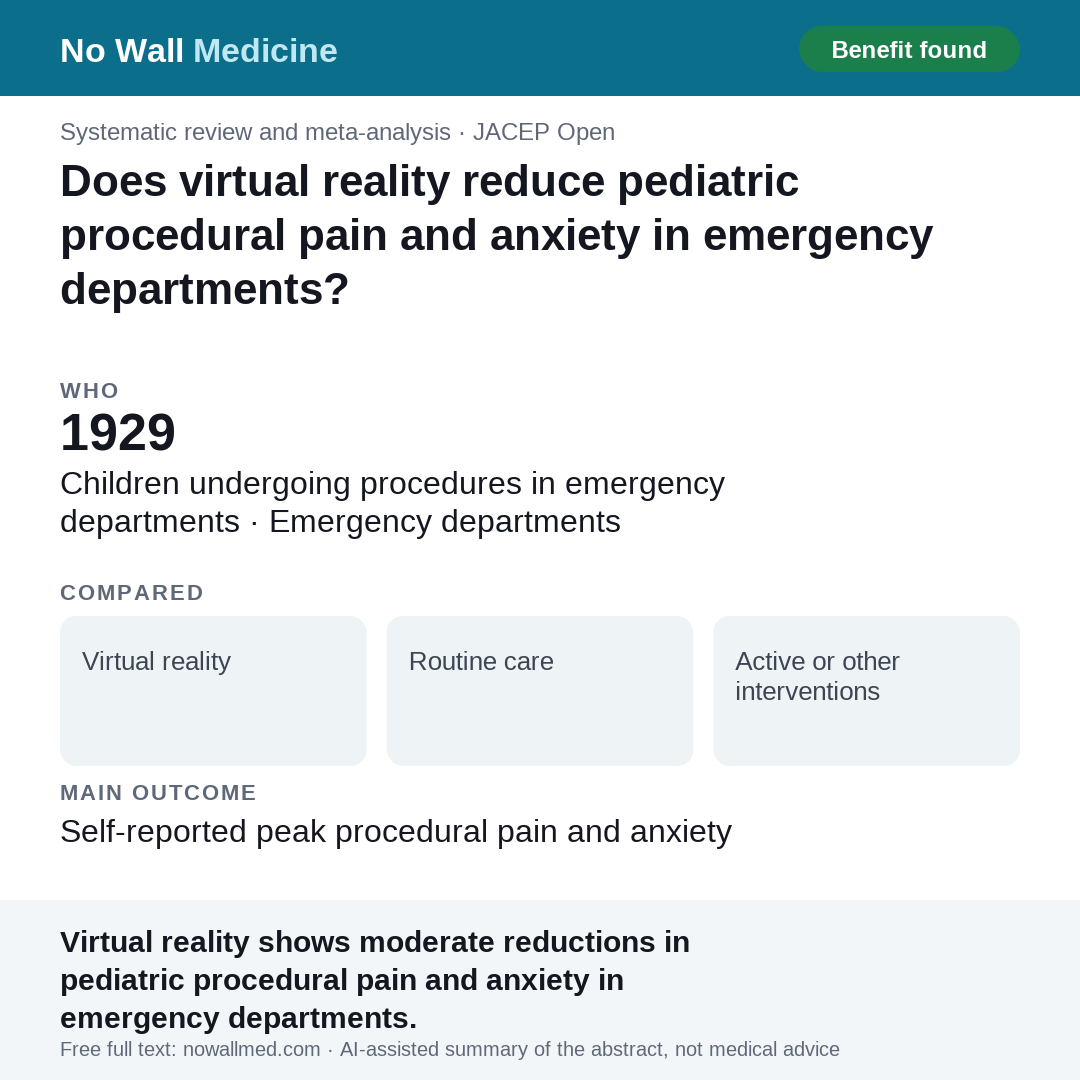
Clinical question: Does virtual reality reduce pediatric procedural pain and anxiety in emergency departments?
Why it matters: The effectiveness of virtual reality for managing pain and anxiety in children during emergency department procedures remains unclear.
Key points
- Researchers analyzed sixteen studies involving 1929 participants to compare virtual reality against routine care and other active interventions.
- Virtual reality reduced self-reported peak procedural pain compared to routine care (mean difference -0.76) and active controls (mean difference -0.51).
- Self-reported anxiety and caregiver-reported pain and anxiety also showed improvements when using virtual reality compared to other methods.
Limitation the authors note: The authors noted that study heterogeneity and methodological limitations reduce confidence in the findings.
Headline and key points written with AI from the paper’s abstract, with every number checked against it. Read the paper before relying on them.
Spotted a mistake? Suggest a correction