Virtual reality training reduces mental effort and improves surgical performance compared to cadaver dissection
Virtual Reality Mastoidectomy as Precadaver Training for Novices: A Randomized Crossover Study
Randomized crossover studyBenefit found
Does virtual reality simulation versus cadaveric dissection training affect cognitive load and performance?
Who
24
24 core surgical trainees with no prior mastoidectomy experience
Compared
Virtual reality simulation: mean relative reaction time rising 26% from baseline
Cadaveric dissection: mean relative reaction time rising 60% from baseline
Main outcome
Cognitive load and cadaveric performance
Bottom line: Virtual reality reduces cognitive load and improves subsequent cadaveric performance in novice surgical trainees.
Laryngoscope · 2026-04-27Download image
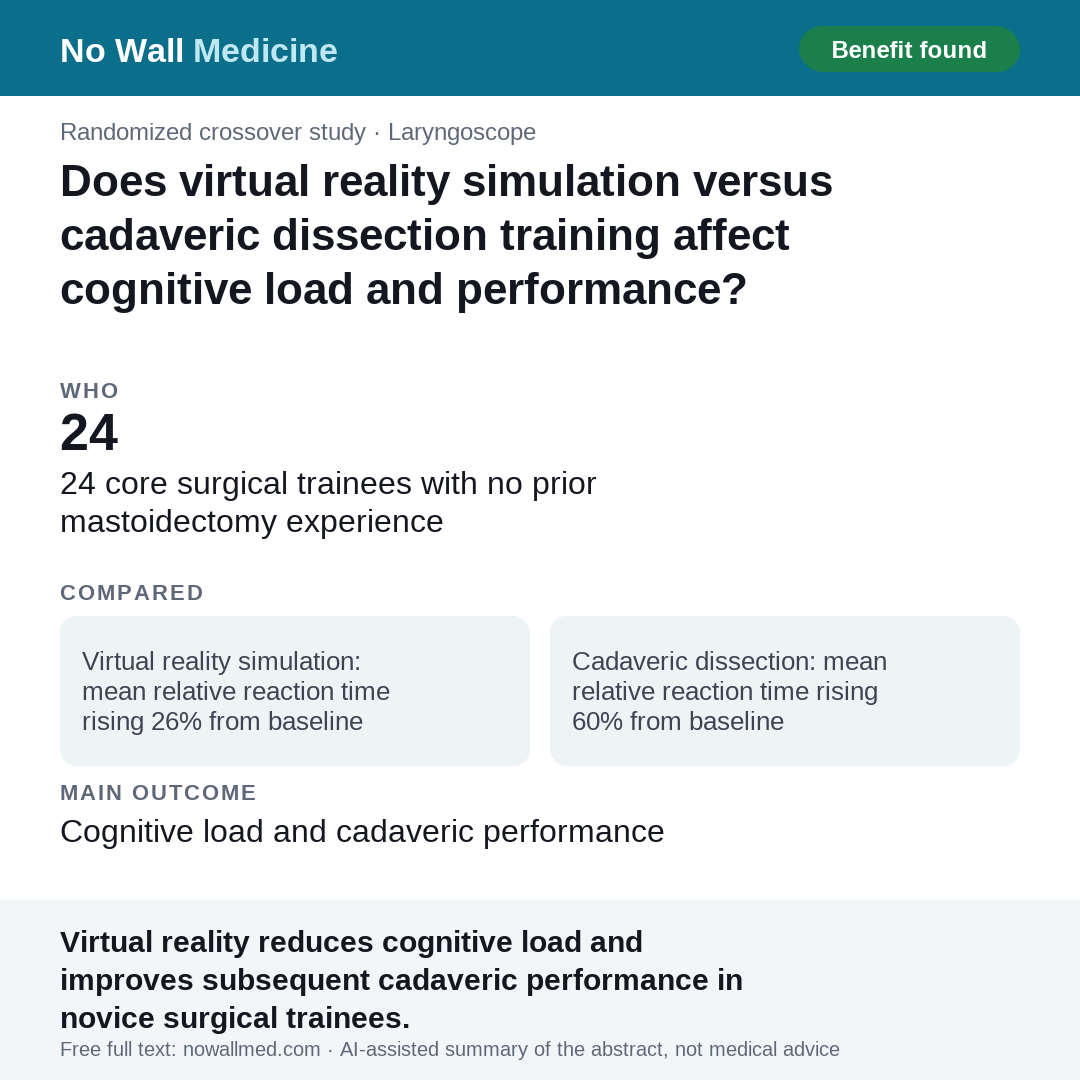
Clinical question: Does virtual reality simulation versus cadaveric dissection training affect cognitive load and performance?
Why it matters: Researchers sought to determine if virtual reality simulation could reduce cognitive load and improve performance before trainees begin practicing on human cadavers.
Key points
- The study compared virtual reality simulation to cadaveric dissection in 24 surgical trainees with no prior experience performing a mastoidectomy.
- Mental effort, measured by reaction time, rose 26% in virtual reality compared to a 60% increase during cadaveric dissection.
- Trainees who started with virtual reality training achieved higher cadaveric performance scores of 9.50 compared to 4.96 for those starting with cadavers.
Headline and key points written with AI from the paper’s abstract, with every number checked against it. Read the paper before relying on them.
Topics
Cite this article
Nijim H, Cho WS, Marsh E, Evans J, Sahota RB, Judd O. Virtual Reality Mastoidectomy as Precadaver Training for Novices: A Randomized Crossover Study. Laryngoscope. 2026. doi:10.1002/lary.70589
Spotted a mistake? Suggest a correction