Virtual reality training led to better long-term cardiopulmonary resuscitation knowledge and skills in adolescents
Virtual reality versus theoretical training in CPR among adolescents: a randomized trial with a one-year longitudinal follow-up
Randomized trial with three parallel groupsBenefit found
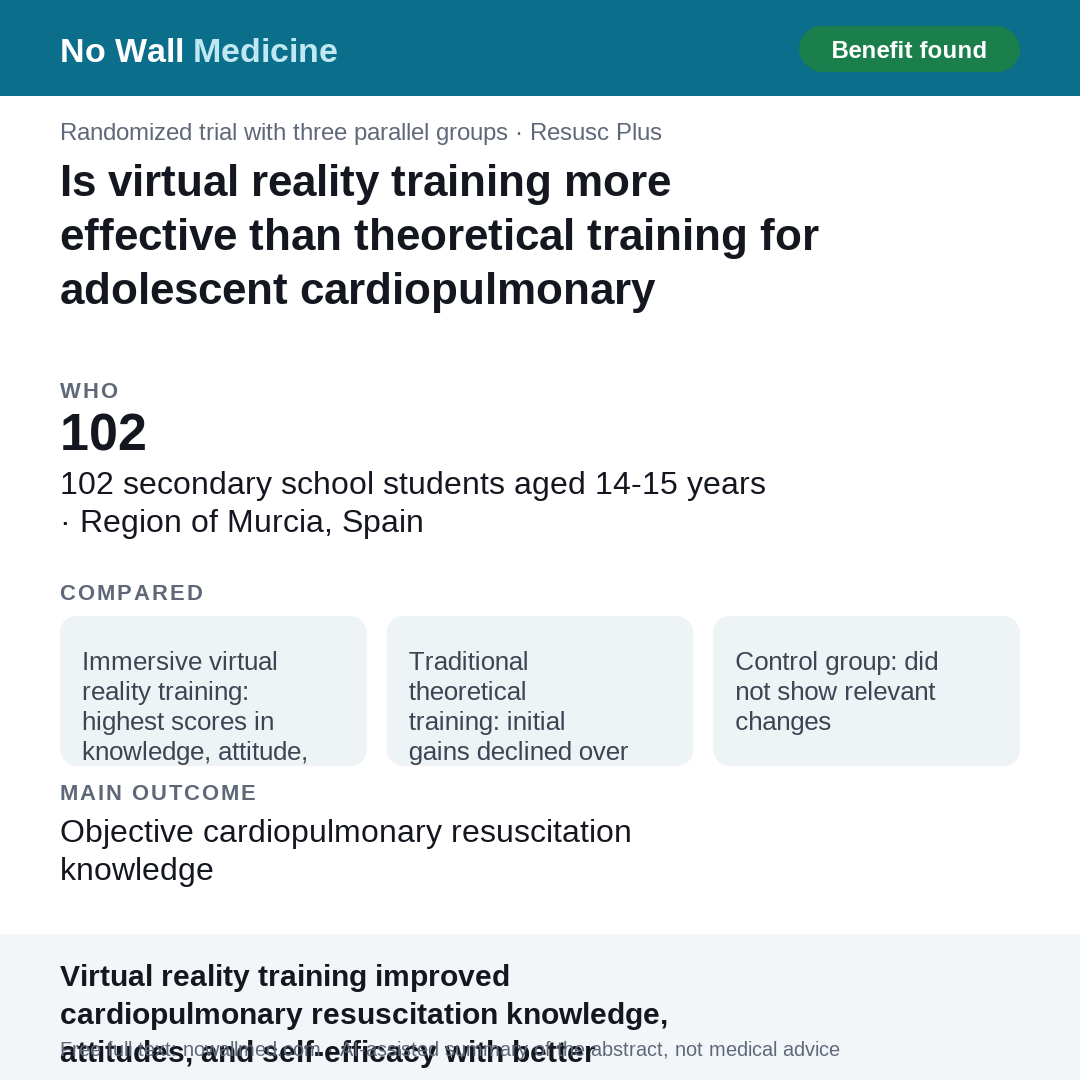
Is virtual reality training more effective than theoretical training for adolescent cardiopulmonary resuscitation?
Who
102
102 secondary school students aged 14-15 years · Region of Murcia, Spain
Compared
Immersive virtual reality training: highest scores in knowledge, attitude, and self-efficacy
Traditional theoretical training: initial gains declined over time
Control group: did not show relevant changes
Main outcome
Objective cardiopulmonary resuscitation knowledge
Bottom line: Virtual reality training improved cardiopulmonary resuscitation knowledge, attitudes, and self-efficacy with better long-term retention than theoretical instruction.
Resusc Plus · 2025-11-25Download image
Clinical question: Is virtual reality training more effective than theoretical training for adolescent cardiopulmonary resuscitation?
Why it matters: It is unclear whether virtual reality or traditional theoretical instruction is more effective for improving and retaining cardiopulmonary resuscitation knowledge and attitudes in adolescents.
Key points
- Researchers studied 102 secondary school students aged 14-15 years, comparing immersive virtual reality training, traditional theoretical instruction, and a control group.
- The virtual reality group achieved the highest scores in knowledge, attitude, and self-efficacy immediately after training (p < 0.001) and maintained more stable results at 1-month and 1-year follow-ups.
- The virtual reality system received a positive usability rating of 75.3 ± 4.5 on the System Usability Scale.
Headline and key points written with AI from the paper’s abstract, with every number checked against it. Read the paper before relying on them.
Cite this article
Ocampo Cervantes AB, López López CA, Cerezo Espinosa C, Greif R, Pardo Rios M, Guillén Martínez D. Virtual reality versus theoretical training in CPR among adolescents: a randomized trial with a one-year longitudinal follow-up. Resusc Plus. 2025. doi:10.1016/j.resplu.2025.101178
Spotted a mistake? Suggest a correction