Viscoelastic haemostatic assays to guide therapy in elective surgery: an updated systematic review and meta-analysis
Systematic review and meta-analysis of 20 randomized controlled trialsBenefit found
Does viscoelastic haemostatic assay guided therapy improve clinical efficacy in elective surgery?
Who
20
Patients undergoing major elective surgery
Compared
Viscoelastic haemostatic assay guided therapy
Standard therapy
Main outcome
Blood product requirements, theatre or intensive care duration, and surgical reintervention
Result: standardised mean difference (95%CI) -0.33 (-0.56 to -0.10) for platelets
Bottom line: Viscoelastic haemostatic assay guided therapy may reduce blood product transfusion requirements and blood loss during major elective surgery.
Limitation: The overall quality of evidence was modest.
Anaesthesia · 2024-11-14Download image
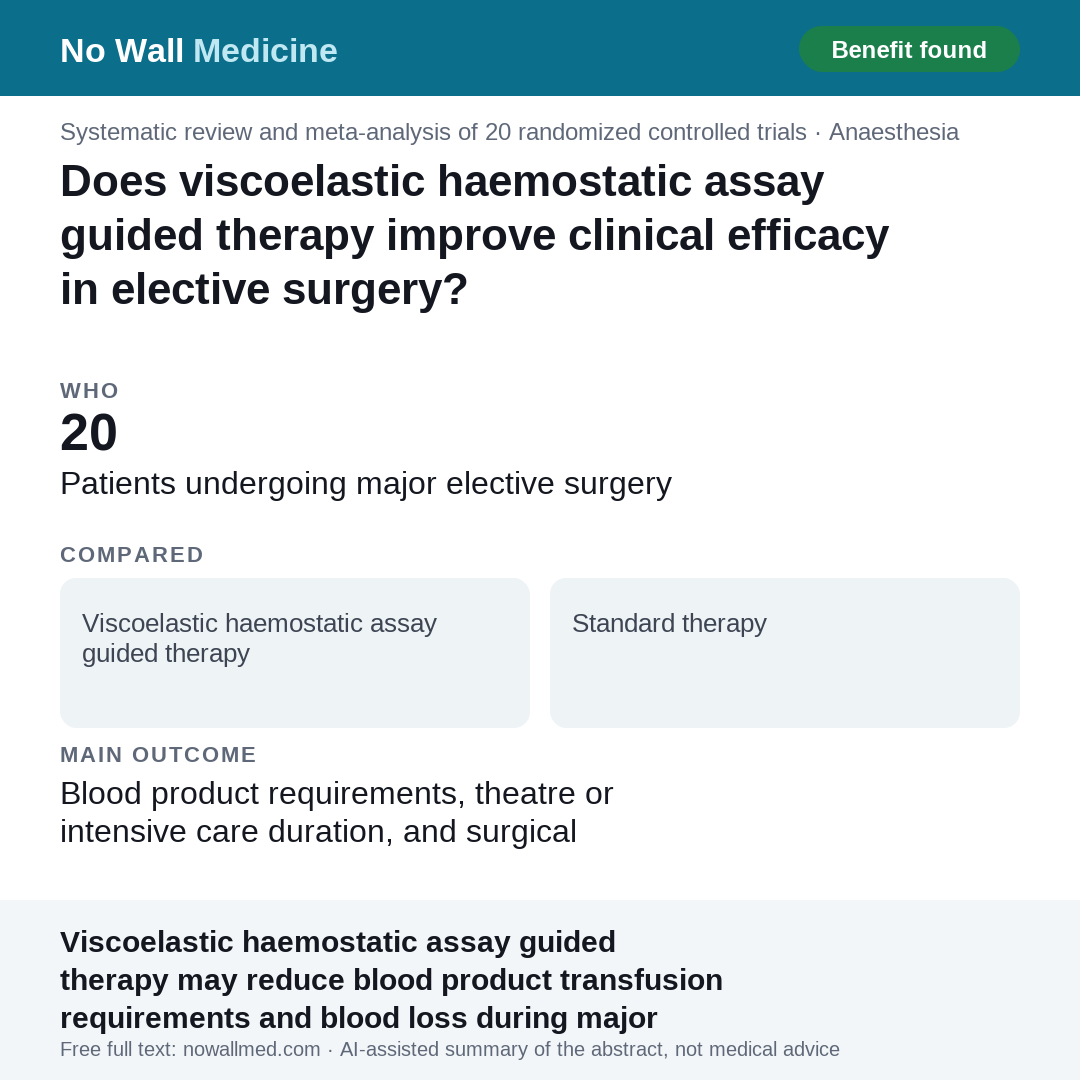
Clinical question: Does viscoelastic haemostatic assay guided therapy improve clinical efficacy in elective surgery?
Abstract
Background
Patients undergoing major surgery frequently experience major uncontrolled bleeding. The aim of this systematic review and meta-analysis was to evaluate the clinical efficacy of using viscoelastic haemostatic assays to manage peri-operative bleeding in elective surgery. Methods
We searched PubMed/MEDLINE and Embase databases for randomised controlled trials according to pre-determined criteria. The primary outcomes were blood product requirements; duration of stay in the operating theatre or ICU; and surgical reintervention rate. Results
We included 20 randomised controlled trials. The overall risk of bias was low to moderate. Twelve studies used thromboelastography-based transfusion algorithms, while eight used thromboelastometry. Viscoelastic haemostatic assay-guided therapy was associated with a statistically significant reduction in transfusion of red blood cells (standardised mean difference (95%CI) 0.16 (-0.29 to 0.02)), platelets (standardised mean difference (95%CI) -0.33 (-0.56 to -0.10)) and fresh frozen plasma (standardised mean difference (95%CI) -0.64 (-1.01 to -0.28)). There was no evidence of an effect of viscoelastic haemostatic assay-guided therapy on surgical reintervention (relative risk (95%CI) 1.09 (0.70-1.69)). Viscoelastic haemostatic assay-guided therapy was associated with lower blood loss and shorter ICU duration of stay. There was no evidence of any effect on total duration of stay and all-cause mortality. Conclusions
Viscoelastic haemostatic assay-guided therapy may reduce peri-operative blood product transfusion requirements and blood loss during major elective surgery, with no discernible effect on patient-centred outcomes. The overall quality of evidence was modest.
Subject terms
Cite this article
Dias JD, Levy JH, Tanaka KA, Zacharowski K, Hartmann J. Viscoelastic haemostatic assays to guide therapy in elective surgery: an updated systematic review and meta-analysis. Anaesthesia. 2024. doi:10.1111/anae.16463
Spotted a mistake? Suggest a correction
Top studies every Monday
The week’s key trials and guidelines in your specialties, plus any topics you follow. By email, free.
Get the weekly digest