Visit-to-visit changes in heart rate in heart failure: A pooled participant-level analysis of the PARADIGM-HF and PARAGON-HF trials
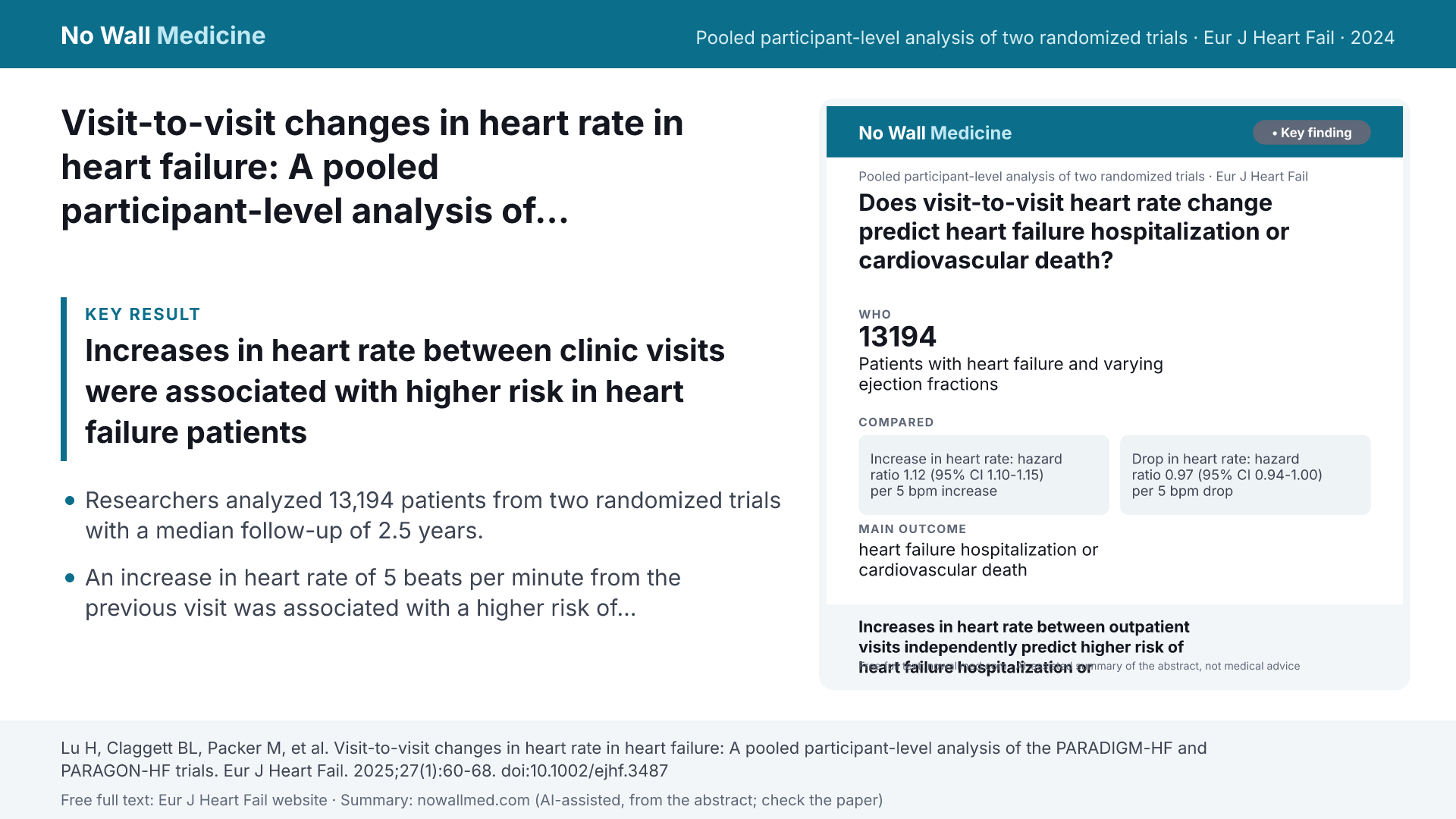
Key result: Increases in heart rate between clinic visits were associated with higher risk in heart failure patients
Pooled participant-level analysis of two randomized trialsKey finding
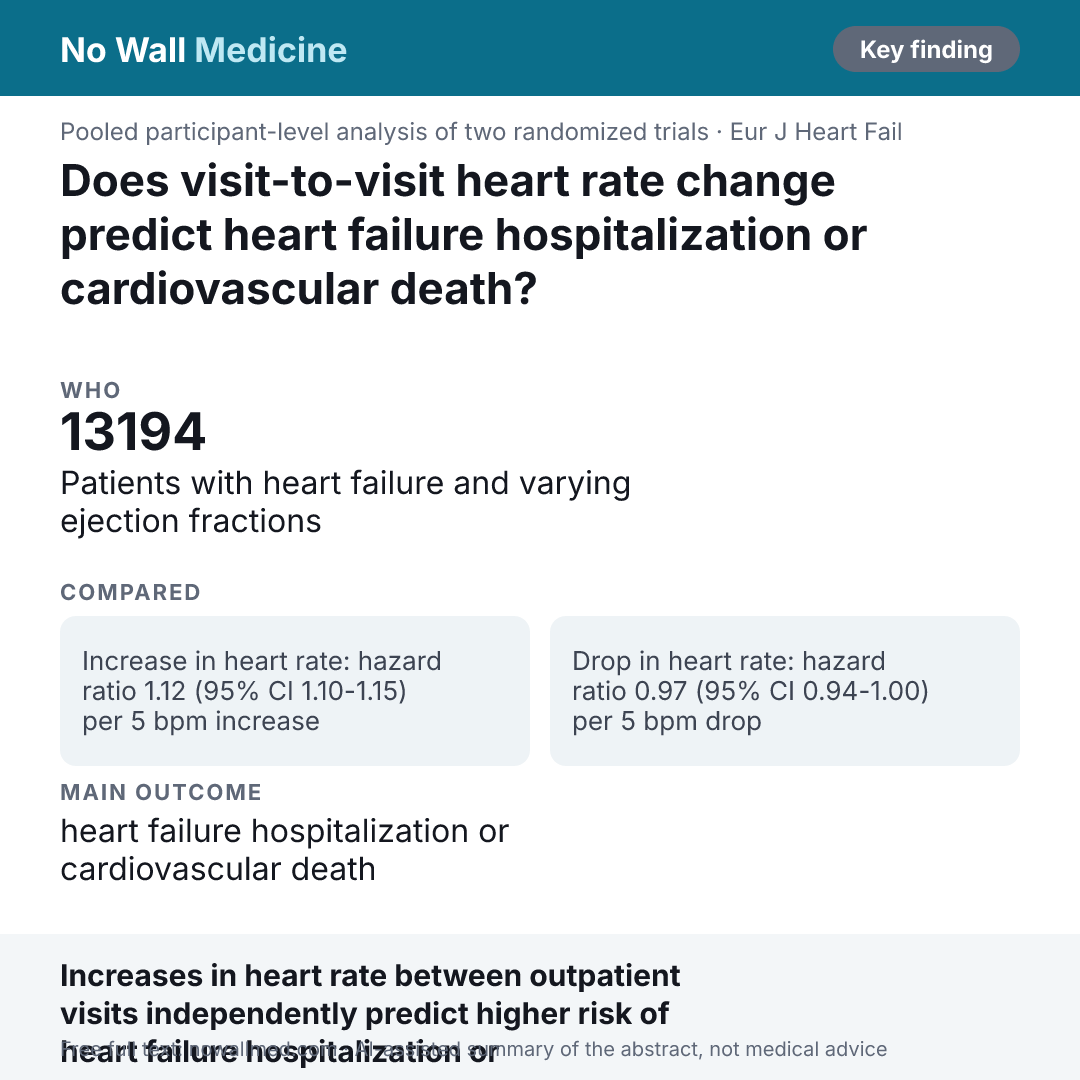
Does visit-to-visit heart rate change predict heart failure hospitalization or cardiovascular death?
Who
13194
Patients with heart failure and varying ejection fractions
Compared
Increase in heart rate: hazard ratio 1.12 (95% CI 1.10-1.15) per 5 bpm increase
Drop in heart rate: hazard ratio 0.97 (95% CI 0.94-1.00) per 5 bpm drop
Main outcome
heart failure hospitalization or cardiovascular death
Result: hazard ratio 1.12 (95% CI 1.10-1.15) per 5 bpm increase
Bottom line: Increases in heart rate between outpatient visits independently predict higher risk of heart failure hospitalization or cardiovascular death.
Eur J Heart Fail · 2024-10-22 · Save PNG
Key points
- Researchers analyzed 13,194 patients from two randomized trials with a median follow-up of 2.5 years.
- An increase in heart rate of 5 beats per minute from the previous visit was associated with a higher risk of heart failure hospitalization or cardiovascular death (hazard ratio 1.12; 95% CI 1.10-1.15).
- A 5 beats per minute drop in heart rate was associated with a lower risk (hazard ratio 0.97; 95% CI 0.94-1.00).
Discussion prompts
- Would these patients look like yours? Who was left out?
- Is the main outcome one that matters to patients?
- Is the difference large enough to change what you do?
Cite: Lu H, Claggett BL, Packer M, et al. Visit-to-visit changes in heart rate in heart failure: A pooled participant-level analysis of the PARADIGM-HF and PARAGON-HF trials. Eur J Heart Fail. 2025;27(1):60-68. doi:10.1002/ejhf.3487
Free full text: Eur J Heart Fail website · Summary and visual abstract: nowallmed.com/a/visit-to-visit-changes-in-heart-rate-in-heart-failure-a-pooled-1vp9o8p/ (AI-assisted from the abstract; check the paper before relying on it).