Visual Feedback-Based Rehabilitation Improves Gait Recovery After Total Hip Arthroplasty: A Randomized Controlled Clinical Trial
Randomized controlled trialBenefit found
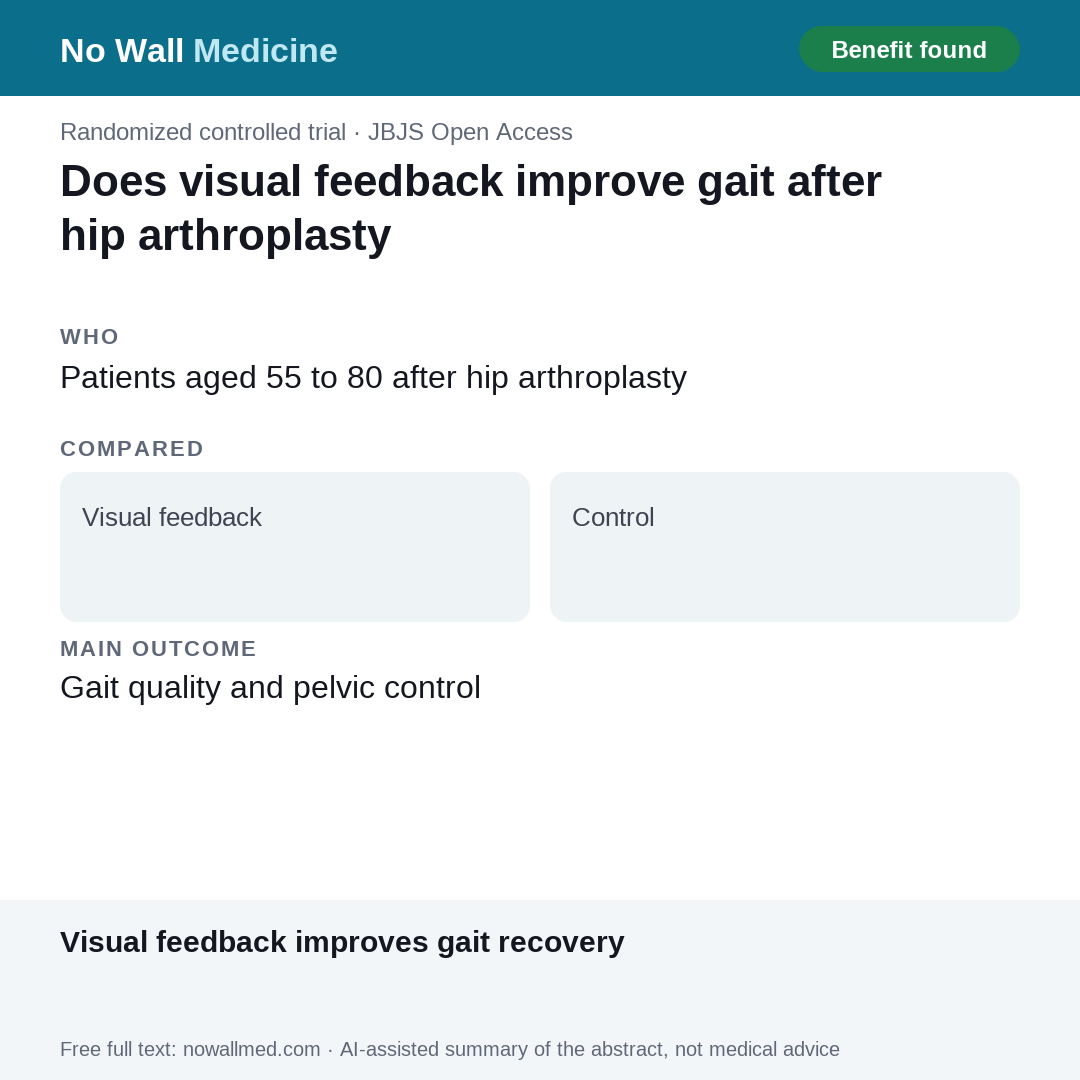
Does visual feedback improve gait after hip arthroplasty
Who
Patients aged 55 to 80 after hip arthroplasty
Compared
Visual feedback
Control
Main outcome
Gait quality and pelvic control
Bottom line: Visual feedback improves gait recovery
JBJS Open Access · 2026-10-15Download image
Abstract
Background
This randomized controlled trial investigated whether adding a visual feedback-based (VFB) rehabilitation program to standard care could enhance gait performance and pelvic kinematics in patients recovering from total hip arthroplasty (THA). Methods
Inpatients aged 55 to 80 years who underwent unilateral THA by a lateral approach were randomized to either a VFB group or a control group. The VFB group received 30 minutes of technology-assisted visual feedback training using TecnoBody systems plus 30 minutes of conventional physiotherapy daily, while the control group received one hour of conventional therapy alone, both 5 days per week for 6 weeks. Gait and pelvic kinematics were assessed using the G-WALK inertial sensor at baseline and after 6 weeks, alongside clinical measures for pain, functional independence, and ambulation capacity. Results
Both groups showed significant improvements on clinical scales, with no meaningful differences between them. However, the VFB group demonstrated significantly greater gains in key gait and kinematic parameters, including cadence, speed, symmetry, pelvic tilt, and pelvic obliquity, with multivariate analysis confirming a distinct and more favorable post-treatment kinematic profile. Conclusion
Incorporating visual feedback-based training into postoperative rehabilitation after THA leads to superior improvements in gait quality and pelvic control compared with conventional therapy alone, supporting its clinical integration in standard physiotherapy programs. Level of evidence
Therapeutic Level I. See Instructions for Authors for a complete description of levels of evidence.
Spotted a mistake? Suggest a correction